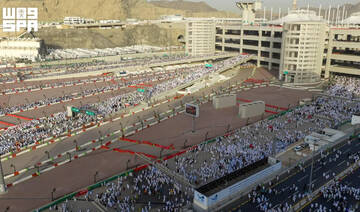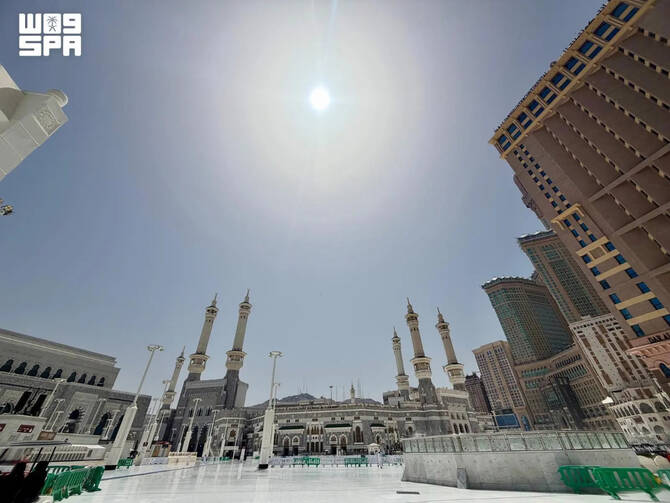

MAKKAH: A rare and precise astronomical phenomenon was witnessed in the skies over Makkah on Thursday, as the sun aligned directly above the Holy Kaaba almost perfectly.
The event, at 12.18 p.m. local time, coinciding with the Dhuhr (midday) prayer call, offered a natural opportunity to determine the global direction of the Qibla, the direction Muslims face during prayer, reported the Saudi Press Agency.
Majed Abu Zahra, director of the Jeddah Astronomy Society, said the sun reached the closest point to complete alignment directly above the Kaaba at an altitude of 89.94 degrees, with a difference of only about 0.06 degrees (about 3.6 arcminutes) from perfect alignment.
Because the sun’s rays hit the ground perpendicularly, the Holy Kaaba and all vertical objects in Makkah completely lost their shadows at that exact minute, meaning they could be used to determine the accuracy of the Qibla direction.
He added the phenomenon occurs twice annually as a result of the sun’s movement between the Tropic of Cancer and the Tropic of Capricorn. It holds scientific and educational significance due to its connection with astronomical calculations and the explanation of concepts related to Earth’s movement and celestial coordinates, in addition to its historical use in correcting the directions of some mosques.
Because Makkah lies at approximately 21.4 degrees north, the sun passes directly over its celestial coordinates twice a year — once during its northward journey in late May, and again on its southward return in mid-July.

Infographic generated by Gemini (Google AI), based on an Arabic version posted by the Jeddah Astronomy Society on social media.
Key technical data illustrating Abu Zahra’s explanation were presented in a detailed infographic posted by the Jeddah Astronomy Society on social media. This contrasted Thursday’s peak with the previous day, which also produced a close alignment, with the sun reaching 89.89 degrees (a difference of 6.6 arcminutes). Thursday’s reading, however, marks the true astronomical peak for this cycle and the most precise moment of the year for shadow-based Qibla verification.
Beyond its deep spiritual resonance, the event carries significant scientific weight, demonstrating planetary rotation and celestial mechanics in real time. Historically, this “shadowless” technique was pioneered by medieval Islamic scholars to calibrate the alignment of distant mosques across continents, according to historians.
The solar alignment also coincided precisely with the second day of Eid al-Adha. Because the Islamic calendar is lunar and shifts backward by around 10-11 days each year against the solar calendar, a perfect intersection where the solar zenith lands during the peak days of the Hajj and Eid season occurs only once every 33 years.
While the intense overhead positioning of the sun often prompts public speculation regarding extreme regional heat, Saudi Arabia’s National Center for Meteorology clarified that such alignments do not directly cause unprecedented heatwaves.
The NCM emphasized that while solar radiation is intensely direct during the zenith, localized daily temperatures remain governed by a broader matrix of climate drivers, including humidity, air mass movements, and wind speeds.