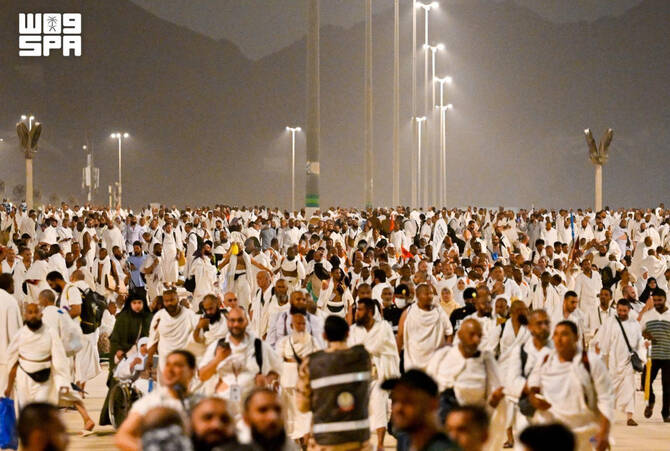
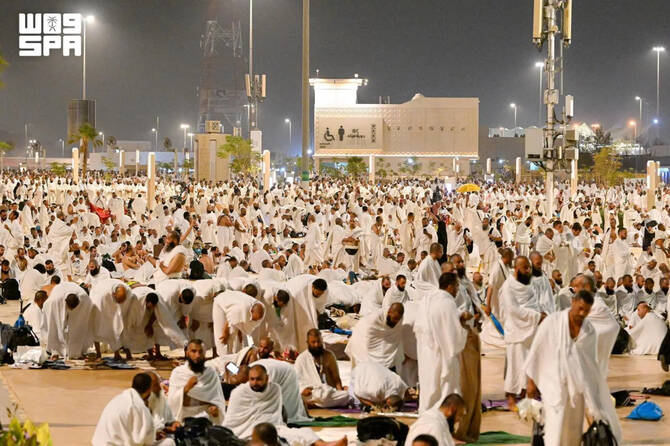
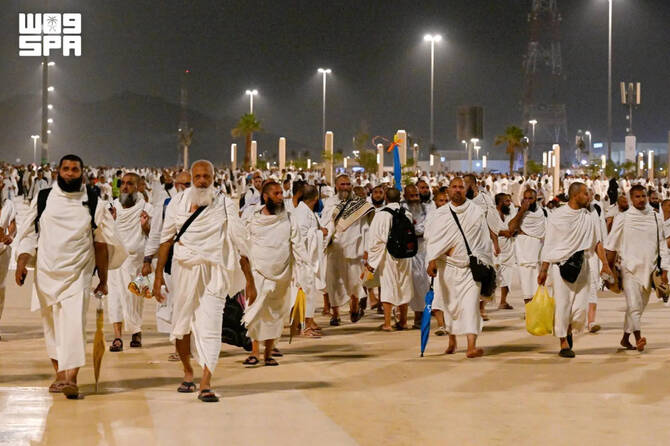

MAKKAH: Muzdalifah is one of the sacred sites of Hajj, where pilgrims spend the night of Dhul Hijjah 10 (May 27) after moving from Arafat, and performing the combined and shortened Maghrib and Isha prayers in an atmosphere of devotion and tranquility, following the tradition of the Prophet Muhammad.
The site is named Muzdalifah either because pilgrims arrive there in the early hours of the night (zulaf al-layl) or because it signifies their “drawing closer” to the Grand Mosque, reflecting the meaning of the Arabic verb izdalaf.
Situated between Arafat and Mina, approximately 8 km from the Grand Mosque, Muzdalifah spans more than 11.68 million sq. meters and can accommodate over 2 million pilgrims. It is an open area with no permanent structures, preserving its religious character and distinct organizational status.
Muzdalifah holds deep spiritual significance, as reflected in the Qur’anic verse: “Then when you leave Arafat, remember Allah (by glorifying His praises through prayers and invocations) at Al-Mash’ar Al-Haram.”

Pilgrims spent the night on Tuesday in Muzdalifah after moving from Arafat, and before moving to Mina for the "stoning of the devil" ritual. (SPA photo)
Standing in prayer and supplication there is encouraged, particularly at Al-Mash’ar Al-Haram, located at its center, which annually witnesses gatherings of worshippers engaged in prayer and reflection.
It also serves as a key station in the sequence of Hajj rituals, where Prophet Muhammad spent the night and collected pebbles for the stoning ritual. In earlier times, pilgrims would spend the night in Muzdalifah under simple conditions and with limited resources.
Over time, however, the site has undergone extensive development to accommodate the growing number of pilgrims, as part of the Kingdom’s ongoing care for the holy sites under the leadership of King Salman and Crown Prince Mohammed bin Salman.
As part of this care, Kidana Development Co. implemented the Mashaer Path project across an area of 170,000 sq. meters.
The project includes 103,000 sq. meters of eco-friendly rubber flooring designed to reduce heat and physical strain, along with designated lanes for vehicles and golf carts. It also provides seating areas, water stations, mobile charging units, mist fans, umbrellas and directional signage.
The Ministry of Islamic Affairs, Dawah and Guidance also carries out annual preparations at the Al-Mash’ar Al-Haram Mosque through a comprehensive plan that includes cleaning, upgrading lighting and sound systems, and providing carpets, as well as expanding the women’s prayer area by 100 percent to ensure smooth pilgrim flow in and out.

Al-Mash’ar Al-Haram remains a profound spiritual symbol representing Muzdalifah’s place in the hearts of pilgrims. (SPA photo)
The mosque spans 5,040 sq. meters and accommodates around 5,500 worshippers. It is equipped with advanced air-conditioning systems, surveillance cameras and full operational staffing to serve worshippers.
For safety purposes, relevant authorities use advanced digital systems to regulate the movement of pilgrims from Arafat to Muzdalifah, with real-time monitoring from a central control room equipped with smart cameras to enable rapid response.
Al-Mash’ar Al-Haram is a profound spiritual symbol representing Muzdalifah’s place in the hearts of pilgrims. The site reflects a model of operational and organizational integration backed by the Kingdom’s enduring commitment to providing pilgrims with safe and seamless conditions to perform their rituals.