

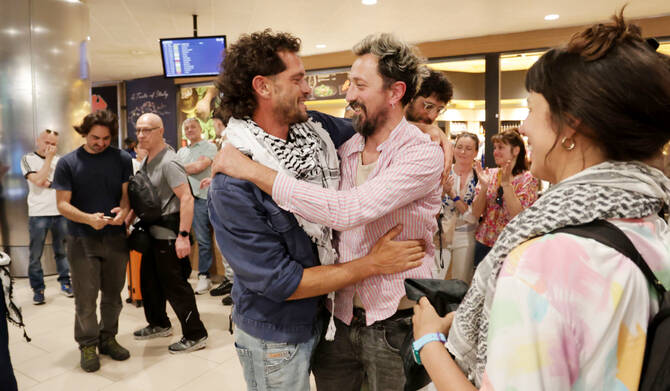

JOHANNESBURG: South African activists who were detained when their boats were intercepted while trying to breach Israel’s blockade of Gaza have alleged they were beaten and tortured by Israeli soldiers.
The Global Sumud Flotilla of 50 boats was intercepted in international waters some 400 km off the coast of Israel as they sought to breach the blockade and deliver aid to Palestinians in Gaza.
According to the activists, who were welcomed by pro-Palestine supporters and their families as they arrived in South Africa from Turkiye on Saturday morning, some of them were even electrocuted while being interrogated about their participation in the flotilla.
They said many of them received even harsher treatment when the soldiers learned that they were from South Africa, a country that has taken Israel to the International Court of Justice and accused it of committing genocide in Gaza.
“We were denied access to water for a while. Food they did give us, food that was not suitable for human consumption. We were denied access to toilets for many hours, and the minute we started protesting, we were shot at with rubber bullets,” said activist Faizel Moosa.
Moosa, a former anti-apartheid activist during South Africa’s liberation struggle against white minority rule, said the treatment they received under detention was the worst he had ever experienced.
“Having experienced detention under the apartheid regime during the struggle, this was far worse. It just goes to show that this is what Palestinians go through on a daily basis,” said Moosa.
According to the activists, they were held for several days at the K’tziot prison, where some of them were electrocuted.
Activist Qutb Hendricks called on the South African government to pile pressure on Israel by banning the sale of coal and other supplies to the country.
The Israeli government has denied allegations of mistreatment of those detained, saying they were “false and entirely without factual basis.”
Israel’s far-right Security Minister Itamar Ben-Gvir, who has called for deporting political opponents and was barred from mandatory military service for his extreme views, sparked global outrage after promoting a video of himself taunting activists from a flotilla to Gaza who were detained by his police force.
Foreign leaders have condemned his on-camera treatment of the detainees and several countries summoned Israeli envoys to air their concerns.
Zeynel Abidin Ozkan, Turkish flotilla board member, detailed being held in a container alongside other detainees shortly after the flotilla raid and he said some people were taken outside the containers where he heard them being physically assaulted.
“We faced periods where we couldn’t stand, our heads were bowed to the ground, we were dragged and pulled by our hair. The handcuffs left serious marks on us.”
After arriving at Ashdod port, Ozkan says he was denied the right to contact his lawyer, embassy officials or relatives back home. He describes being told to sign papers under duress, which he refused.
“When we refused to sign, they treated us like prisoners, creating a file, taking photos, forcibly handcuffing our hands and feet with iron shackles. And then, with the soldiers, dragged us along the ground, surrounded by dogs, releasing the dogs on us, before loading us into prison trucks.”
Christopher Boren, activist from Hawaii, said: “When we got to Ashdod port, I was immediately grabbed by five soldiers or police officers. They put my head down and started beating me. One of them had gloves on with hardened plastic and he started punching my face and it swelled shut,” he said, showing his black eye.
Yiannis Atmatzidis, Greek activist, said: “I was struck with a taser, beaten with punches and kicks, insulted and humiliated. On the prison ship there was a container that everyone had to pass through. You entered through one door and a group of six or seven people would beat you mercilessly until you emerged from the other side. Every single one of us went through that.”
Atmatzidis said he was being processed for identification when Ben-Gvir was touring the prison ship.


