

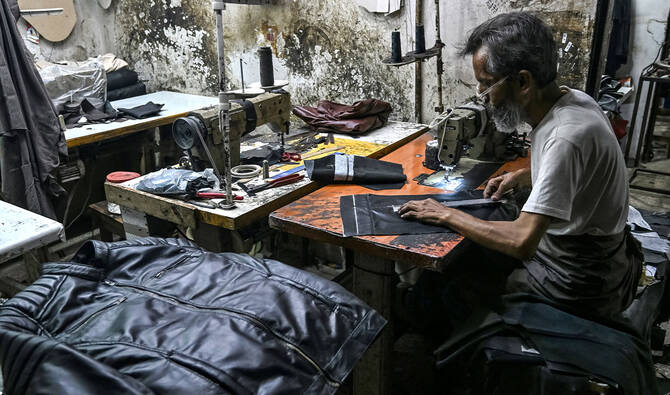

KARACHI: Pakistan’s raw material imports for its nearly $900 million value-added leather exports industry may increase, as around 5 percent fewer small animals are expected to be slaughtered this Eid season due to prevailing inflationary pressures, Chairman Pakistan Tanners Association (PTA) Hamid Arshad Zahur said on Saturday.
Eid Al-Adha, one of the two major Islamic festivals, will fall on May 27 in Pakistan, a leading exporter of tanned leather and leather products, including garments, gloves and footwear, to markets across Europe, Asia and the Middle East.
The leather products sector is one of Pakistan’s major export industries and contributes 1.2 percent to the country’s total industrial production measured under large-scale manufacturing, according to the State Bank of Pakistan’s latest economic report for July-December FY26.
The industry, however, is facing a renewed challenge as inflation is forcing many in Pakistan to opt for collective sacrifices, in which several people contribute toward a larger cow or bull instead of individually buying a pricier goat or sheep.
“This Eid, big animals will be slaughtered more because of the price pressure,” Zahur told Arab News.
According to the association’s estimates, the number of cows and bulls slaughtered this Eid is expected to rise about 12 percent to 2.8 million from 2.5 million last year.
The sacrifice of goats and sheep, on the other hand, is expected to decline 4 percent to 4.8 million animals, including 4.3 million goats and 500,000 sheep. The tanners also expect to collect about 30,000 camel hides.
“The reason is people’s purchasing power, which is declining and forcing them to shift to collective sacrifices,” Zahur said, adding that an average buyer can no longer afford a goat or sheep, with their prices in local cattle markets reaching as high as Rs60,000 ($215.4).
Additionally, he said, even the average size of animals being sacrificed had declined.
“Earlier, during Eid seasons we used to get skin sizes ranging from 30 to 32 feet. That has now reduced to nearly 26 feet,” he continued, suggesting that inflation-hit people were compromising on the size of animals.
“This is happening with goat skins too,” he added.
Pakistani tanners, who expect to collect hides worth Rs10 billion ($36 million) in total this year, provide raw material to Pakistan’s leather exports industry which, according to Zahur, has been importing raw material due to local shortages.
“According to rough estimates, Pakistan imports as much as $150 million worth of raw material in the form of raw skin for our value-added industry needs,” he said, adding that these imports are then translated into leather exports by local manufacturers.
“The size of Pakistan’s leather industry is about $850 to $900 million,” he said.
Zahur said imports could rise further depending on export demand and the global business environment.
Pakistan’s leather exports stood at $848.3 million in FY25. During July-April of the current fiscal year, exports edged down 0.1 percent to $699.5 million, compared with $706.5 million in the same period last year, according to official data.
Exports during the period included $108 million in tanned leather, $479 million in leather garments and gloves, and $113 million in leather footwear.
“We are only down very slightly by one percent, that too, because of this war [in Iran] in the months of March and April which kept vessels away and our exports could not sail out,” Zahur said.
Zahur said Pakistan’s value-added leather industry, including footwear, garments, handbags and gloves, relies on goat skin to produce premium-quality leather, waterproof, fireproof and military gloves, while sheep skin is mainly used in the leather garments export sector.
“When the quantity of goat and sheep skin reduces, the manufacturers would opt for more imports,” he said, without giving details of how many skins Pakistan’s leather exports industry consumes annually.
He added that Pakistan imports small animal skins from countries including New Zealand, the United Kingdom, Australia, South America and South Africa, while its major leather export markets include Vietnam, Bangladesh, China, Indonesia, Italy, Spain, the United States and
Gulf countries such as the United Arab Emirates.
“If we could improve our farming, meat exports and preservations and slaughtering methods during Eid seasons, the tanning industry alone can ensure imports substitution of up to $150 million raw material for local manufacturing,” he said.


