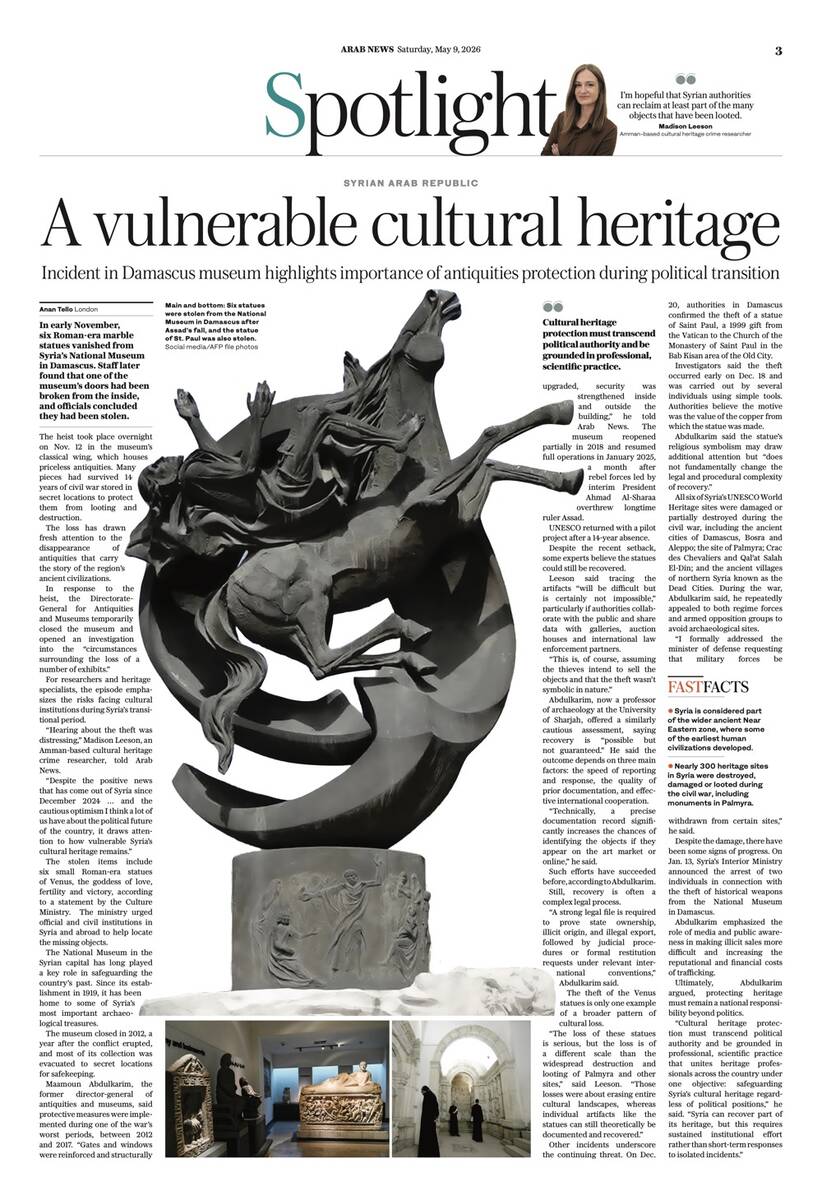
LONDON: In early November, six Roman-era marble statues vanished from Syria’s National Museum in Damascus. Staff later found that one of the museum’s doors had been broken from the inside, and officials concluded they had been stolen.
The heist took place overnight on Nov. 12 in the museum’s classical wing, which houses priceless antiquities. Many pieces had survived 14 years of civil war stored in secret locations to protect them from looting and destruction.
The loss has drawn fresh attention to the disappearance of antiquities that carry the story of the region’s ancient civilizations, even as the more visible scars of war dominate the landscape.
In response to the heist, the Directorate-General for Antiquities and Museums temporarily closed the museum and opened an investigation into the “circumstances surrounding the loss of a number of exhibits.”
The agency also said in a statement it had taken steps to strengthen protection and monitoring systems.
UNESCO has condemned the theft, calling it an attack on Syria’s cultural heritage and history.

An image distributed by Daesh militants on social media on August 25, 2015 purports to show the destruction of a Roman-era temple in the ancient Syrian city of Palmyra. (Reuters/Social Media/File)
For researchers and heritage specialists, the episode emphasizes the risks facing cultural institutions during Syria’s transitional period.
“Hearing about the theft was distressing,” Madison Leeson, an Amman-based cultural heritage crime researcher, told Arab News.
“Despite the positive news that has come out of Syria since December 2024 — namely the toppling of (Bashar) Assad’s regime — and the cautious optimism I think a lot of us have about the political future of the country, it draws attention to how vulnerable Syria’s cultural heritage remains.
“These statues are obviously historically significant, but they also represent part of Syria’s cultural inheritance, to which collective identity is often tied in societies grappling with conflict and instability.”
The stolen items include six small Roman-era statues of Venus, the goddess of love, fertility and victory, according to a statement by the Culture Ministry.
The statement, released on Nov. 14, showed images of the missing statues, along with their registration numbers and dimensions. It said the items were made of marble, alabaster, and plaster.
The ministry urged official and civil institutions in Syria and abroad to help locate the missing objects.

St Paul statue. (Supplied)
The National Museum in the Syrian capital has long played a key role in safeguarding the country’s past. Since its establishment in 1919, it has been home to some of Syria’s most important archaeological treasures.
These include clay cuneiform tablets dating to the 14th century B.C. from Ugarit, where evidence of the oldest known complete alphabet was discovered; first and second century A.D. Greco-Roman sculptures from Palmyra, once one of the most important cultural centers of the ancient world; and a third century A.D. synagogue built at Dura Europos.
Like many cultural institutions in Syria, the museum was affected by the civil war. It closed in 2012, a year after the conflict erupted, and most of its collection was evacuated to secret locations for safekeeping.
Maamoun Abdulkarim, the former director-general of antiquities and museums, said protective measures were implemented during one of the war’s worst periods, between 2012 and 2017.
“Gates and windows were reinforced and structurally upgraded, security was strengthened inside and outside the building, and adequate lighting and high-level surveillance systems were installed,” he told Arab News.
The museum reopened partially in 2018 and resumed full operations in January 2025, a month after rebel forces led by interim President Ahmad Al-Sharaa overthrew longtime ruler Assad.

Jounalists walk near the remains of the Monumental Arch in the historical city of Palmyra, in Homs Governorate, Syria. (Reuters)
The reopening was widely seen as a sign of national recovery. UNESCO returned with a pilot project after a 14-year absence, introducing cultural first-aid measures, training and digitization initiatives aimed at supporting heritage preservation and economic recovery.
Despite the recent setback, some experts believe the statues could still be recovered.
Leeson said tracing the artifacts “will be difficult but is certainly not impossible,” particularly if authorities collaborate with the public and share data with galleries, auction houses and international law enforcement partners.
“From what I understand, the specific statues had been documented so they should be easily identifiable on the open market,” she said.
“This is, of course, assuming the thieves intend to sell the objects and that the theft wasn’t symbolic in nature — in which case the statues may be in danger of being destroyed or disfigured.”
Between 2014 and 2017, the extremist group Daesh systematically targeted pre-Islamic sites for iconoclastic reasons, demolishing Palmyra’s Temple of Bel, Baalshamin Temple, and parts of its Roman theater and tetrapylon.
They also publicly executed archaeologist Khaled Al-Asaad in August 2015 after he refused to disclose the location of valuable artefacts.
Abdulkarim, now a professor of archaeology at the University of Sharjah, offered a similarly cautious assessment, saying recovery is “possible but not guaranteed.”
He said the outcome depends on three main factors: the speed of reporting and response, the quality of prior documentation, and effective international cooperation.
“Technically, a precise documentation record significantly increases the chances of identifying the objects if they appear on the art market or online,” he said.
Recovery efforts, he added, often involve activating tracing mechanisms through international databases and coordinating with specialized anti-trafficking units to monitor auctions, dealers, online platforms and the gray market.
Such efforts have succeeded before, according to Abdulkarim.

Between 2014 and 2017, the extremist group Daesh systematically targeted pre-Islamic sites for iconoclastic reasons, demolishing Palmyra’s Temple of Bel, Baalshamin Temple, and parts of its Roman theater and tetrapylon.. (Reuters/File)
“We successfully halted the sale of looted artifacts in international auctions in cooperation with UNESCO and Interpol,” he said. “These objects had been stolen from archaeological sites rather than museums.”
Still, recovery is often a complex legal process.
“A strong legal file is required to prove state ownership, illicit origin, and illegal export, followed by judicial procedures or formal restitution requests under relevant international conventions,” Abdulkarim said.
“The more thoroughly an object is documented in official museum records, the stronger and easier the ownership claim becomes.”
Diplomacy can also play a decisive role. Abdulkarim said successful recovery often depends on the cooperation of the country where an object surfaces and the political will to enforce legal measures, particularly when organized trafficking networks are involved.
“Given recent diplomatic developments and the restoration of relations with several countries, there may now be improved opportunities for official cooperation,” he said.
However, the theft of the Venus statues is only one example of a broader pattern of cultural loss.
“The loss of these statues is serious, but the loss is of a different scale than the widespread destruction and looting of Palmyra and other sites,” said Leeson.
“Those losses were about erasing entire cultural landscapes, whereas individual artifacts like the statues can still theoretically be documented and recovered.”
Other incidents underscore the continuing threat. On Dec. 20, authorities in Damascus confirmed the theft of a statue of Saint Paul, a 1999 gift from the Vatican to the Church of the Monastery of Saint Paul in the Bab Kisan area of the Old City.
Investigators said the theft occurred early on Dec. 18 and was carried out by several individuals using simple tools. Authorities believe the motive was the value of the copper from which the statue was made.

The ancient Temple of Bel in the historical city of Palmyra, Syria. (Reuters/File)
Abdulkarim said the statue’s religious symbolism may draw additional attention but “does not fundamentally change the legal and procedural complexity of recovery.”
The broader context is stark. All six of Syria’s UNESCO World Heritage sites were damaged or partially destroyed during the civil war, including the ancient cities of Damascus, Bosra and Aleppo; the site of Palmyra; Crac des Chevaliers and Qal’at Salah El-Din; and the ancient villages of northern Syria known as the Dead Cities.
Palmyra in particular became a symbol of heritage loss. In 2015, Daesh destroyed mausoleums and other structures at the site, famous for its 2,000-year-old Roman colonnades and extensive ruins.
“The destruction or looting of sites such as Palmyra or parts of Old Aleppo represents an assault on living heritage, on the urban landscape, and on the memory of place,” Abdulkarim said. “It affects identity, economy, tourism, and the daily life of communities.
“In brief, the destruction of sites means loss of context and place, while theft from a museum means loss of trust and sovereignty over memory.”
During the war, Abdulkarim said, he repeatedly appealed to both regime forces and armed opposition groups to avoid archaeological sites.

The Damascus National Museum. (Reuters/File)
“I formally addressed the minister of defense requesting that military forces be withdrawn from certain sites,” he said. “Although we did not possess the authority to enforce such measures, I considered it my moral responsibility to continue sending those communications despite the personal risks involved.”
Regime and opposition forces reportedly used UNESCO sites as military positions, causing shelling damage to Aleppo’s Umayyad Mosque minaret, Crac des Chevaliers’ fortress walls, and Bosra’s Roman theater.
Despite the damage, there have been some signs of progress. On Jan. 13, Syria’s Interior Ministry announced the arrest of two individuals in connection with the theft of historical weapons from the National Museum in Damascus, recovering 24 stolen items, SANA reported.
The arrests followed another theft at the museum on Oct. 10, when several ancient statues and rare artifacts were stolen.
Drawing on cases elsewhere in the region, experts say there is cause for optimism.
“In Iraq, for example, hundreds of artifacts looted in 2003 were eventually recovered through coordinated research and law enforcement efforts,” Leeson said.

Clay cuneiform tablet from Ugarit. (Supplied)
“With political stability, proper documentation, and international cooperation, I’m hopeful that Syrian authorities can reclaim at least part of the many objects that have been looted.”
Abdulkarim echoed that view but warned that the challenges remain significant, particularly given the scale of trafficking networks and the length of Syria’s crisis.
“The determining factors will include reforming cultural governance to ensure transparent inventories, updated protection systems and effective accountability (and) establishing and continuously updating a modern national database of stolen artifacts,” he said.
It will also require “strengthening international partnerships with law enforcement and heritage experts; achieving greater security stability, since illicit markets thrive in instability; and targeting financial networks and intermediaries, not just the objects themselves.”

A boy rides a camel in the historical city of Palmyra, Syria. (Reuters/File)
Furthermore, he emphasized the role of media and public awareness in making illicit sales more difficult and increasing the reputational and financial costs of trafficking.
Ultimately, Abdulkarim argued, protecting heritage must remain a national responsibility beyond politics.
“Cultural heritage protection must transcend political authority and be grounded in professional, scientific practice that unites heritage professionals across the country under one objective: safeguarding Syria’s cultural heritage regardless of political positions,” he said.
“Syria can recover part of its heritage, but this requires sustained institutional effort rather than short-term responses to isolated incidents.”