


In late July 2026, the third edition of the grandiosely named Global Super League is scheduled to take place in Guyana. It is an invitational league, formally titled the ExxonMobil Guyana GSLT20, after its sponsor.
It is organized by Cricket West Indies and chaired by Sir Clive Lloyd, a Guyanese, who played for the West Indies with distinction between 1966 and 1985, captaining the team during a period of dominance from 1974 until 1985. In addition to Lloyd, Guyana has produced outstanding cricketers for the West Indies team, but its national team plays only inter-regional cricket. So the choice of Guyana for a global league appears, at first sight, to be an unusual one.
In May 2015, ExxonMobil announced the discovery of significant oil reserves off Guyana’s coast. The first draw was made in 2019 and Guyana has become the world’s fastest growing economy. Its government is aware of the risks of being too over-reliant on oil and has invested in diversifying the economy. One strand of this policy is to become a sporting and tourist destination, tapping into a long-standing passion for cricket.
The GSL reflects the country’s ambition. Reportedly, the tournament had a prize pot of $1 million in 2024. There have been several failed attempts to bring together the winners of the various franchise leagues. In cricket’s crowded calendar, this will always be difficult. Furthermore, it appears that those who manage the franchise leagues do not talk with each other, preferring to maintain an air of competitive rivalry. Perhaps the GSL initiative provides opportunities for inter franchise discussions.
The inaugural GSL was played between Nov. 26 and Dec. 7, 2024, involving five teams from different parts of the world. The basis for the invitations and their acceptances is not entirely clear. The Guyana Amazon Warriors team won the 2023 Caribbean Premier League, so was an obvious choice, especially as Guyana initiated the tournament. The Lahore Qalandars had won the Pakistan Super League in 2022 and 2023.
However, the Rangpur Riders’ most recent success in the Bangladesh Premier League was in 2017. A team representing the Australian state, Victoria, seemed a little out of place given that the only success of the Melbourne Renegades in the Big Bash League was in 2019. The English team in the tournament was the Hampshire Hawks, which won the T20 Blast in 2023. In the final Rangpur Riders defeated Victoria by 56 runs.
The second season took take place in July 2025. Guyana Amazon Warriors and Rangpur Riders were involved again. They were joined by the winners of New Zealand’s Super Smash league, Central Districts, the Dubai Capitals, winners of the ILT20 in February 2025 and Hobart Hurtricanes, winners of the BBL in 2024-2025. In the final, Guyana Warriors beat Rangpur Riders by 32 runs.
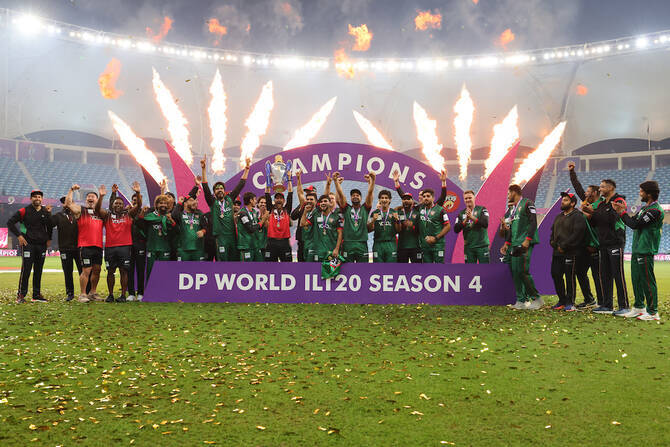
In 2026, the Guyana Amazon Warriors will participate again, as champions. Pakistan will be represented by the Lahore Qalandars, who won the PSL in 2025 and Australia by the Perth Scorchers who won the BBL in 2025-2026, their sixth title. There will be a team from the USA’s Major Cricket League for the first time. This will be San Francisco Unicorns, who were runners-up in the USA’s Major Cricket League in 2024. They have not been as successful as MI New York, twice winners in three years, and Washington Freedom, who have achieved one title and one runners-up spot. The fifth team are the Desert Vipers, who won the ILT20 in January 2026, having twice been runners-up. If the ultimate intention of the GSL is to attract the winners of various T20 franchise leagues, then 2026 represents its closest match so far.
Representatives of the San Francisco Unicorns and the Desert Vipers have expressed their delight at being part of the GSL in 2026. It provides both of them with an opportunity to be part of an international competition. Phil Oliver, CEO of the Vipers, is excited at the prospect of being able to spread the appeal of the franchise and its philosophy more widely. The building of the Vipers’ brand has focused first of all on the UAE and the Gulf and then more widely via the expanded broadcasting of the ILT20. In India, this is via the Zee Network. Coverage is also provided in the Middle East and North Africa, Pakistan, parts of South Asia, the UK on Sky Sports, North America and the Caribbean.
The Vipers’ brand is deliberately designed to be different. It has a strong on and off-field message of sustainability, with numerous initiatives. In GSL 2026, the Vipers will be wearing special kit featuring biodiversity stripes. Each stripe shows global wildlife populations in a given year: green shows more wildlife and the gradual fading to grey shows wildlife decline. This jersey is designed to highlight how, over the past 50 years, global wildlife populations have declined by 73 percent.
The Vipers’ desired message is a wider one, relevant not just to cricket but all sports — healthy ecosystems regulate heat, water, and soil, all of which are essential to sport. Originally, the kit was designed for the Vipers’ Sustainability Match in ILT20 Season 4, produced in a more sustainable way by UAE-based sportswear manufacturers PalmFit. According to Oliver, the 73 percent reduction in biodiversity is “a quite shocking statistic. So, we will be in that kit again. Guyana is a very special place when it comes to biodiversity with over 8,000 species — 85 percent of the country is covered by forest.”
Participation in the GSL offers the Vipers a chance to spread their message of playing for the people and planet across a wider community of cricket fans. In Oliver’s words: “We will be reaching new eyeballs with what we are doing on and off the field and it is a great platform for us to take advantage of in lots of ways.”
The Vipers’ franchise is active 12 months of the year and the GSL provides an opportunity in the middle of the year both to play and spread the Vipers word, prior to the main event of DP World ILT20 at the end of 2026.
One imagines that assembling a squad to compete in the GSL will have posed challenges, something admitted by the director of cricket, Tom Moody. Out of the 11 who played in the ILT20 final on Jan. 4, 2026, none of the nine overseas players are available. This is through a combination of injuries and contracted commitments in other franchises or domestic competitions. Sam Curran, for example, who was so instrumental in the Vipers’ success, reported a groin injury in mid-March, with no date set for his return.
The 14-man squad for the GSL will be led by Chris Green of Australia, who has extensive experience playing in the Caribbean for four different CPL franchises over eight years. Green will be joined by fellow Australian Jason Behrendorff, two New Zealanders, four West Indians, one Pakistani and one from the USA, Andries Gous, who was a member of the winning squad in January 2026. The other four players are from the UAE.
A central strand of the Vipers’ strategy is its promotion and development of local UAE talent for the long term. This has been manifested in local initiatives but, for the GSL, Oliver says that the decision to take four UAE players to Guyana “is reflective of a real vote of confidence in their ability. They all contributed so much, not just from what we could see on the field, moments throughout Season 4, but in the group as well. They (Khuzaima bin Tanveer, Vriitya Aravind, Matiullah Khan and Sanjay Pahal) put so much in to make sure that we had the right environment that helped us achieve the success that we did, and it is just a reward for them. There is going to be quite a lot of playing opportunity for them. Let us see how it plays out in the tournament.”
This reality will be in evidence between July 23 and Aug. 1, 2026. Oliver admits that it will be a challenge but regards it “as a reward for what we have done.” This can be expressed in terms of the Vipers’ performance across the four editions of ILT20, its development of local talent and espousal of sustainability initiatives.
However, there is another reality that tends to be skirted around. GSL is sponsored by ExxonMobil, a strong supporter of cricket in Guyana. In 2024, Hampshire’s participation drew criticism in the UK because of the club’s commitment to “being the greenest international cricket venue.” There may be some people who question whether the Vipers’ sustainability strategy is at odds with the objectives of a major oil company. In the unregulated world of cricket franchises, global corporations rule the roost. The Desert Vipers’ message is different and they have an opportunity to make the case for an alternative stance.


