

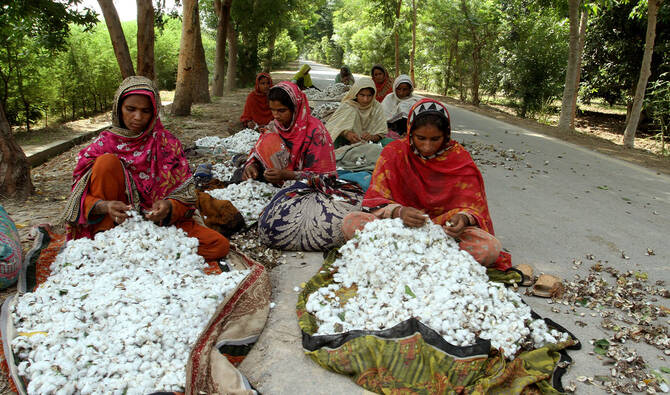

KARACHI: Pakistan’s textile industry has warned that delays in implementing a government-approved cotton revival plan could trigger another surge in cotton imports worth billions of dollars, threatening the country’s foreign exchange reserves and weakening a sector that underpins much of the economy.
The warning from the All Pakistan Textile Mills Association (APTMA), the country’s largest textile industry body, comes as Pakistan enters the cotton sowing season amid a years-long decline in domestic cotton production that has increasingly forced textile manufacturers to rely on imported cotton.
Cotton is Pakistan’s main industrial crop and the backbone of its textile sector, the country’s largest export industry. According to Pakistan’s Board of Investment, textiles account for 46 percent of manufacturing and employ around 40 percent of the labor force, while Pakistan is the world’s fourth-largest producer and third-largest consumer of cotton.
Pakistan’s textile and cotton sectors together contribute around 60 percent of the country’s export earnings, making cotton shortages a major concern for an economy that has repeatedly faced balance-of-payments crises and shortages of foreign exchange.
In a letter sent this week to Food Security Minister Rana Tanveer Hussain, APTMA said reforms approved months earlier by a cabinet committee chaired by Deputy Prime Minister Ishaq Dar had still not been implemented despite repeated reminders from industry stakeholders.
“Any further inaction by the Ministry may accelerate incessant decline in cotton production resulting in ballooning of import of cotton at the cost of valuable hard earned foreign exchange,” APTMA Chairman Kamran Arshad wrote.
The industry body warned that failure to operationalize the reforms before the sowing season could lead to “another cycle of large-scale cotton imports amounting to billions of dollars.”
The cotton revival framework was approved during the sixth meeting of the Cabinet Committee on Essential/Cash Crops in October 2025 and included a restructuring of Pakistan’s cotton governance system, according to official meeting minutes attached with the letter.
The reforms include transforming the Pakistan Central Cotton Committee into a new Pakistan Cotton Advisory Council, introducing an industry-led governance structure, routing cotton cess collection through the Federal Board of Revenue and allocating 70 percent of collected funds to cotton research and development.
The committee also agreed that provinces, universities, farmers and seed-sector representatives would be included in the new framework to improve oversight and research coordination.
APTMA said the reforms were aimed at reversing years of institutional decline, weak research capacity and falling cotton yields that have eroded Pakistan’s competitiveness against regional textile exporters.
Pakistan’s cotton production has fallen sharply over the past decade because of climate shocks, pest attacks, changing crop economics and declining profitability for farmers, according to government studies and industry analyzes.
The decline has forced textile manufacturers to increase imports to meet demand from spinning mills and exporters, adding pressure on Pakistan’s import bill at a time when the country remains under a $7 billion IMF stabilization program approved in 2024.
APTMA said the delay in implementing the revival plan risked undermining both agriculture and industry because cotton supports a long domestic value chain spanning farming, ginning, spinning, textiles and apparel exports.
“Without urgent and decisive action at the policy and institutional level, the agreed strategy cannot translate into tangible outcomes,” the association’s letter said


