

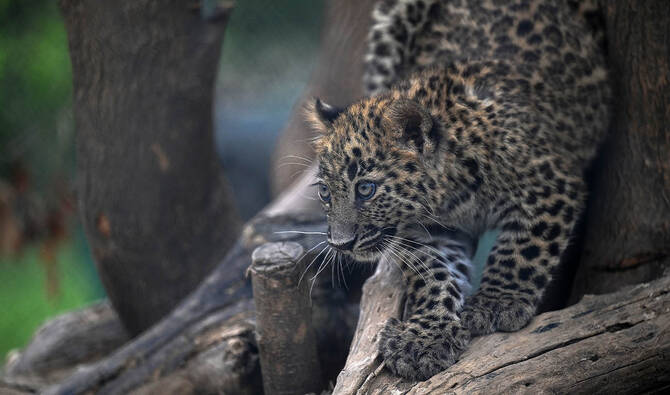

ISLAMABAD: Recent leopard sightings in and around Islamabad reflect growing human-wildlife overlap in the Margalla Hills ecosystem, the World Wide Fund for Nature Pakistan (WWF-Pakistan) said on Saturday, linking the trend to habitat pressure and expanding urban development.
In a statement issued ahead of International Leopard Day on May 3, the group said a common leopard was spotted in March on the campus of the National University of Sciences and Technology (NUST), followed by additional sightings in surrounding areas.
It described the incident as part of a broader pattern, as shrinking habitats, reduced prey availability and development around Margalla Hills National Park push wildlife closer to human settlements.
“The Park and its surrounding habitats represent a critical ecological landscape,” Hammad Naqi Khan, Director General of WWF-Pakistan, said.
He maintained development activities in close proximity to the park posed serious and potentially irreversible risks, including habitat fragmentation, disruption of wildlife movement corridors and degradation of essential ecosystem services.
“Leopards are highly adaptable, but what we are seeing is not adaptation alone, it is displacement,” Muhammad Jamshed Iqbal Chaudhry, Wildlife Practice Lead at WWF-Pakistan, noted. “As natural habitats become fragmented, wildlife is increasingly pushed into human-dominated spaces.”
The statement said one of the main risks of the overlap was conflict with local communities, particularly livestock predation, which could lead to retaliatory killing of leopards.
The organization emphasized habitat conservation, adding it was working on awareness campaigns and using technologies such as camera traps and GPS tracking to monitor leopard movements and address the issue.


