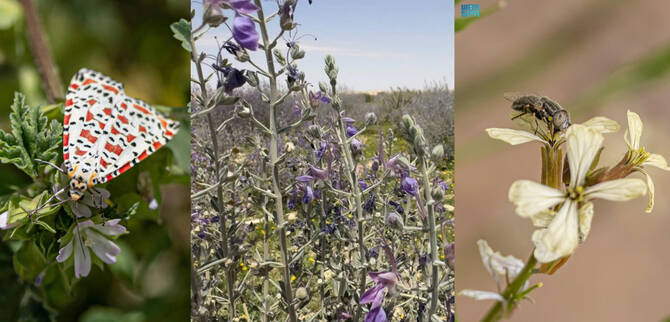

ARAR/RAFHA: Spring has brought a striking revival of life across Saudi Arabia’s Northern Borders region, where desert landscapes are turning vibrant with wild blooms and the return of insects vital to the ecosystem, in developments reported separately by the Saudi Press Agency.
Among the most visible signs of renewal is the reappearance of Teucrium oliverianum, a hardy perennial whose blue-violet flowers now dot the sands of Rafha. The plant, a member of the mint family, can grow up to 70 centimeters tall and is widely seen as an indicator of improving soil health and ecological stability.
Its resurgence reflects broader environmental gains in the Kingdom’s north, where conservation efforts have aimed to restore degraded land and curb desertification. Known locally as Al-Aihlan, the plant is well adapted to harsh desert conditions, with fine bristles on its leaves that reduce water loss. It plays a critical ecological role, providing forage for livestock, food for pollinators such as bees, and shelter for small desert organisms, reinforcing the natural food chain.

Known locally as Al-Aihlan, the Teucrium oliverianum plant is well adapted to harsh desert conditions, with fine bristles on its leaves that reduce water loss. (SPA)
Crimson-speckled moth and spot-eyed hoverfly
The return of insect life further underscores the seasonal transformation. The crimson-speckled moth, Utetheisa pulchella, has been sighted across the region’s open landscapes.
Recognizable by its white wings marked with vivid red and black spots, the migratory species thrives in dry environments and contributes to the balance of vegetation by feeding on wild plants during its larval stage.

The migratory crimson-speckled moth thrives in dry environments and contributes to the balance of vegetation by feeding on wild plants during its larval stage. (SPA)
Equally notable is the presence of the spot-eyed hoverfly, Eristalinus aeneus, observed at several natural sites. With its distinctive patterned eyes and ability to hover with precision, the insect is an efficient pollinator, transferring pollen between flowers and supporting plant reproduction. Specialists regard hoverflies as key indicators of ecosystem health, given their reliance on rich vegetation and clean habitats.
Together, the flourishing of resilient plant species and the return of pollinating and migratory insects highlight a delicate but meaningful recovery in the Northern Borders Region. As spring advances, these signs of biodiversity point to a desert environment regaining balance—where even the smallest organisms play an outsized role in sustaining life.

The spot-eyed hoverfly is an efficient pollinator, transferring pollen between flowers and supporting plant reproduction. (SPA)