

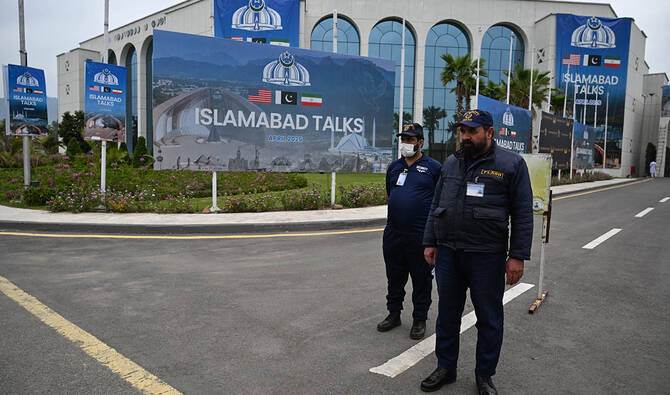

ISLAMABAD: Pakistan’s push for talks between the United States (US) and Iran has raised cautious hopes of a diplomatic breakthrough, but deep mistrust, conflicting demands and persisting regional tensions continue to threaten a fragile ceasefire between the two sides, analysts said on Saturday, after officials from the two countries arrived for high-stake negotiations in Islamabad.
Senior US and Iranian leaders arrived in the Pakistani capital of Islamabad on Saturday for negotiations to end their six-week-old war, although Tehran threw the talks into doubt by saying they could not begin without commitments on Lebanon and sanctions.
These will be the highest-level US-Iran talks since the Islamic Revolution of 1979 and if the two sides hold face-to-face negotiations as expected, they would be the first direct talks since 2015, when they reached a deal on Iran’s nuclear program. Trump scrapped the deal in 2018.
Former Pakistani diplomats expressed their hopes of a breakthrough after both sides agreed to a dialogue process and sent their top officials for the negotiations, following a two-week ceasefire reached between them on Wednesday.
“As the host of this meeting between the United States and Iran, Pakistan is very hopeful and optimistic. We worked very hard for this meeting behind the scenes and today is the culmination of the efforts that we have made so far,” Masood Khan, Pakistan’s former ambassador to the US, told Arab News.
“This war is devastating not only for Iran and the Gulf region, but for the entire world. And the war is holding international economy hostage. And that’s why it is very important to move swiftly and put an end to this war, not only temporarily, but permanently.”
The war, which began on Feb. 28, has largely cut off the Middle East from the global economy, sending energy prices soaring and damaging infrastructure in half a dozen countries in the region.
In Islamabad, the normally bustling streets of Islamabad were deserted on Saturday as security forces and law enforcement personnel sealed roads ahead of the negotiations.
Pakistan Prime Minister Shehbaz Sharif said on Friday the war that began on Feb. 28 was at a “make-or-break” moment.
Vice President JD Vance, who is leading the US delegation, said Washington was optimistic about the talks, but warned that “if they (Iranians) are going to try and play us, then they’re going to find that the negotiating team is not that receptive.”
Foreign Minister Abbas Araghchi, who is part of the Iranian delegation, said Tehran was entering negotiations with “deep distrust” stemming from prior strikes on Iran during previous rounds of talks and that his country was prepared to retaliate if it was attacked again.
Iran has put forward a 10-point proposal for a settlement that includes maintaining control of the Strait of Hormuz, recognition of its right to nuclear enrichment, lifting of sanctions and an end to hostilities, including in Lebanon.
However, key differences remain over the scope of the ceasefire. The United States and Israel say the truce does not extend to Lebanon, while Iran and Pakistan maintain it was part of the understanding, highlighting the challenges facing the talks.
Naghmana Hashmi, a former Pakistani Ambassador to China, said Pakistan had been constantly talking to the Gulf countries, Iran, China, Russia and the Americans since the hostilities began late last month.
“If we are very, very lucky, we could see a long-term peaceful resolution and agreement coming out of these talks,” she said. “But more likely is that on a lot of issues, they may say that, ‘yes, we have agreed to these issues, but there are still one or two contentious issues left on which we may need to have the second or the third round’.”
“Even that would be very, very productive and good,” she added.
Hashmi appreciated all countries involved in the mediation process as well as Gulf states, particularly Saudi Arabia, for playing a positive role during the crisis.
“Saudi Arabia was one of the Middle Eastern countries, which is the most powerful and was in a very, very difficult situation. After a very long hiatus, they were able to restore complete diplomatic relations with Iran... On the other hand, they have very good understanding and relationship with the US,” Hashmi said.
“So, they had a very, very difficult balancing act to do.”
In 2023, Saudi Arabia and Iran had formally restored diplomatic ties seven years after they were severed, following a Chinese-brokered deal.
Hashmi said the Kingdom has shown “great leadership, great strategic and political acumen and fantastic diplomacy to help the other like-minded Arab and Gulf states also to move toward dialogue.”
“Let us hope that everything that happens [at the talks in Islamabad] is positive and that you and I and the rest of the world sort of breathe a sigh of relief,” she added.


