



BEIRUT/LONDON: Lebanon has requested direct talks with Israel — a move that Prime Minister Benjamin Netanyahu says he has accepted, with negotiations set to focus on disarming Hezbollah and establishing formal relations.
But as areas of Beirut and elsewhere lie in ruins after two days of intense Israeli bombardment, the question is unavoidable: is it too little, too late? And could any of this have been averted?
The announcement comes as Lebanon has been pointedly excluded from the ceasefire that the US purportedly agreed with Iranian leadership this week after six weeks of conflict — a distinction President Donald Trump has made explicit.
Lebanon is not part of the agreement “because of Hezbollah,” but will “get taken care of,” Trump said a day after announcing Washington’s truce with Tehran ahead of peace talks in Islamabad on Friday.

Asked by PBS News if he had any objections to Israel’s continued strikes on Lebanese territory, Trump said: “That’s a separate skirmish.”
That separation is precisely the point — and the problem. While Washington and Tehran edge toward de-escalation, Beirut has been attacked largely outside the frame of international attention, raising urgent questions not only about the conduct of the war, but its purpose.
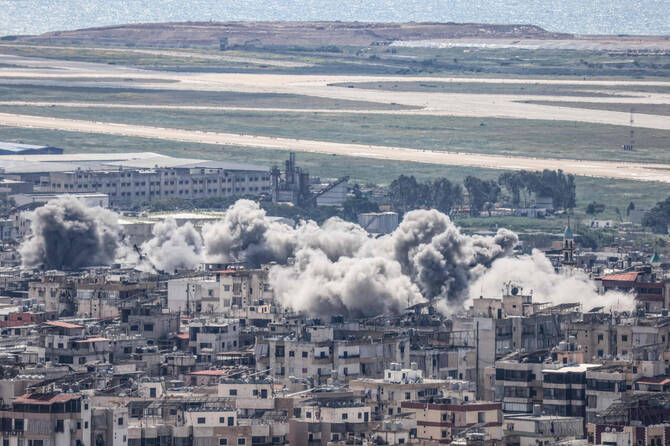
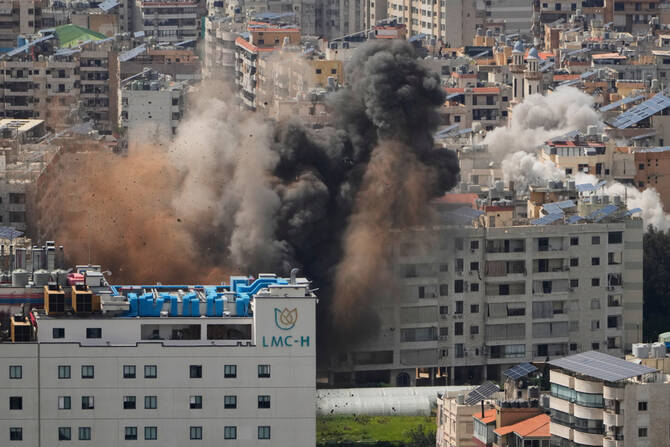
Lebanon has filed an urgent complaint with the UN Security Council after a wave of Israeli strikes on Beirut and across the country killed more than 200 people and wounded more than 1,000 others on Wednesday.
Flags were lowered to half-mast on Thursday in an official day of mourning as rescue teams searched for 33 people still believed trapped beneath the rubble of buildings destroyed in near-simultaneous strikes — many in densely populated civilian areas.

Paramedics transport the body a man or burial after he was killed in a strike in Hay el-Sellum, a densely populated district of Beirut on April 9, 2026. (REUTERS)
The International Committee of the Red Cross said heavy munitions with wide-area impact hit crowded residential districts, including neighborhoods in central Beirut, without any advance warning, reinforcing concerns that the scale and pattern of strikes have been indiscriminate.
Despite the scale of destruction — and the apparent lack of distinction between military and civilian targets — Lebanon remains diplomatically peripheral to the broader conflict.
For many observers, that raises a deeper question: has Lebanon become the victim of both its own chronic governance failures and an Israeli military campaign that appears to operate with few limits?
“Lebanon has struggled to agree on even the most basic pillars of statehood beyond symbolic formalities and superficial institutional frameworks,” Hussein Chokr, a Beirut-based policy expert, told Arab News.
“There remains no consensus on the nature of the state itself, let alone on defining a common enemy or articulating a coherent concept of national security that reflects shared interests and threats.”
Opinion
This section contains relevant reference points, placed in (Opinion field)
Moveover, “whenever internal opportunities emerged to build a functioning and sovereign state, Israel has consistently played a role in deepening Lebanon’s crisis and obstructing the consolidation of a strong national entity.”
Netanyahu had earlier renewed his pledge to continue “striking Hezbollah wherever necessary until we restore full security to residents of the north.”
However, late on Thursday, he said: “In light of Lebanon’s repeated requests to open direct negotiations with Israel, I instructed the cabinet yesterday to start direct negotiations with Lebanon as soon as possible.
“The negotiations will focus on disarming Hezbollah and establishing peaceful relations between Israel and Lebanon.”

Caption
It is unclear whether Israel’s strategy up until now could realistically destroy Hezbollah — or whether it risks instead hollowing out the Lebanese state.
For Lebanese authorities, the latest escalation underscores both the state’s inability to respond and the growing danger that the country itself is being broken in the process.
The immediate focus has shifted to halting the war rather than managing its fallout.
“There is nothing the state can do under wartime conditions,” an official Lebanese source told Arab News. “The priority now is to secure a ceasefire. Only then can other issues be addressed through negotiations.”
The source said this position is being conveyed in all diplomatic contacts, with Lebanon pressing the international community to intervene to stop the fighting and prevent further destabilization.
Despite mounting calls to assert state control over weapons and disarm Hezbollah — now central to the proposed talks — officials say such measures remain impossible under bombardment.
“There is no way to implement anything while Israel is bombing Lebanon. Four Lebanese Army soldiers were killed in Israeli airstrikes on Wednesday alone,” the source said.

Caption
The Lebanese government is scrambling for a way out. After a cabinet meeting at the presidential palace, Prime Minister Nawaf Salam called on the army and security forces to reinforce state authority in Beirut and restrict the possession of weapons.
But even as Beirut signals willingness to confront Hezbollah’s arsenal, the timing raises further doubts about whether the state still has the capacity — or credibility — to do so.
“We’ve seen some landmark decisions taken by this Lebanese government that has outlawed the military activities of Hezbollah, but it hasn’t acted on that,” Fadi Nicholas Nassar, a senior fellow at the Middle East Institute, told the BBC on Wednesday.
“Without a clear end game, Lebanon will remain trapped in a cycle of war that threatens not only its future but the stability of the entire region.”
Telecommunications Minister Charles Hage condemned what he described as Israel’s deliberate targeting of civilians.
“This is entirely unacceptable. Lebanon never chose to be part of this fight, and its people must not be forced to bear the cost of regional wars that have nothing to do with them,” he told Arab News.
Hage warned that the escalation is exacting a heavy civilian toll without bringing the country any closer to a resolution, stressing that “there is no military solution.”
Analysts say the campaign may be serving a broader political objective beyond degrading Hezbollah’s capabilities.
Mohanad Hage Ali, deputy director for research at the Malcolm H. Kerr Carnegie Middle East Center in Beirut, said the strikes appear aimed at isolating Lebanon from any US-Iran agreement while increasing pressure on the Lebanese state.

Caption
He said Israel’s expansion of operations, including the destruction of homes and territorial advances, is designed to force the government into accepting its conditions and push it toward confrontation with Hezbollah.
“Israel’s ultimate aim may be to trigger internal conflict within Lebanon as a way to neutralize the threat posed by Hezbollah,” he said.
Such a strategy risks deepening internal fractures rather than eliminating the group.
Even now, Hezbollah supporters have gathered outside the Grand Serail calling Salam “a Zionist” and demanding his resignation, echoing rhetoric spreading online.
Michael Young, senior editor at the Malcolm H. Kerr Carnegie Middle East Center, said “they’re beginning a process of trying to discredit the government.”
“As in 2006, they would like to bring the government down and form a government that is more in line with their calculations that would protect the resistance.”

Mourners attend the funeral of Hezbollah fighters, killed before the November 27 ceasefire with Israel, in the southern village of Mais al-Jabal on April 4, 2025. (AFP)
In that sense, the war may be weakening the Lebanese state faster than it weakens Hezbollah — raising doubts about whether military escalation alone can achieve Israel’s stated goals, or whether it ultimately serves to reshape Lebanon’s political order instead.
Hage Ali warned that Hezbollah and Iran appear prepared to escalate further, despite the high cost, particularly as many within the Shiite community see the state as unable to provide protection.
“Hezbollah is likely to retain access to funding and logistical support as long as financial flows continue, especially with Iran’s ability to generate revenue through key routes such as the Strait of Hormuz,” he said.
He added that the Lebanese government now faces a critical choice: to initiate a new agreement similar to a previous framework presented last year by Tom Barrack, the US envoy to Lebanon, and which had been accepted by both the government and Hezbollah.
The proposal presented by Barrack called for ending the armed presence of all non-state actors, including Hezbollah, across Lebanese territory; deploying the Lebanese army in border areas; and demarcating the border with Syria, while establishing a monopoly on weapons.
It also called for extending state sovereignty over all its territory; ensuring the sustainability of the cessation of hostilities; securing Israel’s withdrawal; resolving border and prisoner issues through indirect negotiations; facilitating the return of civilians to border areas; holding an economic conference to support the Lebanese economy; and promoting reconstruction.
Independent Beirut MP Waddah Sadek held the Lebanese military forces responsible for “failing to implement the long-standing resolution on the monopoly on arms.”
He told Arab News: “Failure to follow this path has led to a loss of trust in the Lebanese state and brought us to the current crisis we are facing.”

Lebanese army soldiers inspect the site of an Israeli airstrike that targeted their checkpoint in Aamriyeh, south of the coastal city of Tyre, on March 30, 2026. (AFP)
Lebanon, meanwhile, remains excluded from the diplomatic track shaping the wider conflict.
The country was not officially notified whether it was included in the US-Iran ceasefire and has rejected “any negotiations regarding Lebanon conducted on its behalf,” in reference to Iran.
Salam said on Wednesday that “no one negotiates on behalf of Lebanon except the Lebanese state, through its constitutional institutions, safeguarding its sovereignty and the interests of its people.”
The broader war context only sharpens that sense of exclusion. Trump has framed the US-Iran truce as a step toward ending a conflict that has killed thousands and shaken the global economy, but both Washington and Israel insist Lebanon is not covered.
Calls are growing to expand the agreement to include Lebanon, which was drawn into the war after Hezbollah launched rocket fire on Israel following the killing of Iran’s supreme leader, Ayatollah Ali Khamenei, on Feb. 28.
Israel’s response — a ground invasion and sustained air campaign — has killed more than 1,500 people, according to Lebanese authorities, while Hezbollah continues to fire rockets in return.
US Vice President JD Vance reinforced the distinction, saying: “If Iran wants to let this negotiation fall apart... over Lebanon, which has nothing to do with them, and which the United States never once said was part of the ceasefire, that’s ultimately their choice.”
For many in Lebanon, that separation — between diplomacy and destruction — is becoming impossible to sustain.
Mona Fayad, a professor at the Lebanese University, said the public wants the restoration of state authority, not further devastation.
“The state must protect its people and embrace the marginalized Shiites who still fear Hezbollah,” she said.
She also questioned why political actors had allowed Hezbollah and its allies to shape the country’s trajectory.
“No one is taking responsibility for Lebanon,” she said, warning that Israel’s campaign risks devastating the country itself — regardless of whether it succeeds in weakening Hezbollah.


