


NEW YORK CITY: The UN’s top humanitarian officials in Lebanon warned on Wednesday of a rapidly worsening crisis in the country, as a surge in airstrikes across the country underscored Israeli assertions that a two-week regional ceasefire agreement between the US and Iran does not extend to Lebanese territory.
Speaking from Beirut, the UN’s resident and humanitarian coordinator, Imran Riza, said the day began with cautious optimism following news of the truce deal involving the US, Israel and Iran. It quickly became clear, however, that Lebanon was not included.
“Here in Beirut, we woke up this morning to news of the ceasefire … This morning, there was uncertainty as to whether the ceasefire would apply to Lebanon,” he said. “Developments today, however, would seem to indicate otherwise.”
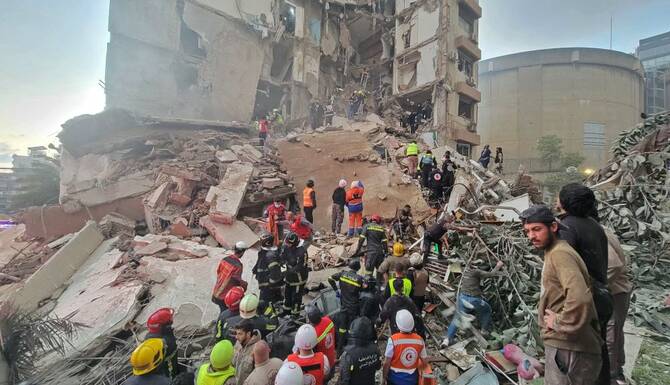
An early morning airstrike on a cafe in the southern city of Saida reportedly killed eight people, and more than a dozen additional strikes were recorded across southern Lebanon within hours. By mid-afternoon, it emerged that Israel had launched its most intensive bombardment of Lebanon since the current conflict began, conducting more than 100 strikes in just 10 minutes across southern regions, the Beqaa Valley and the outskirts of Beirut.
The escalation came hours after the announcement of the US-brokered ceasefire deal in the conflict with Iran, which Israeli Prime Minister Benjamin Netanyahu’s office later confirmed did not apply to Lebanon.
At least 112 people were reported killed in Lebanon on Wednesday alone, and new evacuation warnings were issued for densely populated areas, worsening what was already a severe humanitarian emergency.
Riza said the effects of the strikes have been “enormous,” with the true death toll believed to be in the hundreds, although confirmed figures were as yet unavailable. Rescue operations are ongoing, he added, and hospitals across the country were urgently calling for blood donations.
Earlier in the day, some residents displaced from southern Lebanon had started to prepare to return home.
“The events of the past hours, however, are likely to have triggered further displacement,” Riza said.
Since the escalation of violence in early March, the human toll of the conflict in Lebanon has risen sharply. According to the country’s Ministry of Public Health, at least 1,530 people were killed and 4,812 injured between March 2 and April 7. Among children, 130 were killed and 461 injured, while the toll among women was 102 dead and 544 injured.
“These are not just numbers; they reflect a deepening civilian tragedy,” Riza said.
Meanwhile, displacement has reached an unprecedented level, with more than 1.1 million people, nearly one in five residents, forced from their homes. More than 138,000 are sheltering at 678 sites for displaced persons, many of them schools, and nearly a million are scattered across host communities and informal settlements, often with limited access to basic services.
Echoing and expanding on these concerns, the UN Population Fund’s regional director, Laila Baker, warned that the crisis was not only escalating in terms of scale, but also reshaping the fragile social fabric of the country and placing disproportionate pressure on women and girls.
“What is unfolding here is not just another emergency,” she said after visiting affected communities. “Women and girls are bearing an unprecedented and intolerable burden.”
She described a country that had shifted from fragile optimism to deeply strained in a matter of months, and warned that the continuing violence risks not only a humanitarian collapse but also renewed social fragmentation if displacements become prolonged and communities cannot recover.
The UN estimates that women and girls account for more than half of those displaced, about 620,000 people. They include approximately 13,500 pregnant women, many of whom are struggling to access care. In southern Lebanon alone, about 1,700 pregnant women are cut off from essential maternal services. About 200 of them are expected to give birth within the next month, with no adequate support available.
“I met mothers fleeing under bombardment, carrying their children with nothing but the clothes on their backs, and pregnant women searching desperately for care,” Baker said. She described births taking place in overcrowded shelters with no medical assistance or privacy.
The crisis is being driven in part by widespread displacement orders that now affect 15.5 percent of Lebanese territory, areas that were home to more than a quarter of the country’s population before the escalation.
“While many have fled, others remain trapped or unwilling to leave, fearing they may not be able to return,” Riza said, warning that repeated displacement is compounding trauma and increasing the risks for vulnerable groups.
Those risks are particularly acute for women and girls, who face heightened exposure to violence, exploitation and neglect in overcrowded shelters, Baker added. Access to reproductive healthcare and protective services are “non-negotiable” and life-saving, she added.
Humanitarian access is also deteriorating, particularly in areas south of the Litani River, where at least 106,000 people remain increasingly isolated. Israeli airstrikes in western Bekaa have cut key roads, further restricting movement and deliveries of aid.
Lebanon’s already fragile infrastructure is under growing strain. The healthcare system has been hit particularly hard, with more than 100 attacks on medical facilities reported in recent weeks, forcing the closure of hospitals and primary care centers.
“This is limiting access to life-saving assistance when it is needed most,” Riza said.
Baker echoed this warning and said the damage to healthcare infrastructure was having especially severe consequences for maternal care, with facilities completely closed or operating under extreme pressure, pushing essential services toward collapse.
The education sector has also been severely disrupted. Public schools and the national university are being used as shelters, leaving thousands of students with no access to lessons. Remote-learning efforts have been hindered by displacement, electricity shortages and poor connectivity, raising concerns about the long-term effects, especially for girls and children with disabilities.
Despite the challenges, humanitarian organizations continue to scale up their response to the crisis. More than 4 million meals have been delivered as part of the aid efforts, and shelters have been provided with 130,000 blankets and 105,000 mattresses. About 100,000 displaced families living outside shelters have received financial assistance.
“National partners and affected communities are at the heart of this response,” Riza said, emphasizing the critical role they play.
UN Population Fund teams are also deploying mobile health clinics, midwives and social workers, and distributing essential supplies including hygiene and baby kits, Baker said, though she warned that the current efforts fall far short of mounting needs.
The response overall remains under severe strain. Even before the latest escalation, aid agencies aimed to provide support for 1.5 million vulnerable people through a $1.6 billion Lebanon Response Plan. Funding and staffing shortages are now limiting the scale and speed of assistance.
A $308 million emergency appeal launched on March 13 has so far received only 30.7 percent of the required funding. The Population Fund’s own $12 million appeal is even more underfunded, with critical services at risk of shutting down within weeks without additional support.
“Every day of inaction costs lives,” Baker warned.
Both of the UN officials concluded their remarks with urgent appeals for an immediate halt to the violence, respect for international humanitarian law, and a significant increase in funding for relief efforts.
“This escalation must stop,” Riza said. “There is no military solution. Deescalation and dialogue are urgently needed to prevent further suffering.”
Lasting peace is essential, Baker added, not only to end the violence but so that Lebanon can begin to rebuild. Without immediate action, she warned, the country risks slipping ever deeper into humanitarian and societal crisis.


