

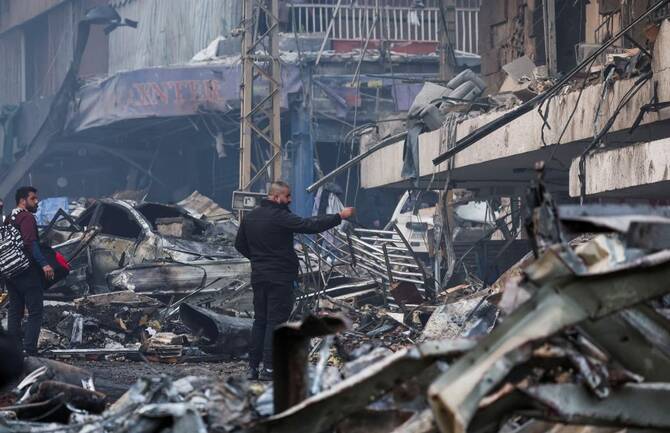

BEIRUT: Lebanese officials have called for urgent state action to disarm Hezbollah, warning of a looming catastrophe after Israel launched one of its most intense waves of airstrikes on Beirut and across the country.
The strikes, which hit several areas simultaneously without warning, marked a shift in Israel’s military approach and deepened fears that Lebanon is entering a far more dangerous phase of the conflict.
Lebanese Information Minister Paul Morcos told Arab News that the Lebanese government holds Israel “fully responsible” for the escalation, which killed more than 250 people and wounded 1,165 others.
He reiterated the president’s position that “there is no solution except through negotiation,” calling on the international community to act urgently to support Lebanon and help advance diplomatic efforts to restore stability.
Morcos condemned the strikes as a “flagrant violation of international and humanitarian laws and norms” and “a blatant and ongoing breach of any existing commitments or arrangements.”
The escalation reflects “a persistent approach aimed at undermining stability,” he added.
Beirut MP Ibrahim Mneimneh described the attacks as a “full-scale war against civilians,” saying they reflected a dramatic escalation in Israel’s tactics.
He told Arab News that “the government must act swiftly to protect all of Lebanon,” stressing that halting the war had become an urgent priority and that Hezbollah must respond to state demands.
He warned that failure to do so would push the country toward disaster, saying Lebanon was now caught between “Israel’s aggression and Hezbollah’s indifference.”
MP Bilal Hechaime said the scale and coordination of the strikes had left the country in shock.
“These were widespread and simultaneous airstrikes targeting all areas at once without warning,” he told Arab News. “It was a moment of panic and fear, and the suffering is immense.”
Hechaime described the operation as premeditated and said it appeared Israel was “changing the rules of engagement” to increase pressure on the Lebanese state.
The strikes came shortly after heightened Israeli warnings and the closure of the Masnaa border crossing — Lebanon’s main land gateway — in what Hechaime called a clear signal that Israel was willing to escalate further.
“The message is that there are no red lines,” he said.
The strikes follow weeks of intensifying hostilities after Hezbollah launched attacks on Israel in early March, drawing Lebanon deeper into a widening regional conflict. Israeli airstrikes have since expanded beyond traditional frontline areas to include Beirut’s southern suburbs and key infrastructure across the country.
Hechaime said the latest developments were also sending a political message to Lebanese authorities.
“What happened shows there is no longer any separation between the state and Hezbollah,” he said, warning that the international community increasingly views Hezbollah as the primary decision-maker in Lebanon.
He added that Lebanon now has limited options, with the state under growing pressure to move toward direct negotiations while civilians bear the brunt of the conflict.
“The country is in shock,” he said. “The state is powerless, and the people are paying the price.”
Both lawmakers emphasized that the issue of Hezbollah’s weapons can no longer be deferred.
Hechaime called for the immediate implementation of measures to place all weapons under state control, warning that failure to act would lead to even more dangerous consequences.
“The state must make a clear decision,” he said. “If it does not act, we are heading toward a more dangerous situation.”
The calls come amid mounting internal divisions and growing pressure on Lebanese authorities to assert control over security decisions, as the war continues to expand and the humanitarian toll rises.


