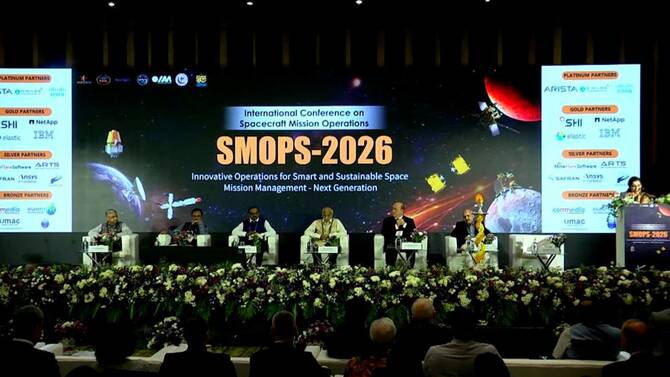

NEW DELHI: Space industry leaders gathered in Bengaluru on Wednesday for the Indian Space Research Organization’s summit to explore emerging technologies and strategies shaping the future of space mission management.
The three-day International Conference on Spacecraft Mission Operations is co-organized by the ISRO, the Astronautical Society of India, and the Indian National Space Promotion and Authorization Center.
“This conference will bring all advances in spacecraft operations and the requirements for a sustainable space. The knowledge base will surely make space missions and operations smarter safer and more ambitious,” Dr. A.K. Anil Kumar, director of the ISRO Telemetry, Tracking and Command Network (ISTRAC), told the participants.
“We will explore mission design, navigation, communication, automation and the tech driving it all, including the ground segment automations missions like Mars rovers, satellite constellations, human spaceflight, and other advanced areas, which push boundaries.”
The conference was first held in 2023, also in Bengaluru — home to ISRO headquarters and numerous aerospace startups — and focused on automation in space mission operations. The 2026 event’s theme focuses on space domain awareness and sustainable space mission management.
“As more countries and private players deploy large satellite constellations, orbital spaces are becoming significantly more crowded, making visibility and coordinated management of space assets essential,” Lt. Gen. AK Bhatt (retd.), director general of the Indian Space Association and one of the conference’s speakers, told Arab News.
“The real significance of this platform lies in addressing how these capabilities evolve from being technical functions to operational necessities. Space domain awareness is no longer limited to tracking objects, but extends to enabling informed decision-making, risk mitigation and collision avoidance. Similarly, sustainable mission management is becoming fundamental to ensuring long-term access to space without compromising future operations.”
Among other speakers are India’s top space scientists, including A.S. Kiran Kumar, International Astronautical Federation honorary ambassador Jean-Yves Le Gall, executives from the European Space Agency, the European Organization for the Exploitation of Meteorological Satellites, and the Space Research Institute of the Russian Academy of Sciences, as well as representatives of the biggest Indian and international companies in the space sector.
India has been expanding its space missions over the past few years; it is currently working on the ISRO-led Gaganyaan human spaceflight program, which would make it the fourth country to independently send humans to space — after the US, Russia and China.
The first uncrewed test of Gaganyaan is scheduled for 2026, following a series of successful missions last year, including the sending of India’s first astronaut to the International Space Station, the autonomous docking of two satellites, and the deployment of BlueBird Block 2 — the heaviest payload launched from Indian soil.
In August 2023, ISRO’s Chandrayaan-3 moon rover made history by landing on the lunar surface, making India the first country to land near the lunar south pole and the fourth to land on the moon — after the US, the Soviet Union and China.
A month later, it launched Aditya-L1 in 2023 — the country’s first solar observation mission, and the world’s second after the US Parker Solar Probe in 2021.
India currently accounts for about 2 percent of the $450 billion global space economy, with its share expected to rise to nearly 8 percent by 2033, driven largely by private companies.