


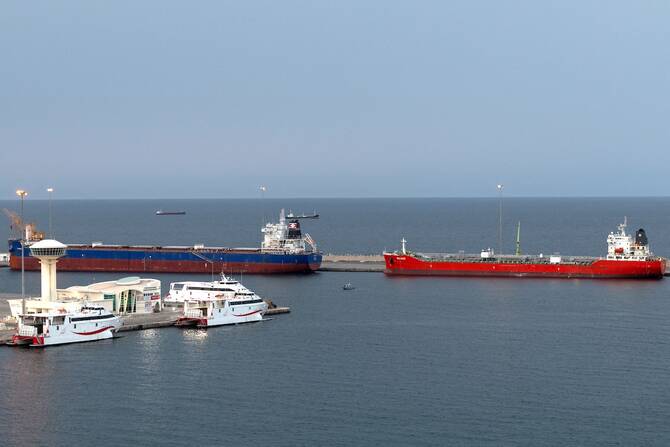
Iran has authorized the passage of vessels carrying essential goods to its ports through the Strait of Hormuz, according to a letter cited by Iran’s Tasnim news agency on Saturday. Some foreign-flagged vessels have also been allowed passsage.
The letter indicates that ships heading to Iranian ports, including those currently in the Gulf of Oman, must coordinate with authorities and comply with established protocols to transit the strait, Tasnim said.
Iran has effectively shut the Strait of Hormuz, which normally carries about a fifth of the world’s total oil trade, in retaliation for US-Israeli attacks that began on February 28.
Turkiye’s Transport Minister Abdulkadir Uraloglu said Saturday a second Turkish-flagged ship has crossed the war-torn Strait of Hormuz.
Uraloglu said that when the war broke out on February 28 there were 15 ships belonging to Turkish shipowners waiting to go through the strategic strait. “Two of these 15 made the crossing,” he said in an interview on the private CNN Turk channel.
India-flagged LPG tanker crosses Strait of Hormuz
An Indian-flagged tanker carrying LPG has safely passed through the Strait of Hormuz, India’s government said on Saturday.
The shipping ministry confirmed that LPG carrier Green Sanvi had transited through the chokepoint.
“Green Sanvi has safely transited the Strait of Hormuz, carrying 46,650 MT of LPG cargo with 25 seafarers on board,” a statement said, without giving further details on its final destination.
It added that 17 Indian-flagged vessels, with 460 Indian seafarers, “remain in the western Arabian Gulf region.”
Data from ship tracking company Marine Traffic’s website confirmed that the Green Sanvi was an Indian-flagged tanker.
Public broadcaster All India Radio said it was the “seventh India-bound LPG tanker” to cross the Strait of Hormuz since the Middle East war began.
French, Japanese vessels also crossed waterway earlier
One French- and another Japanese-owned vessel are among a handful of vessels to have crossed the war-torn Strait of Hormuz, maritime tracking data showed Friday.
The passage, a vital maritime route for oil and liquified natural gas, has been virtually blocked by Iran since the start of the war.
But both ships made the crossing on Thursday, according to ship tracking company Marine Traffic’s website.
The Maltese-flagged Kribi belonging to the French maritime transport group CMA CGM crossed the waterway to leave the Gulf on Thursday afternoon, Marine Traffic’s data showed.
By early Friday, it was off Muscat, Oman, still broadcasting the message “owner France” on its transponder system in the field usually used to give the destination.
The vessel’s navigation data showed it had crossed via an Iranian-approved route through its waters, dubbed the “Tehran Toll Booth” by leading shipping journal Lloyd’s List.
Southern route
In addition, three tankers — including one co-owned by a Japanese company — crossed the Strait of Hormuz on Thursday by taking an alternative, southern route.
They hugged close to the shore of Oman’s Musandam Peninsula — a first in nearly three weeks according to Lloyd’s List.
Before the war, which started more than a month ago, about a fifth of global oil and liquefied natural gas (LNG) passed through the Strait.
All three ships signaled they were an “OMANI SHIP” in the message broadcast by their transponder as they crossed the strait.
The Sohar LNG, which was empty when crossing, is co-owned by Japanese shipping company Mitsui O.S.K.
That makes it the first Japanese vessel to exit the Gulf since the start of the war, according to a company statement quoted by Japanese media.
The Hong-Kong flagged New Vision, which crossed the strait on March 1 right after the war started, is expected in the French port of Le Havre on Saturday evening.
Since the conflict started however, that has dwindled to a trickle as Iran selectively attacks ships and energy facilities throughout the Gulf in retaliation for US and Israeli attacks.
A few commercial ships crossing the Strait of Hormuz recently have passed through the Iranian-approved route in the north of the waterway.
Down to a trickle
Just 221 commodities vessels have crossed the Strait of Hormuz since March 1, some more than once, according to Kpler data up to Friday morning.
In peacetime, the same waterway handles around 120 daily transits, according to Lloyd’s List.
Of the vessels that made the crossing, 60 percent either came from Iran or were heading there.
The other countries whose vessels — of origin or destination — made the crossing, were in decreasing order: the United Arab Emirates, China, India, Saudi Arabia, Oman, Brazil and Iraq.
It was not clear from the data how many had been cleared to make the crossing by Tehran.
But it did show that, among the 118 crossings by ships carrying cargo, 37 had left the Gulf carrying crude oil.
Most of those oil tankers — 30 of them — came from Iran or sailed under the Iranian flag. And most ships carrying Iranian oil did not specify their destination on their transponder.
Of those who did, all but one reported they were heading to China.
In the early days of the war, transponder data showed dozens of ships broadcasting messages such as “Chinese crew” or “Chinese owner” in the field usually used for their destination.
This appeared to be an attempt by the ships to avoid being targeted by Iran.


