

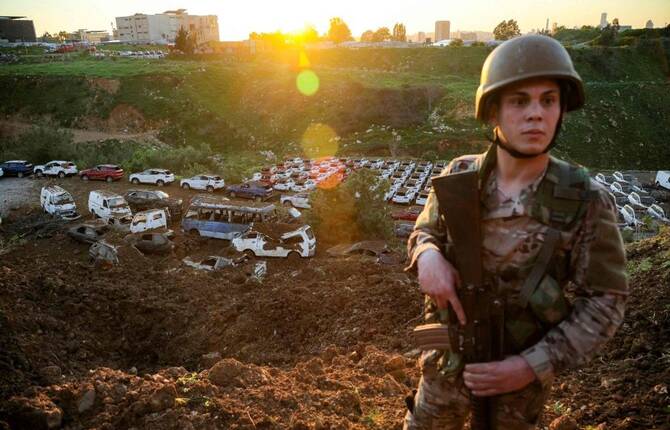
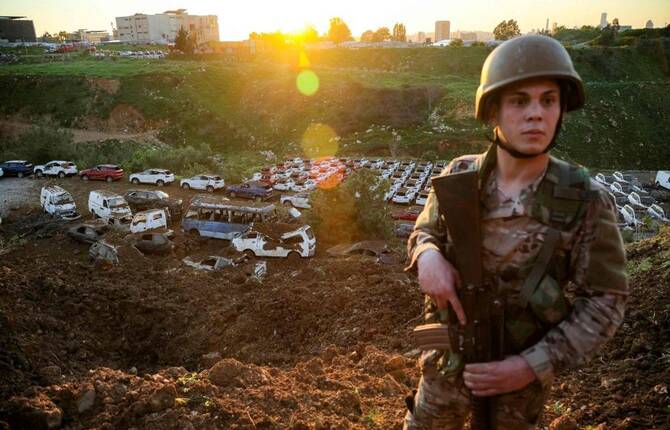
BEIRUT: The Lebanese army has withdrawn from several border positions in southern Lebanon, in what one official described as a necessary move to avoid any direct confrontation with Israeli forces and prevent heavy losses as the war between Israel and Hezbollah escalates.
The redeployments on Wednesday followed Israeli shelling near army positions and repeated demands for Lebanese troops to leave certain positions, military and other official sources in Lebanon said.
“Military units deployed in the south received calls from Israel to evacuate,” an official told Arab News. “One army checkpoint was even hit by Israeli shelling, killing soldiers, after it refused to evacuate.”
The Lebanese army said the withdrawal was intended to prevent units from being surrounded or isolated in the event of a wider Israeli ground incursion, which could have left soldiers cut off from command and supply lines.
Maj. Gen. Abdul Rahman Shuhaitli told Arab News that the military command feared troops could end up besieged and effectively fall under Israeli control if lines of communication with commanding officers were cut.
“Once communication between the soldiers and their superiors is severed, it’s impossible to predict what will happen after they are effectively taken hostage,” he said.
“Nothing deters Israel from such actions. In this context, the Lebanese army is trying to preserve itself until it is able to carry out its missions once a ceasefire is in place.”
Shuhaitli stressed that a direct confrontation with Israel was never under consideration, given the Lebanese army is operating under government orders and there has been no state declaration of war.
The withdrawal sparked protests in Lebanon, however, particularly in Christian border villages where residents had refused to leave their homes and said the departure of the army has left them unprotected.
The army command responded by emphasizing its commitment to “standing with the residents to the fullest extent possible, by maintaining a force of soldiers in those towns.”
However, the security personnel, including army and internal security forces, will remain in place without appearing in uniform, military chiefs said.
The redeployment comes a month into a war between Israel and Hezbollah that has caused widespread destruction and mass displacement across Lebanon. More than 1.2 million people have been displaced, while Israeli strikes have killed more than 1,300 people and wounded 3,935, according to official figures.
The war began on March 2, shortly after the US and Israel began their military campaign against Iran on Feb. 28, when Hezbollah launched attacks on Israeli positions. This prompted a large-scale Israeli air and ground campaign across southern Lebanon, the Bekaa Valley and the southern suburbs of Beirut.
There has been mounting criticism, from opponents of Hezbollah and some political groups, of the state and the army for failing to assert their authority south of the Litani River, despite their previous claims that most of the area had been cleared of Hezbollah weapons.
Shuhaitli said the course of the fighting had shown that both Israel and Hezbollah had long been preparing for this latest round of conflict, with the latter adopting guerrilla-style tactics using small mobile units armed with anti-tank weapons in an attempt to slow Israeli advances.
From a military standpoint, he added, such tactics might not halt a ground incursion but could impede Israeli forces and prevent them from holding territory for extended periods.
UN peacekeeping forces were facing similar pressure from Israel to evacuate positions in the vicinity of areas where Israeli forces are operating, Shuhaitli noted.
“The Lebanese army is the guarantor of security and enjoys the trust of the majority in Lebanon,” he said, adding that the army’s current priority is to preserve its forces so it can carry out its duties once a ceasefire agreement is reached.


