

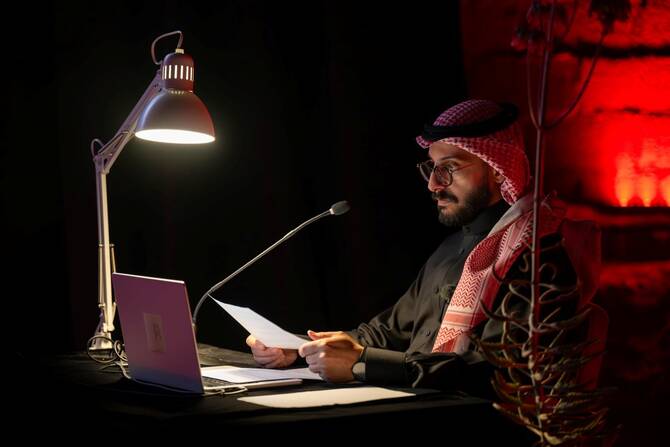

AlUla: In his newly-commissioned work for the exhibition “Arduna” (Our Land), part of the pre-opening program for the upcoming AlUla Contemporary Art Museum, the Riyadh-based Saudi visual artist Ayman Zedani constructs a fictional framework that proposes a radical re-reading of our region’s landscapes and the stories told within them.
While they were helpful in his quest, he chose not to use existing Nabatean or Dadanitic scripts, native to AlUla, instead, he crafted his own script, which he named Daraj (stairs), as it serves as a staircase bridging ancient and contemporary cultures.

A poster for Ayman Zedani’s 'In the Bellies of the Rocks.' (Supplied)
The work, titled “In the Bellies of the Rocks,” arose from Zedani’s participation in the AlUla Artists Residency Program. It is a two-channel video installation in which the two screens are positioned in a V-formation. It merges archival material, new footage and 3D renderings of archaeological sites. Across four acts, the narrative oscillates between documentation and speculation, from the rediscovery of ancient inscriptions to the establishment of a fictional Museum of Earth Matter and, finally, to a visionary proposition that these gateways might be reactivated.
Zedani, who studied biomedical science at university before becoming a full-time artist five years ago, came across an unlikely source while conducting his research; a 1986 essay by the late American sci-fi and fantasy author Ursula K. Le Guin, “The Carrier Bag Theory of Fiction” — itself influenced by the work of anthropologist Elizabeth Fisher. Just as Fisher argued that the major tool for early humans was not a weapon, but a bag in which to transport food and other vital items, Le Guin posited that a novel could be a “container” of diverse, interrelated things, and that narratives didn’t have to focus on conflict and linear progression.
In that context, Zedani’s fictional narrative becomes a conceptual container, carrying the many histories, myths and temporalities that converge in AlUla. Each element of the work — whether 3D scans, archival footage, or “fragments of ancient texts and echoes of oral traditions” — is part of a wider meditation on what it means to inherit and imagine the past. By merging the scientific language of excavation with the poetic techniques of speculation, Zedani brings this imagined history to life.
Zedani grew up in Asir, and says he has always felt most at home among mountains and nature. Although he visited AlUla as a child, he has only really got to know the place intimately over the last three years.
“Asir is the place that I feel has informed my sort of relationship with the non-human world — the natural world… growing up close to juniper trees and other species. My grandmother lived in a simple house and used plants and things native to the land in her daily life. And all of these things have really informed my practice in a lot of ways,” Zedani tells Arab News. “But I also grew up in a military city (bordering Yemen). So that had an opposing structure to organic structure. But those parallels have been really helpful to think with, because they gave me the insight that the world is not one thing. It can be many different things.
“Working with the desert, what I really appreciate is that it challenges us. This terrain (in AlUla) is not easy. I think a lot of the artists came here with the notion that they were trying to place something into the desert. But what I wanted to do is to amplify what was already in that place,” he explains. “For me, the medium comes after what the story needs to be. But for this one, I didn’t want to place anything into the land that couldn’t be removed later,” he adds.
So, for “In the Bellies of the Rocks,” he chose to use video to explore ancient Arabian kingdoms, — particularly the north of the peninsula; areas like AlUla, but also Khayber, Neom and Tabuk.
“For me, the goal is to rehabilitate my own personal relationship with the peninsula and share those micro-experiences with people. Why? I mean, ‘Orientalism’ is a thing — the thinking that the West is the ‘ideal place.’ This is, in some way, reclaiming the narrative.
“The video basically tells a simple story, in which the tombs and the burial sites have another function; they’re actually a portal to different dimensions. There is such an influx of people coming to AlUla for the first time in a very long time. And, for me, it’s almost like there was a portal that has opened. So I’m using the portals (in the work) as a signifier to this specific moment.
“Sometimes, fiction is much more exciting, and more beautiful, than real life,” he adds. “Most of our history, as a species, is embedded in stories. The culture of oral storytelling is the only reason we’ve accumulated (millennia) of history. It’s, like, how do you trick someone into (remembering) something without telling them exactly how? You put it inside of a story.”
That insight is something Zedani’s maternal grandmother helped him realize.
“I owe a lot of the sort of tricks within my practice to my grandmother,” he says. “She was a single mom who raised five kids on her own. She was very tough. Everybody feared her. She was basically like the top of the pyramid at the whole family. But she was really soft with the grandkids,” he says with a laugh.
But it’s not just his personal history that drives Zedani’s art, he stresses.
“The main protagonist within my practice is the Arabian Peninsula. And I mean all of it — all of the areas surrounding all the different seas and all the different terrains. That’s all the portals. What I’m hoping is that people really just understand the history of this place. I mean, it’s hard to keep up with what’s happening at the moment, but I think it’s really important to sit with a place like (AlUla) and try to understand the history; this was the capital of an Arabian kingdom,” he says. “But I don’t want to attribute all of this to one story; there are so many different layers.”


