

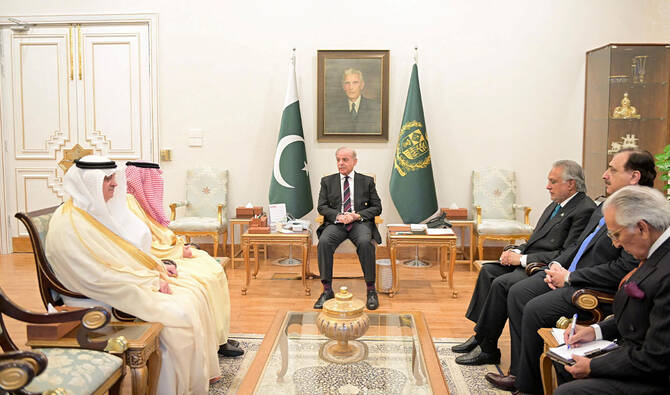

ISLAMABAD: Pakistan hosted foreign ministers from Saudi Arabia, Türkiye and Egypt in Islamabad over the weekend for talks aimed at de-escalating the war between Iran and Israel and the United States, as it seeks to position itself as a potential mediator in one of the most dangerous regional conflicts in years.
The war, triggered by US and Israeli strikes on Iranian targets in late February, has since escalated into a wider confrontation, with Iran launching retaliatory attacks on Israel, US assets and Gulf energy infrastructure. The conflict has disrupted shipping through the Strait of Hormuz, a key artery for global oil and commodity flows, raising concerns over energy security, trade and the risk of further escalation across the Middle East.
Against this backdrop, Islamabad convened ministers from key regional powers on Sunday to coordinate diplomatic efforts and explore pathways toward negotiations. Pakistan’s Foreign Minister Ishaq Dar said after the meeting that Washington and Tehran have both “expressed confidence” in Islamabad facilitating talks between the two sides.
Michael Kugelman, a US-based foreign policy expert, said Pakistan’s role in the current crisis had helped elevate its diplomatic standing.
“Particularly in the eyes of critics that feel that it doesn’t have the capacity to play this really prominent diplomatic role in talks related to such a complex conflict,” Kugelman told Arab News.
“I think that it’s been able to put India on the defensive to an extent.”
Analysts and former diplomats say Pakistan’s current outreach builds on a long history of backchannel mediation between rival powers.
In 1971, Pakistan facilitated a secret visit by then US Secretary of State Henry Kissinger to Beijing, paving the way for the normalization of relations between the United States and China. The breakthrough reshaped global geopolitics and is often cited as one of Islamabad’s most significant diplomatic achievements.
“Pakistan was the bridge in the establishment of this relationship and after that, Beijing was also given the seat in the United Nations Security Council,” said Amjad Ali Sher, a former Pakistani ambassador to the UAE.
More recently, shifting regional dynamics, including the China-brokered rapprochement between Saudi Arabia and Iran in 2023, have given Pakistan greater space to engage with Tehran while maintaining its long-standing strategic ties with Riyadh and Washington.
Kugelman said Pakistan’s ability to maintain working relationships with both Iran and the United States was central to its current role.
“The Pakistani civilian and military leadership have understood the very unconventional ways that this administration in Washington functions,” he said. “And that includes, you know, the constant praise and all of that.”
SPILLOVER RISKS
Analysts say Pakistan’s push to mediate is also driven by immediate national security concerns.
The country shares a porous 900-kilometer border with Iran and has long struggled with militancy in its western regions. Any escalation in the conflict risks spillover effects, including cross-border instability and rising sectarian tensions.
“Pakistan has an incredibly compelling interest in seeing this war come to an end,” Kugelman said. “It borders Iran and that means that the conflict spillover risks are especially stark for Pakistan.”
Pakistan could also face strategic dilemmas if the conflict widens. Islamabad signed a defense cooperation agreement with Saudi Arabia in 2025, raising questions about how it would respond if Gulf allies come under sustained attack.
Despite the risks, analysts say Pakistan has already gained diplomatically by stepping into a high-profile mediating role.
“I don’t think that Pakistan would suffer any type of reputational damage if the talks don’t pan out,” Kugelman said.
“There’s a strong recognition that, you know, this is very ambitious what’s happening here.”


