

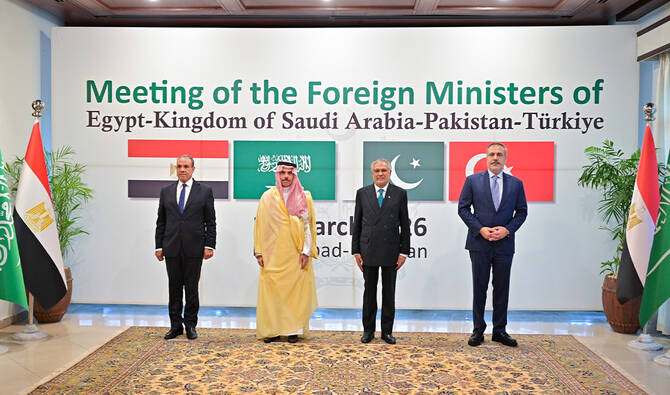

ISLAMABAD: Saudi Arabia and Pakistan have stressed the need for a dialogue to de-escalate tensions in the Middle East, the Pakistani foreign office said on Sunday, as Islamabad hosted quadrilateral talks with regional powers to help end the United States-Israeli war on Iran.
The foreign ministers of Saudi Arabia, Egypt and Türkiye arrived in Islamabad over the weekend for the talks as the US and Israeli war on Iran, which began last month, continues to drag on.
In response to US-Israeli attacks, Tehran has been conducting strikes against Israel and US interests in the Gulf region as well as energy and civilian infrastructure in several Gulf countries.
Ahead of the quadrilateral meeting, Pakistani Foreign Minister Ishaq Dar held detailed discussions on the evolving regional and international developments with his Saudi counterpart, according to the Pakistani foreign office.
“They underscored the importance of dialogue, diplomacy, and collective efforts to promote peace, security and stability in the region,” the foreign office in Islamabad said.
“The two sides agreed to continue working together at bilateral and multilateral levels to further strengthen cooperation and contribute to regional peace and prosperity.”
Pakistan has served as a go-between for messages passed between Iranian and US officials as the conflict drags on, severely disrupting oil and cargo supplies through the Strait of Hormuz as well as regional air corridors.
“The Consultations among the Foreign Ministers of Pakistan, Saudi Arabia, Türkiye, and Egypt have commenced in Islamabad,” the Pakistani foreign office said shortly afterwards on Sunday evening.
“The Foreign Ministers during the consultations will review the evolving regional situation and discuss issues of mutual interest.”
Earlier, Dar also held separate meetings with the foreign minister of Egypt, Dr. Badr Abdelatty, and Türkiye’s Fidan. The discussions revolved around regional developments, including the situation in Iran. The Pakistani foreign office said all three sides stressed the importance of dialogue to promote peace and stability.
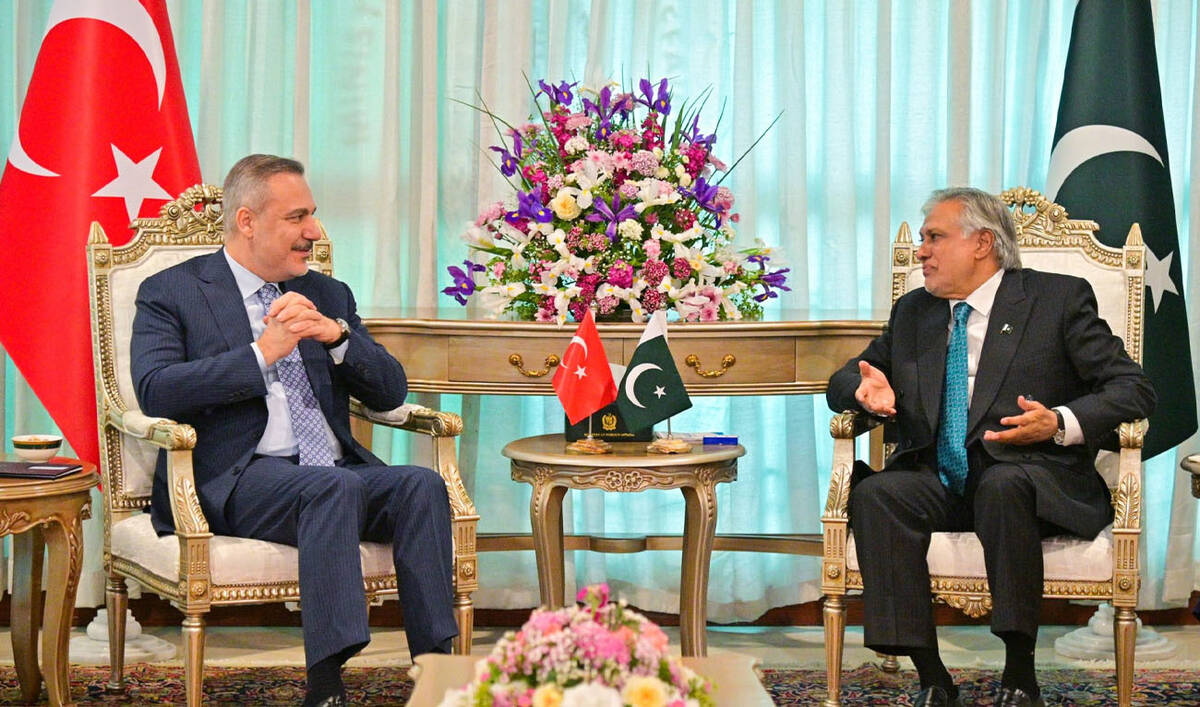
Pakistani Foreign Minister Ishaq Dar (right) meets Turkish Foreign Minister Hakan Fidan in Islamabad, Pakistan, on March 29, 2026. (@ForeignOfficePk/X)
While Tehran has refused to admit to holding official talks with Washington, Iran has passed a response to US President Donald Trump’s 15-point plan to end the war via Islamabad, according to an anonymous source cited by the Iranian Tasnim press agency.
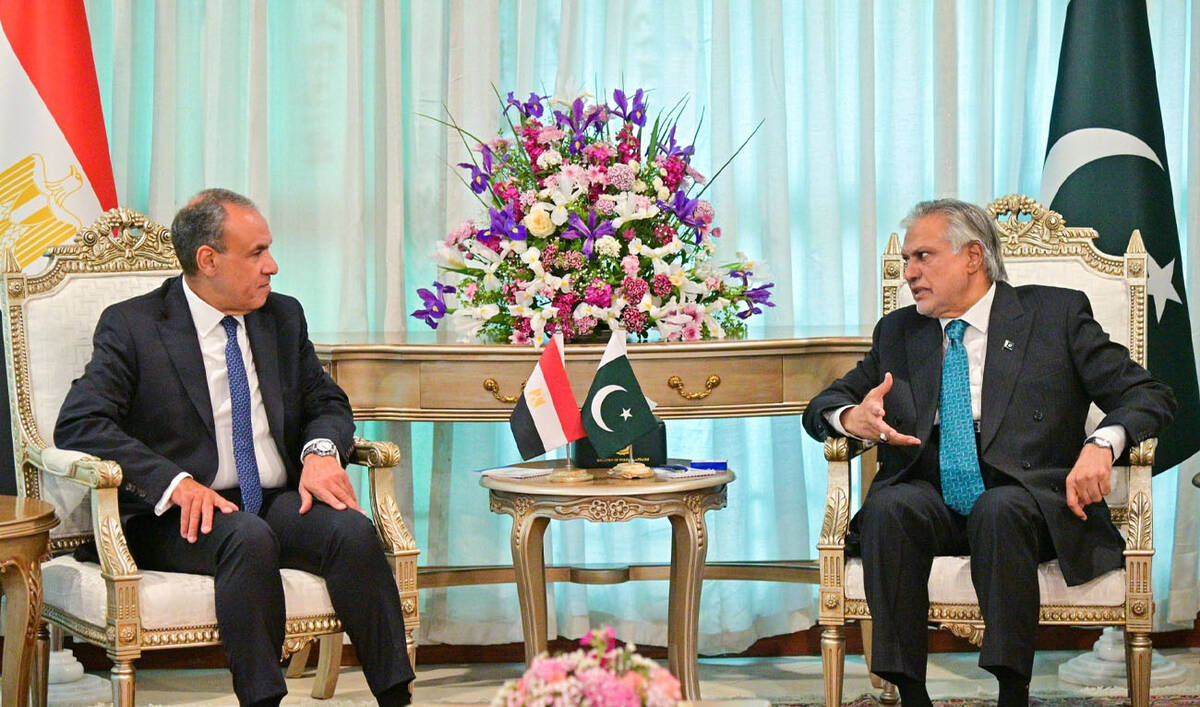
Pakistani Foreign Minister Ishaq Dar (right) meets Egyptian Foreign Minister Badr Abdelatty in Islamabad, Pakistan, on March 29, 2026. (@ForeignOfficePk/X)
‘CRUCIAL MEETING’
Former diplomats and foreign affairs analysts have termed the Islamabad meeting an important attempt by Pakistan to de-escalate regional tensions.
Abdul Basit, Pakistan’s former high commissioner to India and ex-ambassador of the country to Germany, described it as a “crucial meeting.”
“This is a crucial meeting between Pakistan, Saudi Arabia, Egypt, and Türkiye to discuss regional developments,” he told Arab News on Saturday.
He noted that if successful, the talks could force both warring sides to come to the negotiating table and contribute to lasting peace in the region.
Michael Kugelman, a Washington-based South Asia analyst, said the meeting highlights Pakistan’s efforts to stay at the forefront of the “conflict de-escalation diplomacy.”
“It’s also a reflection of the middle power agency, with a range of key regional players coordinating on a strategy to increase the chances of a formal US-Iran mediation taking shape,” he said.
Pakistan’s Dar also spoke to Iranian FM Seyed Abbas Araghchi to discuss the evolving regional situation, Pakistan’s foreign office said on Sunday.
Dar stressed the need for de-escalation, it said, underscoring the importance of an end to all attacks and hostilities.
Prime Minister Shehbaz Sharif also spoke to Iranian President Masoud Pezeshkian on Saturday via telephone, Sharif’s office said.
He condemned Israel’s strikes against Iran and informed Pezeshkian of Pakistan’s ongoing diplomatic outreach, Sharif said in a post on X after the phone call.


