

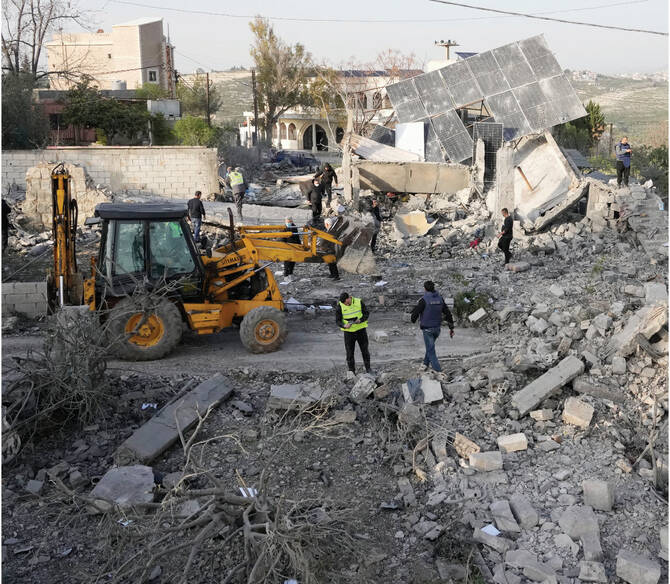
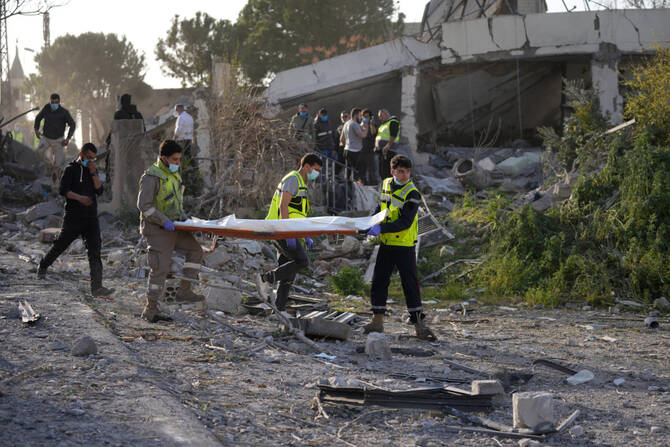

BEIRUT/LONDON: Decades after Israel’s 18-year occupation of southern Lebanon, from which the nation never fully recovered, Lebanese families have once again found themselves uprooted by Israeli evacuation orders, bombings, and creeping ground operations.
Fears of a new occupation have grown since March 22, when Israeli forces struck the Qasmiyeh Bridge, a vital roadway linking the south to the rest of the country.
Lebanon’s President Joseph Aoun called the escalation a “prelude to ground invasion” and an “attempt to sever the geographical connection between the southern Litani region and the rest of Lebanese territory.”
He warned of “suspicious schemes to establish a buffer zone along the Israeli border, solidify the reality of the occupation, and seek Israeli expansion within Lebanese territory.”

On March 24, Danny Danon, Israel’s permanent representative to the UN, denied that his government intends to annex parts of Lebanon. “We have no interest in being there,” he said.
“Our goal is to make peace with Lebanon, but for that to happen, the Lebanese government must take control of the region, push Hezbollah south of the Litani, and respect Resolution 1701.”
However, other Israeli officials have been clearer about their ambitions.
Chief of the General Staff Eyal Zamir said: “We are now preparing to advance the targeted ground operations and strikes according to an organized plan.”
Finance Minister Bezalel Smotrich told an Israeli radio program that the campaign “needs to end with a different reality entirely.
“The new Israeli border must be the Litani,” Smotrich said.

Caption
Defense Minister Israel Katz announced that Israel had destroyed five bridges over the Litani River and would “control the remaining bridges and the security zone up to the Litani.”
Prime Minister Benjamin Netanyahu said Israel was “expanding this security strip to keep the threat of anti-tank weapons away from our towns and our territory.
“We are simply creating a larger buffer zone,” Netanyahu added.
For many Lebanese, that language carries an ominous echo. The buffer zone, they fear, imposes a new reality in which Israel scorches, depopulates and occupies swaths of their territory as it pursues its long-standing goal of neutralizing the threat of Hezbollah.
Tarek Mazraani, head of the Association of the Residents of Border Villages, said Israel’s buffer zone “has become a fait accompli as a result of the systematic destruction carried out by Israel during the last war, which it continued and intensified during the current one.”

Israeli military vehicles in a location given as southern Lebanon, amid escalation between Hezbollah and Israel. (Israeli Military/Handout via REUTERS)
He told Arab News that returning to these villages “has become extremely complicated,” compounded by dwindling aid. “They are increasingly left to fend for themselves as time passes and enthusiasm wanes,” he said.
The current round of fighting escalated on March 2 when Hezbollah launched rockets and drones into Israel in retaliation for Israeli-US strikes on Iran on Feb. 28. Since then, the Israeli military has struck Beirut, the Bekaa Valley, the Baalbek-Hermel governorate, and the south.
Hezbollah has responded with an average of 150 rockets per day since March, according to the Israeli military, as cited by The Times of Israel.
President Aoun has called for direct negotiations with Israel, but the proposal has so far gone unanswered.

Calls for direct negotiations by President Aoun has so far gone unanswered by Israel. (Reuters file photo)
Earlier this month, he criticized Hezbollah for giving “no weight to Lebanon’s interests or to the lives of its people.”
Hezbollah chief Naim Qassem rejected the overture, saying on March 25 that “when negotiations with the Israeli enemy are proposed under fire, this is an imposition of surrender.”
Lebanese political adviser Nadim Shehadi believes Hezbollah “should not be part of the negotiations,” arguing that talks must be “between the two states, with the aim of replacing the armistice agreement of 1949, which was abrogated by Israel after the 1967 war.”
Meanwhile, the matter of the group’s disarmament “should remain an internal one between the state and the group,” he told Arab News.
The final outcome is “inevitably linked to that of the regional war and the future of other Islamic Revolutionary Guard Corps proxies.”
Since the latest outbreak of fighting, at least 1,000 people have been killed, 2,500 injured, and nearly a fifth of the population displaced, according to government figures. Entire residential blocks have been leveled and farmland scorched.

Tents are set at a temporary encampment for displaced people in Beirut, Lebanon, following an escalation between Hezbollah and Israel. (Reuters)
Dr. Ali Faour, head of the Center for Population and Development, puts the displacement figure at 1.3 million people across southern Lebanon, the southern suburbs of Beirut and the Bekaa Valley.
Some 45,000 residential units have been partially or fully damaged or destroyed, he told Arab News, with more than 70 percent of infrastructure — water, electricity, telecommunications and roads — destroyed in some towns.
The destruction is not new, only more severe. Scorched-earth attacks on front-line villages that began during the 2024 war continued at a lower intensity despite a ceasefire that took effect in November of that year.

Destroyed buildings are pictured near a facility used by the United Nations Interim Force in Lebanon (UNIFIL) as seen from across the border in northern Israel on March 8, 2026. (AFP)
The ceasefire, UN bodies report, was repeatedly violated by Israel and, according to Israeli and some Western accounts, also breached by Hezbollah’s continued military posture.
The current offensive has accelerated that pattern into something that looks, to some, like a permanent project.
Whether the current incursions constitute a new occupation hinges on intent as much as duration, said Yeghia Tashjian, regional and international affairs coordinator at the Beirut-based Issam Fares Institute.
“So far, Israel is not just aiming to destroy Hezbollah’s infrastructure in the south but also destroy civil infrastructures, aiming to prevent the southerners from returning to their homes and raze villages to the ground to kill agricultural life,” Tashjian told Arab News.
Recent statements by Israeli officials, he added, “hint that Israel is aiming to expand its occupation and, in the future, turn the south into another Golan or even a West Bank.”

Peacekeepers of the United Nations Interim Force in Lebanon (UNIFIL) stand at a position formerly held by The Hezbollah in the Khraibeh Valley in el-Meri in south Lebanon on August 27, 2025. (AFP)
Faour, who has studied the border strip that Israel held from 1979 until its 2000 withdrawal, sees an unsettling continuity.
“It is as though history is repeating itself,” he said. “Israel, over decades and in every war on Lebanon, has used the protection of its north as a pretext for occupying the south.”
Today, he added, Israel “speaks of a buffer zone, and then a second zone to protect the first, meaning the occupation would extend to the Litani River, effectively annexing approximately 19 percent of Lebanon.”
The strip Israel is attempting to establish, he said, “stretches 80 km from Naqoura on the coast to the Shebaa Farms in the east, encompassing 57 villages and towns” — predominantly Shiite Muslim, with Christian, Druze and Sunni communities also among them.
What alarms him most are Hebrew-language maps now circulating that envisage Israeli control over five key sectors along the Lebanese border, including areas around Naqoura, Bint Jbeil, the Kafr Kila-Adaisseh axis, Maroun Al-Ras and Khiam.
“Today, they are attempting to apply the Gaza model to Lebanon,” Faour said.

sidents queue for food distribution organised by the Nabatieh emergency services in Nabatieh, Lebanon, amid escalating hostilities between Israel and Hezbollah. (REUTERS)
The displacement of over a million Lebanese carries its own long-term risks.
Faour warned that emergency camps for the displaced, “despite their immediate necessity, carry the risk of becoming a permanent reality that reshapes population geography and reproduces latent historical tensions.”
Lebanon’s history bears this out. Temporary shelters built during the 1970s and 1980s hardened into semi-permanent settlements, raising tensions that compounded the country’s security and political crises for decades.
That memory, he said, informs the deep resistance to establishing new camps — a refusal inseparable from the collective trauma of Palestinian refugee camps that, over time, became semi-autonomous enclaves and redrew Lebanon’s demographic and political map.
Those fears resonate among analysts tracking Israel’s posture.
Beirut-based policy expert Hussein Chokr argued that Israel, if it had the means, “would not hesitate” to occupy “not only southern Lebanon but all of Lebanon and Syria (as far as) Aleppo.”
What restrains it, he told Arab News, is the recognition that a ground incursion “entails extremely high military and political costs with largely unpredictable consequences.”
Israel’s 1982 invasion of Lebanon, codenamed Operation Peace for Galilee, aimed to expel the Palestine Liberation Organization and reshape Lebanese politics in Israel’s favor.

The LAU (Lebanese American University) medical center physicians examine patients at a school turned into a shelter for displaced families in Beirut, Lebanon, on March 25, 2026, amid escalating hostilities between Israel and Hezbollah. (REUTERS)
Israeli forces, allied with Lebanese militias, pushed all the way to Beirut, besieging the capital and causing heavy civilian casualties before the PLO evacuated under international arrangements.
Israel then held southern Lebanon through a “security zone” propped up by the South Lebanon Army until 2000, when persistent guerrilla resistance finally wore the occupation down.
That resistance was not incidental to the invasion — it was its direct product. Hezbollah was born from the 1982 occupation.
David Wood, a senior Lebanon analyst at the International Crisis Group, doubts Israel is “planning to do what it did in 1982, which is to invade all the way up to Beirut.”
Israeli leaders, he told Arab News, likely “view the occupation in Lebanon more generally during the civil war and after it as a kind of Vietnam experience — Lebanon became a quagmire.”
A sprawling ground invasion “would be an incredibly dangerous decision,” he said.

Palestinian leader Yasser Arafat walks with his supporters in Beirut during the early days of the 1982 Israeli invasion of Lebanon. (AFP file photo)
“If Israel pursues a long-term occupation of Lebanese territory, it will first and foremost further devastate Lebanon, which is already in an incredibly dire situation.
“It will also run a very serious risk of creating new security threats for Israel going forward. This is precisely what happened between 1982 and 2000 — Hezbollah itself was established as a direct reaction to Israel’s occupation of the south.”
Yet analysts suggest Israel might not be merely pursuing a military objective but manufacturing leverage by occupying land to strengthen its hand in eventual negotiations — a strategy that echoes the shadow diplomacy of the 1982 invasion and the ultimately doomed May 17 Agreement of 1983.
“Whether Israel intends to repeat the 1982 scenario is questionable,” said Tashjian. Israel, he added, is likely expanding operations “to pressure the Lebanese government in future possible negotiations.”
 During the 1982-2000 occupation, Lebanon was in the midst of civil war, and the areas Israel was occupying were inhabited.
“This time, most of the villages have been emptied, which makes it easier for Hezbollah or any armed group to fight Israel and engage it in a war of attrition — something which will be costly for Israel,” Tashjian added.
Chokr pointed to a divergence between Israel’s political and military leadership.
The political leadership, he said, continues to speak of “decisively resolving” the Lebanese front, while the military appears to favor more limited objectives, such as establishing an 8–10-km buffer zone and securing northern settlements.
Since the 2006 conflict, he added, Israel has adopted “a pattern of setting operational military objectives that allow it to generate a perception of victory, while often pursuing broader strategic goals that are, in many cases, more about shaping perception and deterrence narratives than achieving definitive realities on the ground.”
For Wood, as in 1982, Israel “doesn’t have a clear end game in Lebanon, or at least it hasn’t articulated it publicly.”

An Israeli missile is pictured before hitting a building in Beirut's southern Shiyah neighborhood on November 22, 2024, amid the ongoing war between Israel and Hezbollah. (AFP)
Whether it intends to seize territory south of the Litani as a “bargaining chip” or make good on threats to remain until Hezbollah disarms, remains publicly unclear, he said.
Heiko Wimmen, who oversees the Iraq, Syria, and Lebanon project at the International Crisis Group, said Israel’s primary goal of removing the Hezbollah threat “once and for all” seems difficult without a Lebanese government “willing and empowered to actually impose itself.
“That scenario appears unlikely, at least as long as Hezbollah’s foreign backer, the Iranian regime, is still standing,” Wimmen told Arab News.
The fallback, he said, would be “a security zone that mitigates the rocket and drone threat, and perpetual strikes to disrupt the build-up of Hezbollah capacities.”


