
RIYADH: Propelled by the goals of Vision 2030, Saudi Arabia is pioneering a new global standard for inclusivity in the digital age.
Through government mandates and private sector initiatives, the Kingdom is equipping women to stand at the forefront of its artificial intelligence renaissance.
“Saudi Arabia now leads the world in the female-to-male ratio for AI training, a testament to the Kingdom’s commitment to advancing women in the field,” Areeb Alowisheq, vice president of AI research at Humain, told Arab News.
“This momentum, I believe, will extend well beyond training into broader innovation. It is precisely this approach that sets the Kingdom apart, and one the rest of the world would do well to study,” she said.

Areeb Alowisheq, vice president of AI research at Humain. (Supplied)
Alowisheq, who has more than 20 years experience in the sector and is leading efforts to develop Arabic-first AI models, underlined that Saudi Arabia’s support this area did not happen overnight.
It is the result of deliberate, decades-long investment in education and what she described as an economic “turning point in 2016.”
The vice president added: “The foundation was built through scholarships. Saudi Arabia has long funded over 100,000 both men and women to pursue higher education abroad through programs like the Custodian of the Two Holy Mosques Scholarship Programs.”
Since its inception in 2005, the King Abdullah Scholarship Program alone has funded more than 250,000 Saudi citizens to study abroad.
“Domestically, Princess Nourah Bint Abdulrahman University, the largest women’s university in the world, has been producing female graduates in STEM, medicine and engineering for decades. By 2017, female university graduates in Saudi Arabia actually outnumbered male graduates,” she explained.

Front view of the Riyadh's Princess Nourah Bint Abdulrahman University, the largest women’s university in the world. (Supplied)
Alowisheq completed her bachelor’s degree in computer applications at King Saud University before earning her master’s degree.
Her graduate work centered on networking and the Internet, specifically focusing on a distributed system designed to locate individuals in large crowds, such as Hajj pilgrims.
“The College of Computer and Information Sciences had five different programs, and one of them was only accessible to women. I actually did a comparison of all five programs in my first year and wrote a letter to the department head laying out my concerns and suggestions. One of the things I flagged was: why isn’t artificial intelligence part of our curriculum?”
Opinion
This section contains relevant reference points, placed in (Opinion field)
She added: “That early frustration lit a fire in me to understand the field myself.”
Her journey evolved from advocating for change to becoming the catalyst for it — ultimately building the very AI infrastructure that powers Saudi Arabia today.
Alowisheq highlighted that the “real turning point for women entering the workforce came in 2016 with Vision 2030.”
She said: “Crown Prince Mohammed bin Salman launched the plan, recognizing that over 50 percent of Saudi women held university degrees yet remained largely outside the workforce, a massive untapped economic resource.”

Alowisheq added: “The vision set a concrete target to raise female workforce participation from 22 percent to 30 percent. To remove structural barriers, the government lifted the driving ban in 2017, introduced anti-harassment laws in workplaces, and amended the Civil Status Law to allow women to act as heads of households, manage businesses and travel independently.”
She stated that the result “exceeded expectations” and female participation surpassed 36 percent by 2025, ahead of schedule.
Alowisheq said: “In Humain, where I am working now, every day I’m surrounded by capable, enabled women leaders working shoulder to shoulder with our outstanding colleagues, both men and women. Nothing is watered down, expectations are the same, and opportunities exist for all.”
In a strategic push to bridge the gender divide in STEM, Saudi Arabia is advancing initiatives that empower women in science, fulfilling both the Kingdom’s national vision and the UN Sustainable Development Goals.

Saudi Arabia is the first Arab nation to join the Global Partnership on AI (GPAI) and hosts the UNESCO-sponsored International Center for Artificial Intelligence Research and Ethics (ICAIRE) in Riyadh. (SPA)
Investment in the sector has grown significantly, with government spending on emerging technologies rising by more than 56 percent in 2024 and AI companies securing $9.1 billion in funding.
Saudi Arabia is also expanding its presence in the global AI landscape, becoming the first Arab nation to join the Global Partnership on AI and hosting the UNESCO-sponsored International Center for Artificial Intelligence Research and Ethics in Riyadh.
In 2022, the Saudi Data and AI Authority and Google Cloud launched the Elevate Initiative, a collaboration designed to bridge the gender gap in the global technology sector.

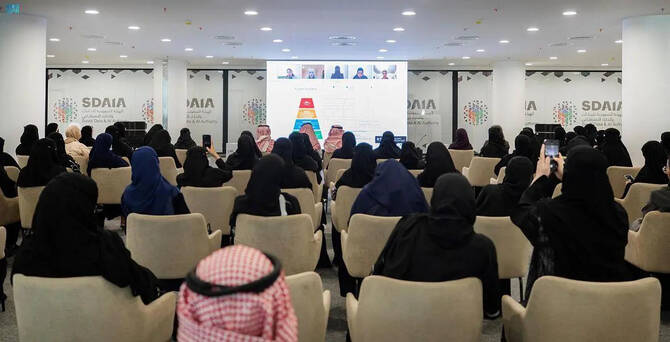
Several Saudi universities took part in the third Global AI Summit organized by the Saudi Data and Artificial Intelligence Authority (SDAIA) in 2024. (SPA)
The five-year program aims to empower more than 25,000 women in emerging markets by providing specialized training in artificial intelligence and machine learning.
Setting a new global standard, Saudi Arabia saw more than 666,000 women receive training in data and AI in just one year, positioning the Kingdom first globally in women’s AI empowerment, according to the 2025 AI Index by Stanford University.
Alowisheq said that having 666,000 women trained “creates the mass adoption layer that any functioning AI economy needs: informed consumers, capable operators, and a generation that normalizes AI fluency.”
Globally, the AI sector faces a major diversity crisis. UNESCO and UN Women report that women hold only one in five professional roles in the field — about 22 percent — a benchmark Saudi Arabia is working to surpass through Vision 2030 initiatives.
“Saudi Arabia’s trajectory in this space is one of the fastest transformations globally, built on a clear conviction that economic growth and women’s empowerment are the same goal. By building a strong foundation of a capable workforce and removing barriers to entry, Saudi Arabia has supported women in proving they can excel in the many diverse career paths AI offers,” she noted.