

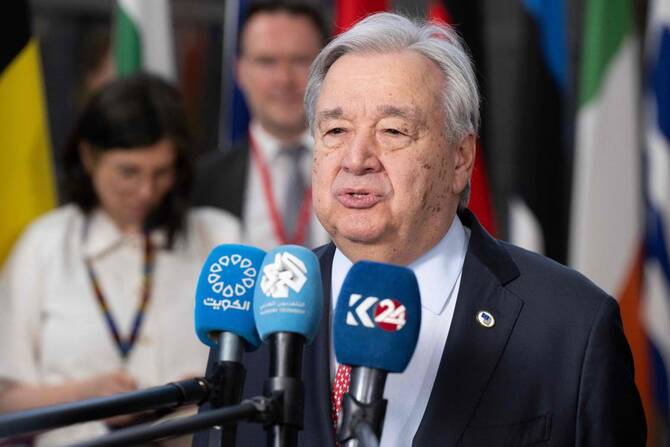

BRUSSELS: UN chief Antonio Guterres called on the US and Israel on Thursday to end their war with Iran before it spirals “out of control,” warning of “potential tragic consequences” for civilians as well as the global economy.
“To the United States and to Israel: it’s high time to end this war that is risking getting completely out of control,” Guterres told reporters at an EU summit in Brussels.
“To Iran, stop attacking your neighbors. They were never parties to the conflict,” he said.
FASTFACT
EU foreign policy chief Kaja Kallas said there was ‘no appetite’ among leaders to expand a European naval force in the Red Sea to help secure the Strait of Hormuz or otherwise join the fray.
European leaders doubled down on Thursday, refusing to join military campaigns in the Middle East as they met in Brussels to grapple with rising oil and gas prices caused by the war.
“We are very worried about the energy crisis,” said Belgian Prime Minister Bart De Wever ahead of the summit. He said that energy prices were too high before the war, but that the conflict “created another spike.”
“If that becomes structural, we’re in deep trouble,” he said.
The summit was initially expected to center on overcoming Hungary’s opposition to a massive loan for Ukraine, but the conflicts in Iran and Lebanon reset the agenda.
European leaders have been deeply critical of the Iranian government, but none have offered immediate help to the US. Britain is flat-out refusing to be drawn into the war. France says the fighting would have to die down first.
Austrian Chancellor Christian Stocker said that Europe “will not allow itself to be blackmailed” into joining the US and Israel military campaign in the Middle East.
“Europe — and Austria as well — will not allow itself to be blackmailed,” he said ahead of the European Council summit of the leaders of the 27 EU nations.
“Intervention in the Strait of Hormuz is not an option for Austria anyway.”
EU foreign policy chief Kaja Kallas said there was “no appetite” among leaders to expand a European naval force in the Red Sea to help secure the Strait of Hormuz or otherwise join the fray.
Four of the EU’s largest economies signaled a willingness on Thursday to contribute to “appropriate efforts” to ensure ships can pass safely through the Strait of Hormuz.
France, Germany, Italy, and the Netherlands, alongside the UK and Japan, issued a joint statement welcoming “the commitment of nations who are engaging in preparatory planning” for securing the key oil route, and demanding Iran “cease immediately” its drone and missile attacks and other attempts at blocking it.
Looking ahead to the war’s end Chancellor Friedrich Merz said the war must end before his country can help with matters such as keeping shipping lanes clear.
“We can and will commit ourselves only when the weapons fall silent,” he said of potential German military support to secure shipping lanes in the Strait of Hormuz.
“We can then do a great deal, up to opening sea lanes and keeping them clear, but we’re not doing it during ongoing combat operations.”
He said that would require an international mandate, among other complicated steps, “before we can even consider such an issue.”
While the EU is not a party to the conflict, Dutch Prime Minister Rob Jetten said he understood the US and Israeli reasons for launching the campaign against the “brutal” Iranian government.
He called for the EU to increase both sanctions on Iran and support for Iranian opposition groups.
But others blasted the war as “illegal” and destabilizing.
“We are against this war because it is illegal,” Spanish Prime Minister Pedro Sanchez said:
“It’s causing a lot of damage to civilians, of course, refugees, and the economic consequences that the whole world, especially the global south, is already suffering.”


