
ALULA: Co-curated by Candida Pestana from the Royal Commission for AlUla and Anna Hiddleston from Centre Pompidou, Paris, “Arduna” brings together more than 80 artworks from the Kingdom and beyond in the otherworldly setting of AlUla.
The exhibition was supported by curators Ftoon Al-Thaedi from RCU and Noemie Fillon from Centre Pompidou, with additional support from AFALULA (French Agency for AlUla development).
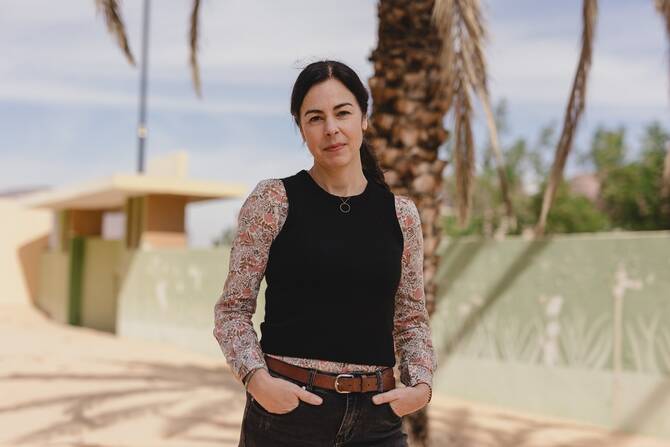
Hiddleston, curator of international projects at the Musee National d’Art Moderne, Centre Pompidou, spoke to Arab News about the activation.

David Hockney's 'The Arrival of Spring in Woodgate, East Yorkshire in 2011' at 'Arduna.' (Centre Pompidou)
“Working in AlUla was fundamental to the conception of ‘Arduna: Our Land.’ The site itself is not simply a backdrop, but a historical and symbolic framework that shaped both the exhibition’s structure and its thematic trajectory,” she told Arab News.
“For centuries, AlUla has been a place of passage, refuge and contemplation, qualities that deeply informed our exploration of the garden and the oasis as both physical and metaphorical spaces,” she added.
The collaborative curatorial vision was attentive and attuned to the cultural, historical and spiritual dimensions of the ancient landscape, all while being mindful of similar environments around the globe that have much in common with AlUla.
“We sought to create a narrative that felt both universal and deeply rooted in place,” she said.

Pablo Picasso's 'Le Printemps' at 'Arduna.' (Centre Pompidou)
For example, Picasso’s “Spring” could be perceived as a peculiar work within his oeuvre, as it departs from his more emblematic Cubist language and well-known themes.
Yet its depiction of a goat in a rural, pastoral setting “resonated powerfully with AlUla’s agricultural and farming history,” Hiddleston said, creating an unexpected but meaningful connection between a modern European masterpiece and the traditional Saudi sensibility.
The space welcomes locals to see their own landscape reflected, not merely through detached historical narratives, but through contemporary artistic practices, fostering a lively dialogue between global perspectives and lived experience.
“Bringing together the Centre Pompidou and RCU collections offered a unique opportunity to create a dialogue between international modern and contemporary art and the rich artistic production of the MENA region,” she said.
One of the key challenges was to avoid presenting collections in hierarchical terms.
“We sought to construct a fluid narrative in which works from both collections could speak to one another across geographies, time periods, and artistic languages,” she said.
The RCU collection brought critical regional perspectives that grounded the exhibition, rooted in AlUla’s cultural and geopolitical context, while works from the Centre Pompidou provided historical depth and an art-historical framework.
“More importantly, the exhibition reveals how artists across cultures and geographies are bound by shared human experiences and a deep, universal need for connection with the natural world,” she concluded. --