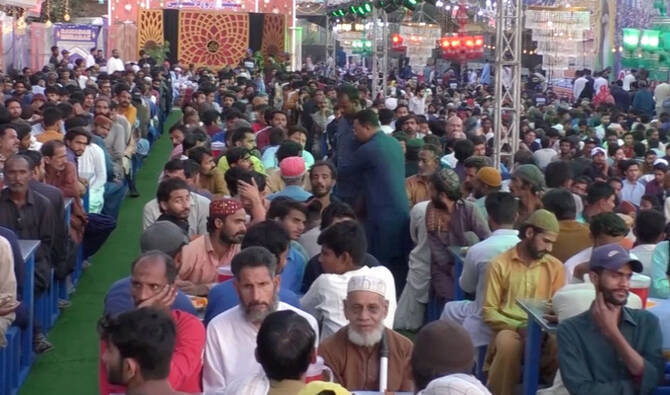

KARACHI: With the call for evening prayers, hundreds of Pakistanis enjoyed free meals provided by local charities for their iftar, the fast-breaking meal during Ramadan in Pakistan’s biggest city, Karachi.
For many years, street iftar meals have been a Ramadan tradition in the city, with temporary roadside tables and mats set up by charity workers. The practice is also common in other big cities.
But soaring staple food and fuel prices are drawing larger crowds this year following the Iran war, organizers said. They, along with workers and volunteers, provided iftar food for travelers and the poor.
Pakistan raised petrol prices by 55 rupees ($0.20) to more than 320 rupees ($1.15) per liter last week, passing on surging global oil prices to consumers as tensions threaten supplies through the Strait of Hormuz.
“Petrol prices have increased, and you know that when petrol prices go up, everything else becomes more expensive,” philanthropist, social worker and head of Chhipa foundation Muhammad Ramzan Chhipa told Reuters.
“After that, we’ve seen a huge crowd, a huge rush at the Chhipa sehri and iftar tables,” he said, referring to the pre-dawn and sunset meals during Ramadan. He did not elaborate on numbers.
The central bank said Monday (March 9) that rising global energy prices linked to the Middle East war had increased uncertainty around the inflation outlook.
“Look at the inflation. If you go outside now, you will have to pay at least 1,000 to 1,500 rupees ($3.60 to $5.40) for iftar for two people. Because of the inflation, we come here to have iftar,” said Zain Rabbani, a 44-year-old textile factory worker, while breaking fast with his family.
The free iftar initiatives are usually funded by charities, as volunteers aim to achieve the Muslim blessing and reward of offering iftar to fasting people.
Donors usually offer money and food products to volunteers who set up the food stalls one hour before Maghrib prayers to prepare the meals.
The free meals are not just for those who cannot afford them, but also for those who are working and cannot make it home in time to eat with their families.
Mohammad Naseem, a 41-year-old traveler who works as a mechanic, said it was a great facility for those who cannot make it home in time.
“I was on my way home. I live in Qur’angi (referring to an area on the outskirts of Karachi). I saw this place and it seemed suitable and nice, so I sat here for iftar.”
Ramadan, also known as “Sawm,” is one of the five pillars of Islam and requires that individuals abstain from eating, drinking, smoking and sexual intercourse from dawn to dusk.
Pakistan is a predominantly Muslim country where more than 90 percent of its 240 million people practice Islam.