

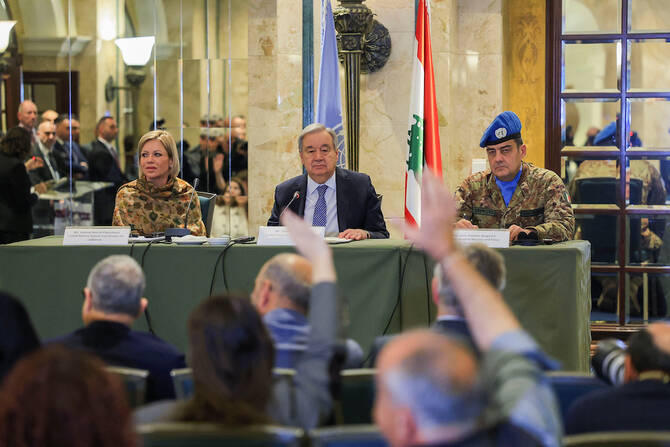

BEIRUT: UN Secretary-General Antonio Guterres acknowledged on Saturday that the UN Security Council lacks the effectiveness needed to halt major conflicts, warning that the situation is unlikely to improve in the near future.
Speaking at a press conference in Beirut at the end of his visit to Lebanon, Guterres told Arab News that the Security Council “has a problem of legitimacy and efficiency because of the vetoes.
“We have witnessed that, time and time again, when we have situations of conflict and when it is necessary to stop the conflict, there is a veto (that) emerges that does not allow the Security Council to act.”
He added: “Unfortunately, this will not change in the short term.”
Guterres said that the council does not represent the world as it exists today, but instead is stuck representing the world after 1945.
The UN chief’s remarks come as Lebanon faces a deepening humanitarian crisis following escalating hostilities between Hezbollah and Israel, which have triggered heavy Israeli airstrikes, mass displacement, and fears of a broader regional war.
“The Lebanese people did not choose this war. They were dragged into it,” he said, referring to Hezbollah’s attacks against Israel in response to the killing of Iran’s Supreme Leader Ayatollah Ali Khamenei in US-Israeli strikes on Feb. 28.
The UN chief said diplomatic channels remained open to end the war and stressed that international mediation is essential to prevent further escalation.
“There is no military solution; only diplomacy, dialogue and full implementation of the UN Charter and Security Council resolutions. The diplomatic avenues are available, including through my special coordinator for Lebanon ... and through key member states,” he said.
During his visit, Guterres held meetings with Lebanese political leaders as part of efforts to push for an immediate de-escalation.
“We are doing everything we can now to bring about an immediate de-escalation and cessation of hostilities. My special coordinator is engaging with all actors around the clock to bring the parties to the table,” he said.
Guterres also confirmed that UNIFIL peacekeepers remain deployed along the Lebanese-Israeli border despite rising tensions.
However, he said attacks against peacekeepers and positions were “completely unacceptable and they must stop. They are in breach of international law and may constitute war crimes.”
Three peacekeepers serving with the Ghanaian contingent were wounded earlier this month in southern Lebanon.
Guterres arrived in Beirut on Friday for what he called a “solidarity” visit, and launched a $325 million humanitarian appeal to support Lebanon as it responds to the displacement crisis.
He urged the international community to support the Lebanese government, which last year committed to disarming Hezbollah.
“My message to the international community is simply step up your engagement, empower the Lebanese state and support the Lebanese Armed Forces to secure the capabilities and resources they need. Respond generously to the humanitarian appeal,” he said.
“I was deeply saddened by the testimonies I heard of displaced people that I visited in the reception shelter earlier today,” he added.
The UN chief referred to Lebanon’s internal political decisions aimed at strengthening state authority over weapons, a central issue in the country’s ongoing security debate.
He stressed that UN Resolution 1701, adopted after the 2006 Israel-Hezbollah war, “cannot be brought to life by the Army alone. It requires a whole-of-government effort to address the entrenched reality of non-state arms — and to heal long-standing grievances and divisions.”
At the same time, he called on Israel to respect Lebanon’s sovereignty.
“It is imperative that Israel respects the sovereignty and territorial integrity of Lebanon. This war must stop,” he said.


