

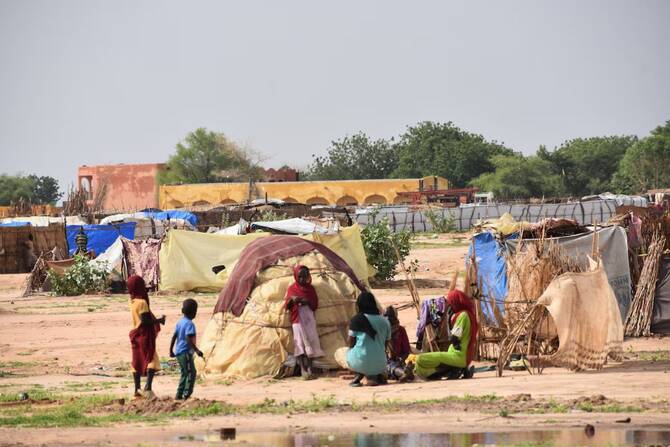
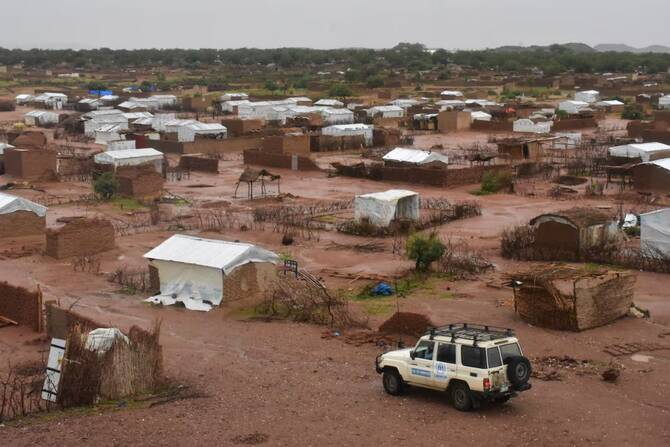
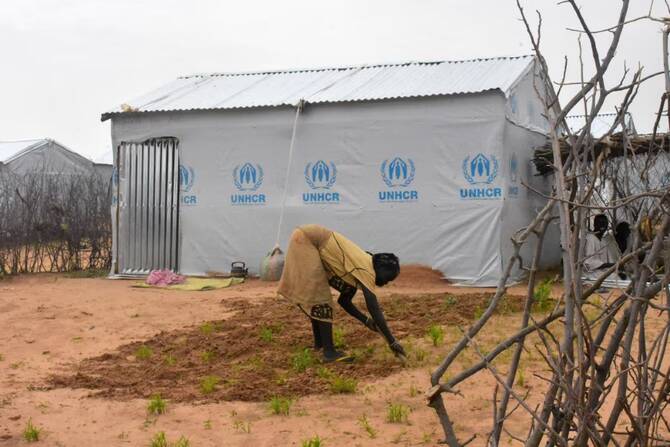

ADRE, CHAD: At the Adre border crossing between Chad and Sudan, the desert heat settles over rows of tarpaulin shelters and weary travelers wait in an atmosphere of uncertainty.
Women sit beneath sparse acacia trees, shielding infants from the sun with scraps of cloth. For those fleeing Sudan’s war, the crossing into Chad has been one of the few remaining routes to safety. Now even that fragile escape is closing.
On Feb. 23, 2026, Chad shut its 1,300-km eastern border with Sudan after deadly clashes spilled across the frontier. Fighters from the Rapid Support Forces launched drone strikes and ground attacks that killed five Chadian soldiers and three civilians, prompting authorities in Chad to seal the border “until further notice.”
Officials framed the decision as a defensive necessity, aimed at protecting both citizens and refugees, yet for hundreds of thousands who have already sought refuge from Sudan’s nearly three-year war, the closure has intensified an already severe humanitarian crisis.
Fleeing Sudanese have few safe options. Many who remain trapped in RSF-controlled Darfur face famine and violence, while others risk longer, more dangerous desert routes via remote paths, paying smugglers for clandestine crossings that expose them to extortion, sexual violence, or death.
Some attempt diversion to South Sudan, Egypt, or Libya, involving even harsher journeys, or enduring internal displacement in overcrowded, insecure areas of Sudan.
For Maab L., a 35-year-old mother of six who fled Darfur in late 2023, the border once represented the thin line between survival and catastrophe.
“We lost our previous life: house, relatives and peace,” she said quietly inside the Farchana refugee settlement. “Many were killed. Others are still missing.”
Chad has become one of the primary shock absorbers of Sudan’s war. The country already hosts refugees from conflicts across the Sahel and the Central African Republic, while its military plays a central role in regional counterinsurgency efforts.
Analysts warn that sustained instability along the Sudan border could stretch Chad’s fragile resources and risk destabilizing one of the few remaining security anchors in the Sahel.
Across eastern Chad, vast refugee settlements stretch across dusty plains where humanitarian agencies struggle to keep pace with the influx. Clinics report rising cases of severe malnutrition, with aid workers estimating that roughly one in five young children arriving from Sudan shows signs of acute hunger.
Many of the new arrivals describe violence that forced them to flee with almost nothing.
Abkar N., a mother who crossed into Chad last year, recalls armed men storming their village. “They raped women in front of us,” she said. “We were beaten before we escaped.”
Since the war erupted in April 2023 between the Sudanese Armed Forces and the RSF, more than 765,000 Sudanese refugees have entered Chad, pushing the country’s total refugee population to roughly 1.5 million.
Most arrivals were women and children, many of whom are deeply traumatized.
Mohamed Adam, another refugee, lost his children during the journey. “They killed my young children when we tried to flee,” he said quietly.
At the Adre reception center, testimonies like these pour out daily. Some refugees arrive after month-long journeys through contested territory. Others cross after surviving sieges in towns where food supplies have collapsed.
Civilians displaced from conflict zones describe days without food, surviving on leaves or small amounts of grain when available. For many, reaching Chad was the only realistic hope.
The border closure now threatens to trap others inside Sudan’s most volatile regions. Humanitarian groups warned that thousands attempting to escape violence may become stranded if access routes remain blocked.
“As violence continues in Sudan, the closure of the border with Chad is extremely concerning for families searching for safety,” said Zeleke Bacha of the International Rescue Committee. “For many people, crossing into Chad has been a lifeline.”
Even for those who have already reached safety, conditions remain fragile.
Host communities in eastern Chad — home to nearly 2 million residents living with chronic poverty, drought and limited infrastructure — are struggling to absorb the influx. Water points are overcrowded, firewood has become scarce, and competition over land and resources is rising.
The arrival of aid organizations has brought clinics, schools and food programs, but tensions sometimes simmer between refugees and local residents who face the same shortages.
Aid funding is also falling far short of needs. Humanitarian appeals for Sudan’s refugee crisis remain heavily underfunded, leaving agencies to stretch limited resources across growing populations.
At the same time, security along the frontier remains volatile despite the closure. Days after Chad sealed the border, rockets fired from Sudan struck border areas, underscoring how easily the conflict can spill across the desert frontier.
The reality is that the border has never been fully controlled.
Stretching across vast desert terrain and long-established pastoral routes, the Sudan-Chad border has historically been crossed by traders, nomadic communities and armed groups alike. Informal tracks vastly outnumber official crossing points.
Closing formal border gates may slow civilian movement, but it does little to stop fighters or smugglers navigating remote desert corridors. For civilians fleeing war, however, the consequences are immediate. The escape routes narrow, while the dangers grow.
Each new military advance brings headlines, displacement and hunger, with more families searching for safety across a border that is becoming harder to cross.
Nearly three years into Sudan’s war, more than 13 million people have been displaced, causing what the UN labeled the world’s worst humanitarian crisis. Entire communities across Darfur and beyond have been destroyed, leaving survivors scattered across camps and host villages throughout the region.
Meanwhile diplomatic efforts to end Sudan’s conflict remain stalled, with the risk that the conflict spreads beyond Sudan growing day by day. During the early-2000s Darfur war, Janjaweed militias — precursors to the RSF — regularly crossed into Chad, destabilizing the frontier.
Recent incidents followed a similar pattern. Humanitarian organizations warn that without stronger de-escalation measures and humanitarian access, the fragile line between containing the war and drawing neighboring states into it may continue to erode.
At a time when global attention is absorbed by conflicts elsewhere, Sudan’s catastrophe has unfolded largely out of view. But conflicts rarely remain contained.
As violence multiplies across regions already strained by displacement, climate shocks and fragile governance, the risks of neglect grow. Along the Sudan–Chad border, where exhausted families still arrive seeking refuge, the consequences of a world overwhelmed by simultaneous crises are already visible.


