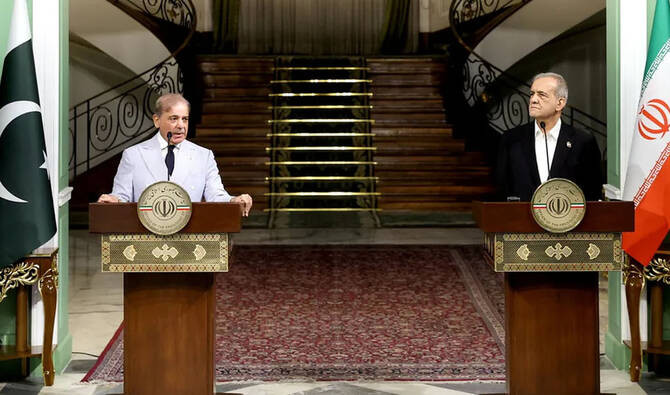

ISLAMABAD: Pakistan said on Tuesday it was willing to host talks between the United States and Iran after the world media widely reported that a US delegation was due in Islamabad to hold negotiations with Iranian officials to end the ongoing war in the Middle East.
US President Donald Trump, whose country launched a joint military campaign against Iran with Israel in late February, announced a five-day postponement of planned major strikes against Iranian power plants, citing “very good and productive” conversations with Tehran aimed at resolving the hostilities.
However, the claim of any conversation between the two countries was swiftly denied by Iranian officials.
“If the parties desire, Islamabad is always willing to host talks,” Tahir Andrabi, spokesperson for Pakistan’s foreign office told Arab News, responding to a query about the reported visit of a US delegation to the federal capital for talks with Iranian officials.
“It has consistently advocated for dialogue and diplomacy to promote peace and stability in the region,” he added.
Since the media reports of talks in Islamabad emerged this week, neither the US nor Pakistan has refuted that such negotiations are being considered to address the situation in the Middle East.
Arab News tried to reach out to the White House spokesperson and the US embassy in Islamabad through email for comment on the reported delegation, but there was no response until the filing of this report.
Pakistani and international media reports, citing diplomatic sources, indicate that Islamabad has been formally proposed as a neutral venue for face-to-face negotiations between the two countries.
According to a report by the Financial Times, Pakistan’s military chief, Field Marshal Syed Asim Munir, held a telephone conversation with President Trump on Sunday.
This was followed by Prime Minister Shehbaz Sharif’s conversation with Iranian President Masoud Pezeshkian on Monday.
During the call, Sharif underscored the “urgent need” for collective efforts to settle differences through diplomacy, particularly as the conflict begins to threaten regional energy and water security.
Pakistan’s The Express Tribune, quoting Axios, reported that “Islamabad is being considered for possible talks involving a US delegation,” while The Times of Israel cited Channel 12, quoting an unnamed Israeli official, stating that mediators are “trying to convene a meeting in Islamabad... as soon as later this week.”
While Washington maintains that back-channel discussions are proceeding in a “positive direction,” Tehran has officially dismissed these reports as “psychological warfare” intended to manipulate oil prices.
The war in Iran started on Feb. 28, when the US and Israel launched a series of coordinated strikes targeting Iranian nuclear sites and leadership. The conflict has since exacted a staggering human toll, with casualty figures in the hundreds and hundreds of thousands displaced.
Iran has fired a barrage of missiles and carried out drone attacks against Gulf countries such as Saudi Arabia, the United Arab Emirates, Oman, Kuwait, Bahrain and others.
Iran also threatened this week to attack energy and water systems in Gulf countries if the US follows through with its threat to hit Iranian power plants amid the ongoing war.
Washington said it would hit Iran’s power plants if Tehran does not fully open the Strait of Hormuz, a narrow channel between Iran and Oman linking the Gulf to the Gulf of Oman, which carries roughly one-fifth of the world’s oil and a quarter of seaborne liquefied natural gas exports.
The fighting has paralyzed global energy markets. With the strategic waterway effectively closed, Brent crude prices have surged toward $120 per barrel.
The International Energy Agency (IEA) has warned that the crisis represents a greater shock to the global economy than the 1970s oil embargoes.