

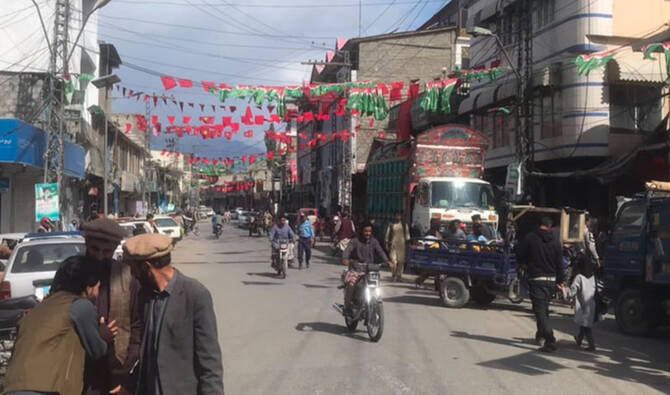

Skardu, Gilgit-Baltistan: At a busy road in the northern Skardu district, cars drive by with banners of various political parties plastered across them. Election symbols and party flags dot the landscape as Gilgit-Baltistan (GB) prepares for elections on June 7.
GB is a semi-autonomous region in northern Pakistan that borders China, Afghanistan and Indian-administered Kashmir. It is home to some of the world’s tallest peaks, including parts of the Karakoram mountain range, and is one of Pakistan’s most important regions for tourism, water resources and strategic connectivity.
Both India and Pakistan claim all of the Kashmir region since gaining independence 73 years ago, and have fought two wars over it. Both control parts of the territory, which is divided between them by a United Nations-mandated Line of Control (LoC). GB used to be a part of Jammu and Kashmir, but is administered by Pakistan since shortly after its independence in 1947.
On June 7, GB is set to hold elections after six years to elect 33 members to its legislative assembly. The assembly comprises 24 general seats, six reserved seats for women, and three reserved seats for technocrats and professionals.
Khawaja Khalid, a Skardu district resident, desperately hopes elected representatives resolve some of GB’s longstanding issues.
“There is an electricity problem, a water problem, an infrastructure problem,” Khalid told Arab News.
“So, we will support a person who knows how to solve these issues.”
For Sadiq Sadpara, another Skardu resident, GB’s roads are in dire need of repair.
“You can see the condition of the roads. All the roads are broken,” Sadpara said. “People have to face a lot of problems.”
He said there were plenty of “nice schools” in the region but they did not have any teachers.
“In addition, Skardu has become a major hub for tourism, but tourists and local people still face many challenges due to the lack of proper facilities and infrastructure,” he said.
ALL EYES ON GB
Political analyst Qaseem Naseem siad the upcoming GB election reflects both the region’s growing prominence and its unresolved political issues.
Although elections were also held in 2009, 2015 and 2020, Naseem said the political landscape in northern Pakistan had changed considerably.
“Skardu has developed significantly; it now has an international airport, and millions of tourists are visiting the region,” he noted. “As a result, the attention of the entire world is focused on Skardu.”
Mainstream political parties such as the Pakistan Peoples Party, the Pakistan Muslim League-Nawaz and the Pakistan Tehreek-e-Insaf have campaigned in GB for the upcoming polls.
“Unlike the past, when only a few major political leaders visited the region, today the central leadership of almost all major political and religious parties in Pakistan are actively campaigning here,” Naseem noted.
According to Naseem, the region’s constitutional status remains the most important issue for many voters.
“Even after 78 years, the people of the region are still deprived of full constitutional rights,” he said. “Therefore, people want to be integrated into the national mainstream and granted their constitutional rights.”
The analyst noted that despite the region’s growing tourism industry, many communities continue to face severe shortages of basic services.
“Despite being a major tourist destination, many areas face up to 22 hours of electricity load-shedding,” he said. “Although the region is known for its rivers, lakes, streams, and springs, there are still shortages of drinking water.”
And there’s also the issue of voters following a longstanding electoral trend in the region.
“Since Gilgit-Baltistan depends heavily on financial support and development funds from the federal government, voters often prefer parties that are in power at the federal level,” Qaseem said.
He said historically whichever party forms its government at the center is elected to power in GB as well. In 2009, the PPP won GB polls while in 2015, the PML-N formed its government there.
In 2020, the Imran Khan-led PTI secured victory in the GB polls.
However, Sadpara was adamant that the issues of the region, such as unemployment, inflation, lack of infrastructure and education should be addressed.
“If these issues are not addressed, the problems will continue to increase,” he warned.


