


ISLAMABAD: Prime Minister Shehbaz Sharif on Sunday spoke over phone with Jordan’s King Abdullah II and Bahrain’s King Hamad bin Isa Al Khalifa and expressed Pakistan’s support after Iranian attacks against Gulf countries.
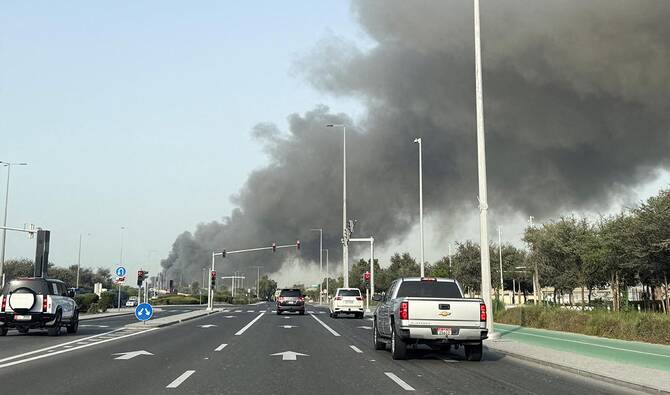
Tensions surged across the Middle East on Saturday after the United States and Israel launched coordinated strikes on Iran. Iran subsequently targeted US military bases in Gulf states, including the United Arab Emirates, Bahrain, Qatar, Kuwait and Jordan, which prompted condemnations from regional governments. Saudi Arabia also confirmed Iran launched attacks in Riyadh and the Eastern Province.
Tehran launched missile and drone strikes in the Middle East for the second consecutive day on Sunday in response to ongoing US-Israeli air raids that have killed Supreme Leader Ayatollah Ali Khamenei, throwing the future of the Islamic republic into uncertainty and raising the risk of further instability in the volatile region.
In his conversation with the King Hamad, Sharif, who earlier described Khamenei’s killing as a “violation” of international law, expressed Pakistan’s solidarity with Bahrain during the ongoing crisis and urged restraint to restore peace in the Middle East.
“I expressed Pakistan’s deep concern over the recent escalation in the region following Israeli attacks on Iran and the subsequent attacks on Jordan and other brotherly countries,” Sharif said on X, following his telephonic conversation with Jordan’s King Abdullah.
“We emphasized the urgent need for restraint, dialogue, and de-escalation to preserve peace and stability. Pakistan stands in full solidarity with the brotherly people of Jordan and remains ready to support all efforts aimed at restoring calm in the region.”
INTERNAL, REGIONAL SECURITY SITUATION
Hours earlier, Sharif convened a high-level meeting to review internal and regional security situation, his office said, amid nationwide protests over the killing of Khamenei and Islamabad’s ongoing military operation against Afghan forces.
Protests erupted in several cities across Pakistan on Sunday after the killing of the Iranian supreme leader in US-Israeli joint strikes, with at least 17 people killed and dozens more injured in clashes with law enforcement agencies.
The unrest came amid Pakistan’s ongoing military operation against Afghan forces following a series of tit-for-tat strikes by the neighbors which began after Islamabad hit what it said were Tehreek-e-Taliban Pakistan and Daesh camps in Afghanistan on Feb 21-22.
Officials briefed Sharif and other participants about the country’s internal situation and security arrangements in place to thwart any untoward incident, according to Sharif’s office.
“Pakistan’s role and various measures to establish peace in the region were reviewed at the meeting,” Sharif’s office said. “The situation in Afghanistan was also reviewed in detail at the meeting.”
AFGHANISTAN OPERATION
Pakistan’s Information Minister Attaullah Tarar said on Sunday that 415 Afghan Taliban fighters had been killed and more than 580 wounded since the latest phase of hostilities between the neighbors began on Thursday.
Afghan officials earlier said that dozens of Pakistani soldiers had been killed and several Pakistan posts had been captured by their forces. None of the casualty figures or battlefield claims from either side could be independently verified.
Earlier in the day, gunshots and explosions were reported in Kabul. Afghan government spokesperson Zabihullah Mujahid said the sounds were the result of Afghan forces targeting Pakistani aircraft over the capital.
“Air defense attacks were carried out in Kabul against Pakistani aircraft,” Mujahid wrote on X. “Kabul residents should not be concerned.”
KHAMENEI KILLING ‘VIOLATION’ OF INTERNATIONAL LAW
Separately, Sharif said the killing of Khamenei was a “violation” of international law.
“People of Pakistan join the people of Iran in their hour of grief and sorrow and extend the most sincere condolences on the martyrdom [of Khamenei],” he wrote on X.
“Pakistan also expresses concern over violation of the norms of international law.”
EVACUATION OF PAKISTANIS FROM IRAN
Officials of the foreign ministry also briefed the prime minister during Sunday’s meeting on the evacuation of Pakistani nationals from Iran, according to a statement issued from Sharif’s office.
“The evacuation of Pakistani citizens from Iran is being made possible through Azerbaijan,” they were quoted as saying.
There are over 3000 Pakistani students studying in various medical and non-medical institutes of Iran, according to Pakistan’s Ambassador to Tehran Muhammad Muddasir Tipu. Pakistani students and expatriates in Iran are being evacuated via land routes.
Islamabad earlier asked its citizens in Gulf countries to exercise caution, avoid travel and strictly follow official adviseries, amid escalating tensions following the killing of Khamenei.
The foreign ministry shared emergency contact details of Pakistani embassies and consulates for the facilitation of Pakistani nationals abroad.


