Turkiye ‘deeply disturbed’ over Israel-US strikes, Iran attacks on Gulf

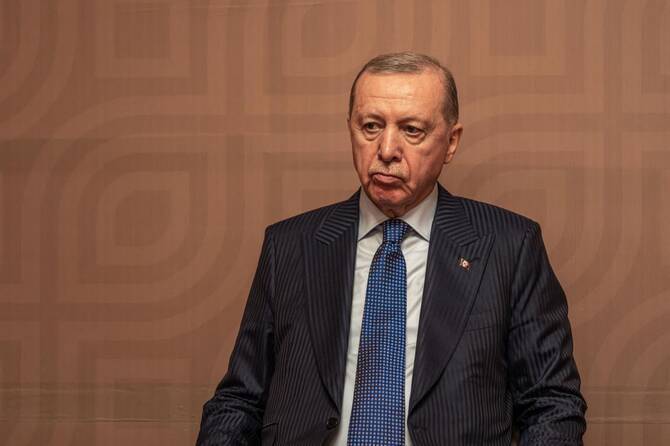
Turkish President Recep Tayyip Erdogan said Saturday he was “deeply disturbed” by the Israeli-US attacks on Iran, but also condemned Tehran’s retaliatory strikes on the Gulf, demanding action to end the conflict. (AFP/File)
Short Url
Updated 28 February 2026
Follow

Turkiye ‘deeply disturbed’ over Israel-US strikes, Iran attacks on Gulf

  • “We are deeply disturbed over the US-Israel attacks on our neighbor Iran,” Erdogan said
  • “In order to prevent our region from experiencing greater suffering, all actors, especially the Islamic world, must take action“

ISTANBUL: Turkish President Recep Tayyip Erdogan said Saturday he was “deeply disturbed” by the Israeli-US attacks on Iran, but also condemned Tehran’s retaliatory strikes on the Gulf, demanding action to end the conflict.
The confrontation began earlier on Saturday with the Israeli and US strikes and quickly broadened regionally as Tehran retaliated against Gulf states and Israel.
“We are deeply disturbed over the US-Israel attacks on our neighbor Iran,” Erdogan said in a televised address, in which he also denounced Iran’s drone and missile attacks against the Gulf as “unacceptable, regardless of the reason.”

“In order to prevent our region from experiencing greater suffering, all actors, especially the Islamic world, must take action,” he added.
Turkiye had “worked hard for a long time to resolve the conflicts at the negotiating table... but the trust deficit between the parties could not be overcome,” he said, vowing to “accelerate Turkiye’s diplomatic efforts” to bring the parties back to the table.
Earlier Saturday, Foreign Minister Hakan Fidan spoke by phone with his Iranian counterpart Abbas Araghchi and six other top diplomats about ways to “end the attacks,” a foreign ministry source said.
Erdogan also said Turkiye had not seen any problem “in terms of border security” along the 500-kilometer (300-mile) frontier it shares with Iran.
“The police, gendarmerie and intelligence services are taking all necessary measures,” he said.
Earlier, Turkiye’s Interior Minister Mustafa Ciftci also held calls with his Azerbaijani counterpart Vilayet Eyvazov and Iraq’s Interior Minister Abdul?Amir al?Shammari on “strengthening areas of cooperation,” the ministry wrote on X.
All three countries share a border with Iran.
Iran’s neighbors have long feared that a new round of strikes on the country could destabilize the entire region, with concerns focused on a possible influx of refugees.
Turkiye currently hosts more than 74,000 Iranians with residence permits and some 5,000 refugees.


Aid trucks resume crossing Egypt-Gaza border after closure

Updated 2 sec ago
Follow

Aid trucks resume crossing Egypt-Gaza border after closure

  • More than 100 aid trucks crossed the Egyptian side of Gaza’s Rafah border crossing on Tuesday, two sources told AFP
RAFAH: More than 100 aid trucks crossed the Egyptian side of Gaza’s Rafah border crossing on Tuesday, two sources told AFP.
Israel closed all crossings into the Gaza Strip on Saturday, after it launched a joint attack on Iran with the United States.
It agreed to reopen the Kerem Shalom crossing, where trucks from Egypt are inspected, for the “gradual entry of humanitarian aid.”
“More than 100 United Nations aid trucks, including UNICEF’s, entered the Rafah border crossing” on Tuesday, a source at the border told AFP on Wednesday on condition of anonymity.
An official with the Egyptian Red Crescent, which coordinates aid deliveries, said the trucks “went through Rafah to the Kerem Shalom crossing,” where Israeli authorities did not send any back to Egypt — their procedure when aid shipments are rejected.
Both sources said no Palestinians were allowed through the crossing on Tuesday.
The Rafah crossing, the only gateway for Gazans to the outside world that does not pass through Israel, had reopened for a trickle of people on February 2, nearly two years after Israeli forces seized it.
A statement from the Red Crescent on Tuesday said the convoy included hundreds of tons of food, relief supplies and “fuel products to operate hospitals and vital facilities.”
The UN had warned its partners were “forced to ration fuel, prioritize life-saving operations” in the devastated Palestinian territory.
The Red Crescent official said another aid convoy was sent on Wednesday and was waiting to be allowed in.
The October peace deal between Israel and Palestinian militant group Hamas stipulates that 600 aid trucks should be allowed in per day.