

Pakistan revises screening criteria for Shariah-compliant index to boost investor confidence

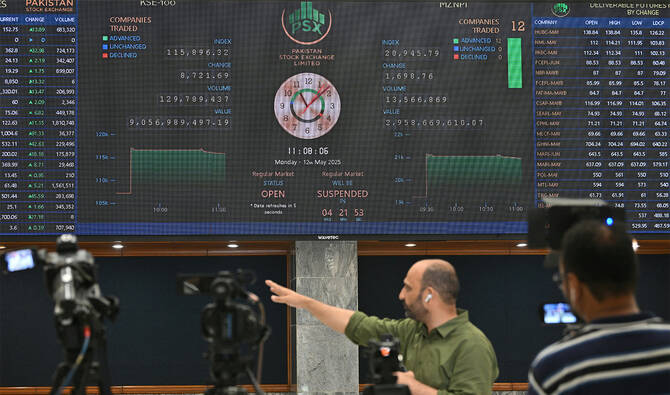
Local journalists report during a trading session at Pakistan Stock Exchange (PSX) in Karachi on May 12, 2025. (AFP/File)
Short Url
Updated 26 February 2026
Follow

Pakistan revises screening criteria for Shariah-compliant index to boost investor confidence

  • Revised framework to encourage listed companies to adopt Shariah-compliant capital structures, says regulator
  • Revisions introduce rating mechanism for companies to enable investors to assess Shariah compliance levels 

KARACHI: The Securities and Exchange Commission of Pakistan (SECP) announced on Thursday that it has approved revisions to the Shariah screening criteria and methodology for companies listed on the Pakistan Stock Exchange (PSX) that comply with Islamic regulations, with the move aimed at boosting investor confidence. 

The PSX-KMI All Share Index comprises all Shariah-compliant companies listed on the PSX. The index has been designed to track the performance of all Shariah-compliant companies listed on the stock market. 

The SECP’s decision to approve the revisions was taken after a meeting Pakistan’s finance secretary chaired on implementing initiatives in line with the Federal Shariat Court’s 2024 ruling on eliminating “riba” or interest from the country before Jan. 1, 2028.

“The revised framework is expected to support the development of the Islamic capital market, facilitate informed investment decisions, and encourage listed companies to adopt Shariah-compliant capital structures,” the SECP said in a statement. 

“Under the new criteria, the non-compliant debt-to-total assets ratio has been reduced from 37 percent to 33 percent.”

A new Shariah compliance rating mechanism has been introduced as per the revisions, the SECP said. The new rating mechanism assigns three, four or five-star ratings to qualifying companies to enhance transparency and help investors assess Shariah compliance levels.

The statement said that a list of Shariah-compliant companies for the PSX-KMI All Share Index will be published with a five-working-day objection window for evidence-based requests for revision.

The SECP said that a mechanism has also been introduced for the interim inclusion of newly listed companies, subject to screening and approval by the KMI Index Committee.

“SECP has further advised PSX to consider additional enhancements, including reducing the non-compliant investments-to-total assets ratio from 33 percent to 30 percent, introducing quarterly index updates, and automating data collection,” the statement said. 

Islamic finance has become a significant part of the global financial system, with countries across the Middle East and Southeast Asia using Shariah-compliant instruments to attract savings and investment.

In Pakistan, officials see the sector as a way to broaden financial inclusion, promote a savings culture, and offer alternatives to conventional interest-based products.

The Central Directorate of National Savings, the country’s main state-run savings institution, last month recorded Rs23.6 billion ($84 million) in Islamic finance inflows between July 1, 2025, and Jan. 23, 2026. 

The inflows brought the institution close to its Rs25 billion ($89 million) Islamic finance target for the ongoing fiscal year ending in June, reflecting a rising demand for interest-free investment options in Pakistan. 


Pakistan announces four-day work week among austerity measures to offset impact of Middle East crisis

Updated 54 min 30 sec ago
Follow

Pakistan announces four-day work week among austerity measures to offset impact of Middle East crisis

  • The development comes as ongoing US-Israeli strikes on Iran disrupt oil supplies in Strait of Hormuz, push prices past $119 a barrel
  • Islamabad bans government purchases, cuts fuel allocation for vehicles as well as workforce in public and private offices by 50 percent

ISLAMABAD: Prime Minister Shehbaz Sharif on Monday announced austerity measures, including a four-day work week and cuts in government expenditures, to offset the impact of rising global oil prices due to an ongoing conflict in the Middle East.

Global fuel supply lines have been disrupted in the Strait of Hormuz, which supplies nearly a fourth of world oil consumption, after Tehran blocked it following United States-Israeli strikes on Iran and counterattacks against US interests in the Gulf region.

Oil prices surged more than 25 percent globally on Monday to $119.50 a barrel, the highest levels since mid-2022, as some major producers cut supplies and fears of prolonged shipping disruptions gripped the market due to the expanding US-Israeli war with Iran.

In his televised address on Sunday night, Sharif said global oil prices were expected to rise again in the coming days but vowed not to let the people bear their brunt, announcing austerity measures to lessen the impact of fuel price hikes.

“Fifty percent staff in public and private entities will work from home,” he announced, adding this would not be applicable to essential services. “Offices will remain open for four days a week. One-day additional off is being given to conserve oil, but it would not be applicable to banks.”

Sharif didn’t specify working days of the week and the government was likely to issue a notification in this regard.

He said a decrease of 50 percent was being made in fuel allocation for government vehicles immediately for the next two months, but they would not include ambulances and public buses.

“Cabinet members, advisers and special assistants will not draw salaries for the next two months, 25 percent salaries of parliamentarians are being deducted, two-day salaries of Grade 20 and above officers, or those who are paid Rs300,000 ($1,067) a month, are being deducted for public relief,” he said.

Similarly, there will be 20 percent reduction in public department expenses and a complete ban on the purchase of cars, furniture, air conditioners and other goods, according to the prime minister.

Foreign trips of ministers and other government officials will also be banned along with government dinners and iftar buffets, while teleconferences and online meetings will be given priority.

Sharif’s comments were aired hours after Pakistani authorities said the country had “comfortable levels” of petroleum stocks and the supply chains were functioning smoothly, despite intensifying Middle East conflict.

Petroleum Minister Ali Pervaiz Malik said three oil shipments were due to reach Pakistan this week, state media reported.

Meanwhile, Pakistan Navy (PN) launched ‘Operation Muhafiz-ul-Bahr’ to safeguard national energy shipments, the Pakistani military said on Monday, amid disruptions to critical sea lanes due to the conflict.

The navy is conducting escort operations in close coordination with the Pakistan National Shipping Corporation (PNSC), according to the Inter-Services Public Relations (ISPR), the military’s media wing. It is fully cognizant of the prevailing maritime situation and is actively monitoring and controlling the movement of merchant vessels to ensure their safe and secure transit.

“With approximately 90 percent of Pakistan’s trade conducted via sea, the operation aims to ensure that vital sea routes remain safe, secure, and uninterrupted,” the ISPR said on Monday. “Currently, PN ships are escorting 2 x Merchant Vessels, one of which is scheduled to arrive Karachi today.”