

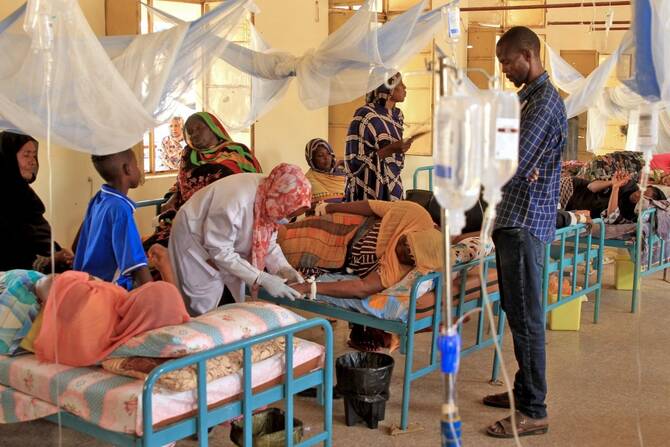

KHARTOUM: Sudan’s health system has suffered an unprecedented collapse since war erupted in mid-April 2023, with most hospitals in the capital, Khartoum, and other cities across several states turned into military barracks.
A severe shortage of medical services has fueled widespread epidemics, disease outbreaks and worsening malnutrition.
Health Minister Haitham Mohamed Ibrahim told Asharq Al-Awsat that losses to the sector are “very large.”
“The destruction has affected all Sudanese states,” he said, citing the sabotage of hospitals and health institutions, the looting of medicines, vehicles and equipment, and the direct targeting of health workers.
He said Saudi Arabia is one of Sudan’s main supporters, particularly through the King Salman Humanitarian Aid and Relief Center, mainly by providing medical supplies, equipment and medicines.
Health sector losses
Preliminary estimates put health sector losses at about $11 billion, Ibrahim said, noting that final figures will only be determined after the war ends, as large areas remain under the control of the Rapid Support Forces.
He outlined a $2 billion reconstruction plan to secure basic services and restore the health system in states recaptured by the Sudanese army. But rebuilding what the war destroyed will require additional funding, he said.
“Attacks on hospitals have exceeded 500 incidents, and the tragedy is ongoing,” Ibrahim said. Several health workers have been killed, while others remain under house arrest in North Darfur, unable to reach their families.
Rebuilding and rehabilitating the system will require “massive budgets and exceptional efforts,” he added.
Sudan needs at least $300 million now to secure essential medicines and medical supplies.
Saudi support
Total Saudi humanitarian and relief assistance during the Sudan crisis exceeded $134 million as of early November 2025, according to new figures.
Donations through the Saudi public campaign to support the Sudanese people via the “Sahem” platform have surpassed $19.4 million, based on recent official estimates.
The campaign was launched in May 2023 under directives from Custodian of the Two Holy Mosques King Salman bin Abdulaziz and Crown Prince and Prime Minister Mohammed bin Salman. More than 537,000 donors have contributed.
Ibrahim reiterated that Saudi Arabia remains a key supporter, especially through the King Salman Humanitarian Aid and Relief Center, which primarily supplies medical consumables, equipment, and medicines.
Malnutrition crisis
Sudan ranks among countries in the World Health Organization’s Eastern Mediterranean Region with high malnutrition rates, Ibrahim said. The national average stands at about 15%, rising to 30% in some states, particularly in areas cut off from regular aid, notably in Darfur and parts of Kordofan.
The Health Ministry, working with UNICEF and other UN agencies and nutrition programs, has opened more than 400 supplementary and therapeutic feeding centers in Darfur to serve those in need.
Vaccination coverage fell below 40% in 2023 and 2024 at the outset of the war, he said, but climbed to more than 70% by the end of 2025. He described the rebound as “a major achievement” that helped reduce measles and diphtheria cases.
Authorities have launched campaigns to reach unvaccinated children, alongside polio drives and routine immunization programs targeting more than 9 million children across Sudan.
Funding constraints
Weak funding remains the main challenge facing the health system, Ibrahim said, pointing to widening health and humanitarian gaps, particularly in western states and Darfur. Reconstruction needs and efforts to improve the work environment to restore services to citizens add further pressure.
Access to some areas in the five Darfur states and parts of Kordofan remains difficult, he said, forcing heavy reliance on international and national organizations operating on the ground.
Securing drug supplies
By 2025, stability in the supply of essential medicines had been fully restored, with more than 700 drug items secured without interruption for chronic and life-saving treatments, Ibrahim said.
Several pharmaceutical factories have resumed operations, with more than three fully operational and four preparing to begin production, a move he said would strengthen supply sustainability and health security.
Availability of essential medicines has risen from less than 30% to more than 75%, with a relative decline in shortages of life-saving drugs.
Storage capacity has expanded at the state level, and the reopening of the main Medical Supplies Center in Khartoum has boosted capacity by more than 60% compared with the previous period.
Disease outbreaks
As the health crisis deepens, 79 dengue fever cases have been recorded in the Merowe locality in Northern State, according to the latest official report.
Outbreaks of malaria and dengue in the capital and several states are part of recurring epidemic waves in recent years, Ibrahim said, stressing that authorities have “a clear strategy to combat disease vectors.”
He announced a major malaria eradication campaign to be launched under the patronage of the prime minister, underscoring the need to sustain vector control programs at the locality and administrative unit levels.
The Rapid Support Forces control all hospitals and health facilities in the five Darfur states and large parts of Kordofan. Ongoing clashes and indiscriminate shelling have directly disrupted medical facilities and destabilized health workers.
Delivering services to areas outside government control remains extremely difficult, the minister said, citing reports of severe shortages that require urgent and sustained health and humanitarian intervention.


