

BBC slammed for ‘shameful’ cut to ‘free Palestine’ comment at BAFTA Awards

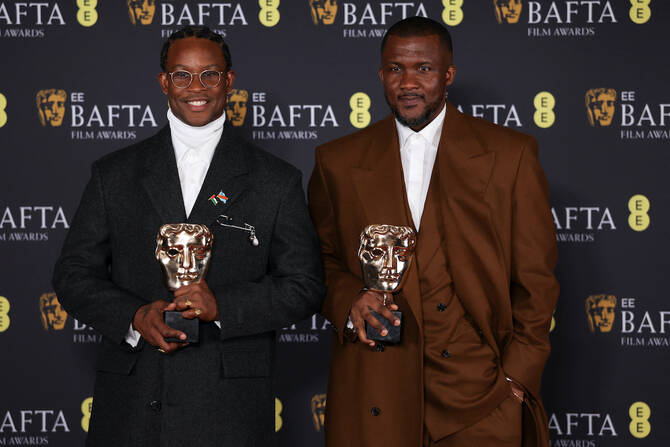
Akinola Davies Jr. and Wale Davies pose with the award for Outstanding Debut by a British Writer, Director or Producer for 'My Father's Shadow', during the 2026 British Academy of Film and Television Awards in London. (Reuters)
Short Url
Updated 24 February 2026
Follow

BBC slammed for ‘shameful’ cut to ‘free Palestine’ comment at BAFTA Awards

  • Broadcaster removes from broadcast part of filmmaker Akinola Davies Jr.’s acceptance speech at the British Academy Film Awards
  • Amnesty UK praises filmmaker for speaking up for those ‘facing and fleeing from persecution and mass atrocities’

LONDON: The BBC was accused on Monday of a “shameful” decision after it cut part of an acceptance speech at the previous night’s British Academy Film Awards in which a filmmaker uttered the phrase “free Palestine.”

British-Nigerian director and co-writer Akinola Davies Jr. and his brother, co-writer Wale Davies were collecting the award for outstanding debut by a British writer, director or producer for their film “My Father’s Shadow” when the former made the comment.

The BBC chose not to include the final part of his speech when it broadcast the BAFTAs ceremony later in the evening. However, the corporation did broadcast an inadvertent racist slur shouted by a person with Tourette syndrome while Black actors Michael B. Jordan and Delroy Lindo were presenting an award.

Akinola thanked industry figures and family for their support as he accepted the award, before dedicating it to “all those whose parents migrated to obtain a better life for their children.”

In the final part of his speech, cut by the BBC, he said: “To the economic migrant, the conflict migrant, those under occupation, dictatorship, persecution and those experiencing genocide, you matter and your stories matter more than ever.

“Your dreams are an act of resistance. To those watching at home, archive your loved ones, archive your stories yesterday, today and forever. For Nigeria, for London, Congo, Sudan, free Palestine. Thank you.”

The BBC, which broadcast the ceremony with a two-hour time delay, said the cut was made for timing reasons.

A spokesperson told Deadline: “The live event is three hours, and it has to be reduced to two hours for its on-air slot. The same happened to other speeches made during the night, and all edits were made to ensure the program was delivered to time. All winners’ speeches will be available to watch via BAFTA’s YouTube Channel.”

Human rights campaign group Amnesty UK described the decision by the BBC to cut part of the speech as “shameful.”

It added: “Thank you Akinola Davies Jr. for using your platform to speak out for the rights of migrants and people facing and fleeing from persecution and mass atrocities, from the Congo to Sudan to Palestine.”

In June last year, the BBC was at the center of a row after it broadcast a Glastonbury Festival performance by the duo Bob Vylan, during which the lead singer chanted “death to the IDF” in protest against the Israeli Defense Forces’ assault on Gaza.


Study finds nearly half of UK news stories on Muslims show signs of bias

Updated 09 March 2026
Follow

Study finds nearly half of UK news stories on Muslims show signs of bias

  • Centre for Media Monitoring finds 20,000 out of 40,913 articles from 30 major news outlets contain bias and 70% link Muslims to negative behaviors or themes
  • Findings reveal ‘deeply concerning evidence of structural bias’ in portrayal of Muslims by UK press and point to ‘systemic problem’ within the media, says center’s director

LONDON: Nearly half of news articles published in the UK in 2025 that referenced Muslims or Islam contained some degree of bias, according to a report issued on Monday by the Centre for Media Monitoring. It also found that about 70 percent of stories linked Muslims to negative behaviors or themes.

The nonprofit organization, which tracks the ways in which Muslims and Islam are portrayed in the media, examined 40,913 articles from 30 major news outlets and found that about 20,000 showed some form of bias.

The study looked at “structural patterns” in coverage that “shape public narratives” about Muslims amid rising hostility toward the community.

“As the largest study of its kind ever conducted in the UK, this report presents deeply concerning evidence of structural bias in how Muslims are portrayed in the UK press,” said Rizwana Hamid, the director of the organization.

It found that 70 percent of the articles it reviewed highlighted negative aspects related to Muslims, though not all of the stories were biased in themselves. The wider patterns were also troubling: 44 percent of the coverage omitted key context, 17 percent relied on generalizations, and 13 percent included outright misrepresentation.

Taken together, the monitoring center said, the findings amounted to evidence of an “information integrity crisis” that distorts public understanding, and “a deeply concerning trend” in reporting on Muslims.

The research points to a “systemic problem within our media ecosystem,” Hamid said.

“When entire communities are repeatedly framed through lenses of suspicion or threat, it inevitably shapes public attitudes, political debate and the everyday lives of British Muslims,” she added.

News brands targeting right-wing audiences were more likely to produce biased coverage, the report found.

The Spectator magazine and GB News were identified as having the highest proportion of “very biased” articles, and as the “worst across all five bias categories”: negative framing, generalizations, misrepresentation, lack of context, and problematic headlines.

Other outlets highlighted for displaying high levels of biased content about Muslims included The Telegraph, The Jewish Chronicle, Daily Express, The Sun, Daily Mail and The Times.

In contrast, the BBC, other broadcasters and left-leaning outlets recorded the lowest rates of bias in the study.

The research comes as British Muslims report rising levels of discrimination. Official figures published in October revealed that religious hate crimes against Muslims rose by 19 percent in the year to March 2025 compared with the previous 12 months.