

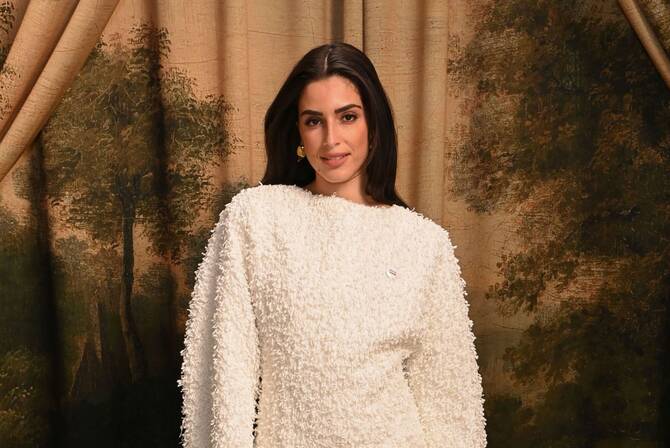
Saja Kilani shines at BAFTAs 2026

Palestinian-Jordanian-Canadian actress Saja Kilani, one of the stars of “The Voice of Hind Rajab,” stepped onto the BAFTA Film Awards 2026 red carpet in a sculptural look from Bottega Veneta’s Spring 2026 collection. (Getty Images)
Short Url
Updated 23 February 2026
Follow

Saja Kilani shines at BAFTAs 2026

DUBAI: Palestinian-Jordanian-Canadian actress Saja Kilani, one of the stars of “The Voice of Hind Rajab,” stepped onto the BAFTA Film Awards 2026 red carpet in a sculptural look from Bottega Veneta’s Spring 2026 collection.

Nominated for Best Film Not in the English Language, Kaouther Ben Hania’s “Voice of Hind Rajab” tells the story of Hind Rajab Hamada, who was fleeing the Israeli military in Gaza City with six relatives last year when their car came under fire.

The sole survivor of the Israeli attack, who was then shot and killed, her desperate calls recorded with the Red Crescent rescue service caused international outrage.

Kilani plays Rana Faqih, the real-life Palestine Red Crescent Society volunteer who spoke to Hamada in the final hours of her life as she waited, surrounded by the bodies of her family, for help to come. 

Meanwhile, politically charged thriller “One Battle After Another” won six prizes, including Best Picture, at the British Academy Film Awards on Sunday, building momentum ahead of Hollywood’s Academy Awards next month.

Blues-steeped vampire epic “Sinners” and gothic horror story “Frankenstein” won three awards each, while Shakespearean family tragedy “Hamnet” won two, including Best British Film.

“One Battle After Another,” Paul Thomas Anderson’s explosive film about a group of revolutionaries in chaotic conflict with the state, won awards for directing, adapted screenplay, cinematography and editing, as well as for Sean Penn’s supporting performance as an obsessed military officer.

“This is very overwhelming and wonderful,” Anderson said as he accepted the directing prize. He paid tribute to his longstanding assistant director, Adam Somner, who died of cancer in November 2024, a few weeks into production.

“We have a line from Nina Simone that we used in our film, ‘I know what freedom is: It’s no fear,’” the director said. “Let’s keep making things without fear. It’s a good idea.”

Bookies’ favorite Jessie Buckley won the Best Actress prize for her portrayal of grieving mother Agnes Hathaway, wife of William Shakespeare, in “Hamnet.” Buckley, 36, is the first Irish performer to win the Best Actress prize at the awards.

She dedicated her award “to the women past, present and future who taught me and continue to teach me how to do it differently.”

Horror film “Sinners” took home trophies for director Ryan Coogler’s original screenplay, the film’s musical score and for Wunmi Mosaku’s supporting actress performance as herbalist and healer Annie.

The British-Nigerian actor said that in the role she found “a part of my hopes, my ancestral power and my connection, parts I thought I had lost or tried to dim as an immigrant trying to fit in.”


Review: Netflix docuseries highlights the ugly truth of ‘America’s Next Top Model’

Updated 57 min 53 sec ago
Follow

Review: Netflix docuseries highlights the ugly truth of ‘America’s Next Top Model’

DHAHRAN: Out this month, nearly a decade after the successful show went off air, there is understandably a lot to unpack in Netflix’s three-episode documentary series “Reality Check: Inside America’s Next Top Model.”

Premiering in 2003 and running for 24 seasons until 2018, “America’s Next Top Model” invited aspiring models from across America to compete for a coveted modeling contract, and a glossy magazine cover (remember those?).

All this while juggling growing pains, random challenges cooked up by producers, marvelously messy makeovers, photoshoots, and living — and competing — with fellow contestants.

What could go wrong? Turns out — plenty. The show’s intimate format made for compelling TV.

Tyra Banks, one of America’s top models, was the show’s brainchild.

The young contestants were impressionable and eager, full of sky-high dreams and sky-high heels. They came from fractured backgrounds or from small towns. They were meant to have a mentor in Banks.

Instead, their deepest, most shameful moments were broadcast for the world to see. To my knowledge, while some contestants became semi-successful, none truly reached the “top model” level.

The docuseries hits like a punch in the face. And maybe that is the point.

Three episodes, each just an hour long, barely scratches the surface of the trauma, chaos, and behind-the-scenes drama on and off the screen.

The series is essentially a catwalk down nostalgia lane — but the road is uneven and swerving, much like the show itself. The style of filming is also similar to the show, which makes it all the more compelling for avid fans.

Designed for the TikTok-and-meme generation, these bite-sized scenes in the docuseries are tailor-made for viral clips.

Banks appears alone in every scene. Speaking directly at the camera, she seems to shrug through every apology and justify her past behavior.

The docuseries highlights interviews with main judges: Jay Manuel, Nigel Barker, and most prominently, a shocking update on beloved judge J. Alexander, known as “Miss J.” All claim to be estranged from Banks.

A few former contestants are also featured, each seated alone as tears or rage bubble to the surface. Nobody speaks favorably about Banks, especially while replaying clips showing her old judging panels.

Was this backlash justified? Are the vicious things said about Banks fair? The docuseries offers viewers the chance to be the judge in what invariably turns into a trial of Banks and her role on the show.

The docuseries ends on a cliffhanger, teasing a possible revival for cycle 25. Mixed feelings aside, there is clearly an audience for it.