

Pakistan stock market sheds over 5,400 points amid US-Iran tensions, lack of risk appetite

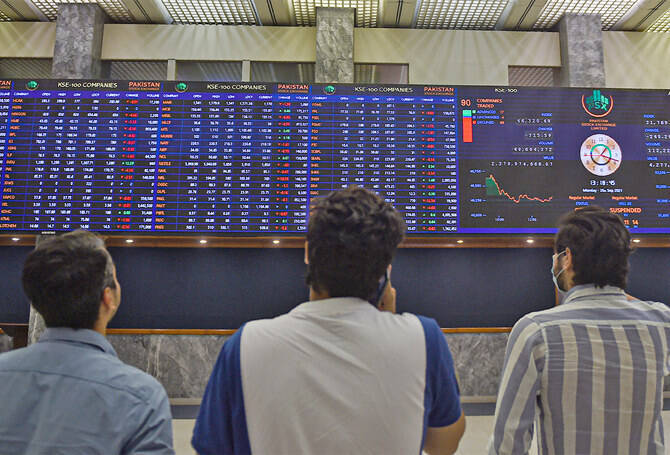
Stockbrokers watch an index board showing the latest share prices during a trading session at the Pakistan Stock Exchange (PSX) in Karachi, Pakistan, on September 20, 2021. (AFP/File)
Short Url
Updated 23 February 2026
Follow

Pakistan stock market sheds over 5,400 points amid US-Iran tensions, lack of risk appetite

  • Trump said on Thursday he would decide in ‘10 or 15 days’ whether to order strikes on Iran if no nuclear deal is reached
  • Despite the decline, the market witnessed trading activity, with 461 million shares traded and a turnover of $89 million

KARACHI: The Pakistan Stock Exchange (PSX) tumbled sharply and lost more than 5,400 points on Monday, the market data showed, amid escalating geopolitical tensions between the United States and Iran and a marked lack of investor risk appetite.

The benchmark KSE-100 index 5,478 points, or 3.16 percent, to close at 167,691 points on Monday as compared to Friday’s close of 173,169 points, according to the PSX website.

The development comes a day after US President Donald Trump said he would decide in “10 or 15 days” whether to order strikes on Iran if no nuclear deal is reached. Iran has said any US attack would be an “act of aggression” that would precipitate a response.

“Risk appetite remains fragile. Markets are still pricing uncertainty,” Muhammad Waqas Ghani, head of research at JS Global Capital, told Arab News.

“Investors don’t wait for inflation prints, trade disruptions, or macro data to confirm the damage, they sell first on heightened geopolitical risk.”

During the intra-day trade, the index fluctuated within the range of 174,336 to 166,886 points, largely influenced by rollover-week dynamics, according to a market review by Topline Securities.

Index-heavy constituents, including Fauji Fertilizer Company (FFC), Lucky Cement (LUCK), Engro Holdings (ENGROH), National Bank of Pakistan (NBP) and Habib Bank Limited (HBL), emerged as the principal laggards, collectively dragging the benchmark down by 1,797 points during the session.

Despite the decline, the market witnessed trading activity, with total volume of 461 million shares and turnover amounting to Rs24.9 billion ($89 million). K-Electric led the volumes chart, recording over 35.9 million shares traded.


Pakistan awards 11 onshore oil and gas blocks to boost domestic production

Updated 5 sec ago
Follow

Pakistan awards 11 onshore oil and gas blocks to boost domestic production

  • Pakistan has faced a widening energy gap due to rising demand, limited domestic output, forcing it to import costly fuels
  • Successful joint venture partners include state-run enterprises as well as local and international explorations companies

KARACHI: Pakistan has awarded 11 onshore oil and gas blocks for exploration to state-owned and private firms to boost domestic production and reduce reliance on costly energy imports, the Pakistani information ministry said on Thursday.

Pakistan has faced a widening energy gap due to rising demand and limited domestic output, forcing it to import costly fuels and expose the economy to global price swings. Its petroleum, oil, and lubricants import bill fell 4.39 percent to $9.046 billion in July 2025-January 2026.

On Thursday, the Petroleum Division signed petroleum concession agreements (PCAs) and exploration licenses (ELs) to award 11 onshore blocks for exploration, marking a significant step forward in advancing oil and gas exploration activities across the South Asian country.

The successful joint venture partners include the state-run Oil and Gas Development Company Limited (OGDCL), Pakistan Petroleum Limited (PPL), Mari Energies Limited (MariEnergies), Pakistan Oilfields Limited (POL) and Prime Global Energies (Prime).

“Signing of agreements demonstrate strong investor confidence in Pakistan’s upstream potential,” Petroleum Minister Ali Pervaiz Malik said, adding it aimed to boost domestic exploration, attract investment and reduce reliance on imported energy.

MariEnergies will serve as operator for six blocks. The company has secured 100 percent working interest in five blocks, including Padag, Chagai, Dalbandin, Merui, and Merui West, and will lead the Ahmad Wal block as operator with a 60 percent working interest, alongside the

Oil and Gas Development Company Limited (OGDCL) that will be holding 40 percent.

OGDCL will operate three blocks, including Kalat North with 100 percent working interest. It will also lead two joint venture blocks: Naing Sharif (OGDCL 70 percent as operator, Prime 30 percent) and Khiu-II (OGDCL 60 percent as operator, MariEnergies 40 percent).

PPL emerged as the highest bidder for the Kalat South block and will operate it with a 40 percent working interest, in partnership with OGDCL (30 percent) and MariEnergies (30 percent). POL secured the Jherruk block with 100 percent working interest.

“The minimum committed investment by the successful bidders exceeds USD31 million (approximately Rs8.66 billion) over the next three years,” the information ministry said. “In addition, more than Rs276 million ($987,133) has been committed toward social welfare initiatives in the respective areas.”

In the event of commercial hydrocarbon discoveries, substantial additional investments amounting to millions of dollars are anticipated for field development and production activities, according to the ministry.

Pakistan has announced new oil and gas discoveries in recent months. Islamabad this month announced a discovery at an exploratory well that produced 225 barrels of oil per day (BOPD) and 1.01 million standard cubic feet per day (MMSCFD) of gas.

In January, a discovery regarding an exploratory well, flowing at the rate of 4,100 barrels of oil per day (BOPD) and 10.5 million standard cubic feet per day (MMSCFD) of gas, was made in Kohat. In September 2025, Pakistan Petroleum Limited announced a discovery in Attock district, while Mari Energies reported a new gas find in North Waziristan.

“Recent discoveries would lead to further investments in development and production, create employment opportunities, stimulate economic activity in the regions and will contribute meaningfully to reducing reliance on imported energy,” Malik added.