

Pakistan awards 11 onshore oil and gas blocks to boost domestic production

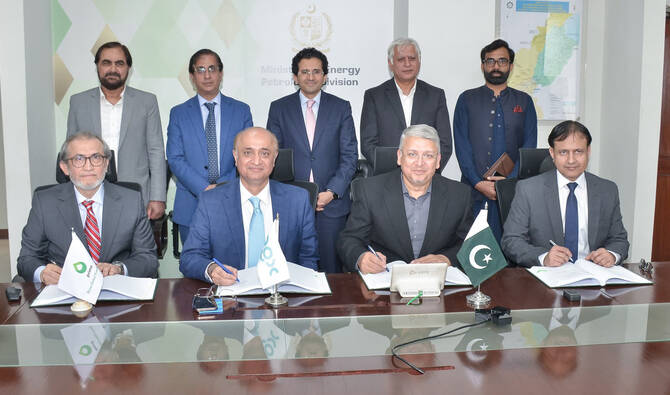
Officials from Pakistan’s Petroleum Division sign petroleum concession agreements and exploration licences for 11 onshore blocks in Islamabad, Pakistan, February 26, 2026. (Petroleum Division, Ministry of Energy/X)
Short Url
Updated 27 February 2026
Follow

Pakistan awards 11 onshore oil and gas blocks to boost domestic production

  • Pakistan has faced a widening energy gap due to rising demand, limited domestic output, forcing it to import costly fuels
  • Successful joint venture partners include state-run enterprises as well as local and international explorations companies

KARACHI: Pakistan has awarded 11 onshore oil and gas blocks for exploration to state-owned and private firms to boost domestic production and reduce reliance on costly energy imports, the Pakistani information ministry said on Thursday.

Pakistan has faced a widening energy gap due to rising demand and limited domestic output, forcing it to import costly fuels and expose the economy to global price swings. Its petroleum, oil, and lubricants import bill fell 4.39 percent to $9.046 billion in July 2025-January 2026.

On Thursday, the Petroleum Division signed petroleum concession agreements (PCAs) and exploration licenses (ELs) to award 11 onshore blocks for exploration, marking a significant step forward in advancing oil and gas exploration activities across the South Asian country.

The successful joint venture partners include the state-run Oil and Gas Development Company Limited (OGDCL), Pakistan Petroleum Limited (PPL), Mari Energies Limited (MariEnergies), Pakistan Oilfields Limited (POL) and Prime Global Energies (Prime).

“Signing of agreements demonstrate strong investor confidence in Pakistan’s upstream potential,” Petroleum Minister Ali Pervaiz Malik said, adding it aimed to boost domestic exploration, attract investment and reduce reliance on imported energy.

MariEnergies will serve as operator for six blocks. The company has secured 100 percent working interest in five blocks, including Padag, Chagai, Dalbandin, Merui, and Merui West, and will lead the Ahmad Wal block as operator with a 60 percent working interest, alongside the

Oil and Gas Development Company Limited (OGDCL) that will be holding 40 percent.

OGDCL will operate three blocks, including Kalat North with 100 percent working interest. It will also lead two joint venture blocks: Naing Sharif (OGDCL 70 percent as operator, Prime 30 percent) and Khiu-II (OGDCL 60 percent as operator, MariEnergies 40 percent).

PPL emerged as the highest bidder for the Kalat South block and will operate it with a 40 percent working interest, in partnership with OGDCL (30 percent) and MariEnergies (30 percent). POL secured the Jherruk block with 100 percent working interest.

“The minimum committed investment by the successful bidders exceeds USD31 million (approximately Rs8.66 billion) over the next three years,” the information ministry said. “In addition, more than Rs276 million ($987,133) has been committed toward social welfare initiatives in the respective areas.”

In the event of commercial hydrocarbon discoveries, substantial additional investments amounting to millions of dollars are anticipated for field development and production activities, according to the ministry.

Pakistan has announced new oil and gas discoveries in recent months. Islamabad this month announced a discovery at an exploratory well that produced 225 barrels of oil per day (BOPD) and 1.01 million standard cubic feet per day (MMSCFD) of gas.

In January, a discovery regarding an exploratory well, flowing at the rate of 4,100 barrels of oil per day (BOPD) and 10.5 million standard cubic feet per day (MMSCFD) of gas, was made in Kohat. In September 2025, Pakistan Petroleum Limited announced a discovery in Attock district, while Mari Energies reported a new gas find in North Waziristan.

“Recent discoveries would lead to further investments in development and production, create employment opportunities, stimulate economic activity in the regions and will contribute meaningfully to reducing reliance on imported energy,” Malik added.


Pakistan rules out talks with Afghanistan, says over 330 Afghan fighters killed in clashes

Updated 10 sec ago
Follow

Pakistan rules out talks with Afghanistan, says over 330 Afghan fighters killed in clashes

  • Clashes between the neighbors erupted after Pakistan’s airstrikes on Afghan territory last weekend
  • US voices support for Pakistan, Information Minister Attaullah Tarar says they aim to make Pakistan safe

ISLAMABAD: Pakistan has ruled out any talks with Afghanistan until an end to “terrorism” emanating from the Afghan soil, officials said on Friday, following the killing of more than 330 Afghan fighters in cross-border clashes this week.

The latest clashes between the neighbors erupted after Pakistan’s airstrikes on Afghan territory last weekend triggered Afghan retaliatory attacks along the border on Thursday, escalating long‑simmering tensions over Pakistan’s claim that Afghanistan shelters Pakistani Taliban militants. Afghanistan denies this and argues Pakistan is deflecting blame for its own security failures.

Pakistani Information Minister Attaullah Tarar said they had killed 331 Afghan fighters, destroyed over 100 posts and targeted 37 military locations across Afghanistan. Afghan officials have said that more than 50 Pakistani soldiers have been killed and several Pakistan posts have been captured by their forces. None of the casualty figures or battlefield claims from either side could be independently verified.

Meanwhile, Mosharraf Zaidi, Prime Minister Shehbaz Sharif’s spokesperson for foreign media, ruled out any talks with Afghanistan until Kabul addresses the issue as the United States (US) expressed his support for what it called Pakistan’s “right to defend itself” against attacks from Afghanistan’s Taliban rulers.

“There won’t be any talks, there is nothing to talk about... Terrorism from Afghanistan has to end,” Zaidi told Pakistani state media, saying Islamabad would continue to target militant havens inside Afghanistan.

“Pakistan’s responsibility is to protect its citizens. If we know that there is a terrorist in point A and we know that there is a terrorist enabler at point A, we will find a weapon to land at point A and eliminate the threat.”

Zaidi said he didn’t expect Pakistan to deviate from this position and that the government had clearly conveyed what it was doing.

“We have clearly articulated what we are doing and what we plan on continuing to do and what it will take for us to stop doing what we are doing,” Zaidi said.

“And we will expect that both the international community and the regime in question, the Afghan Taliban, will come to their senses and will help reduce instability and disorder in this region.”

Pakistan is a major non-NATO ally of Washington, while the US considers the Afghan Taliban to be a “terrorist” group.

“The United States supports Pakistan’s right to defend itself against attacks from the Taliban, a Specially Designated Global Terrorist group,” Reuters quoted a State Department spokesperson as saying. US diplomat Allison Hooker said on X she spoke on Friday with Pakistan Foreign Secretary Amna Baloch.

The State Department spokesperson said Washington was aware of the escalation in tensions and “outbreak of fighting between Pakistan and the Afghan Taliban,” adding the US was “saddened by the loss of life.”

“The Taliban have consistently failed to uphold their counterterrorism commitments,” the State Department said, adding that “terrorist groups use Afghanistan as a launching pad for their heinous attacks.”

Meanwhile, Afghan Taliban spokesperson Zabihullah Mujahid called for talks to resolve the crisis.

“We have always emphasized peaceful resolution, and now too we want the issue to be resolved through dialogue,” he said on Friday afternoon.

Asked what Pakistan desired, Information Minister Tarar said: “Neutralizing the threat and ensuring that Pakistan is safe.”

“Because for us, we’ve been good neighbors, we’ve been very friendly neighbors, we’ve been very, very generous neighbors. Our generosity, unfortunately, has often been seen as our weakness,” he told state media.

“So the objective, aim is to neutralize the threat and make Pakistan safe.”

To a question about a ceasefire, Tarar said it was “too early” to comment on that as it was an evolving situation.