

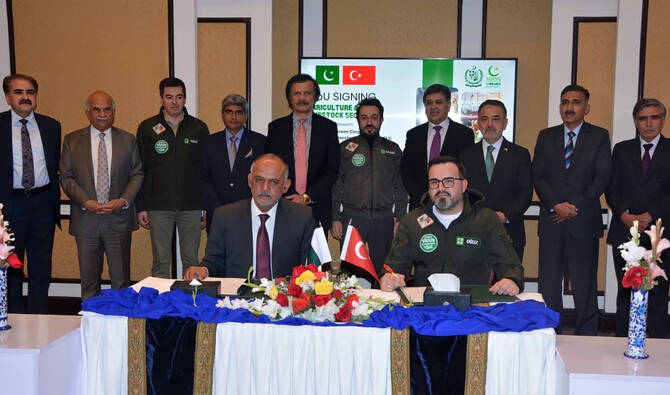
Pakistan signs agriculture, livestock technology deals with Türkiye to boost exports

The photograph released on February 13, 2026, shows officials from Pakistan and Türkiye posing for a group photo during a Memorandum of Understanding (MoU) signing ceremony in Islamabad, Pakistan. (X/@jameelaq)
Short Url
Updated 13 February 2026
Follow

Pakistan signs agriculture, livestock technology deals with Türkiye to boost exports

  • The deals link Pakistani research and corporate entities with Turkish companies
  • MoUs align with Islamabad’s export-led growth push after IMF-backed stabilization

ISLAMABAD: Pakistan has facilitated two memoranda of understanding (MoUs) with Turkish partners in agriculture technology and livestock development, an official announced on Friday, as Islamabad seeks to boost productivity and exports following recent economic stabilization efforts.

The deals, brokered under the Special Investment Facilitation Council (SIFC), bring together the Pakistan Agricultural Research Council and Türkiye’s Agricultural Technologies Cluster (TÜME), as well as Green Corporate Livestock Initiative (Pvt.) Ltd. and Dost Agriculture Enterprises.

The SIFC, a hybrid civil-military body formed in 2023 to fast-track decisions related to international investment in sectors including tourism, livestock, agriculture and mines and minerals, has been central to Pakistan’s efforts to attract foreign capital and streamline approvals.

“Pakistan possesses vast agricultural potential, fertile land, and a dynamic workforce,” Jamil Qureshi, Federal Secretary of the SIFC, said in a post on social media. “By combining these strengths with Türkiye’s advanced expertise and technological innovation, we are unlocking new pathways for productivity, value addition, and global market access.”

Qureshi said the agreements reflected a shared commitment to technology transfer, modernization of livestock practices and enhanced export competitiveness.

Pakistan is pushing for export-led growth after emerging from a prolonged economic crisis that saw foreign exchange reserves fall sharply and inflation surge. The country stabilized its economy with the support of the International Monetary Fund and financial assistance from friendly nations, and is now seeking to accelerate reforms and attract investment into productive sectors.

“At the SIFC, our role is clear: to facilitate investors, enable strategic partnerships, and ensure seamless coordination so that agreements translate into measurable economic outcomes,” Qureshi said.

He added the government had pledged to create a business-friendly environment to draw foreign investors, particularly in sectors where international collaborations can thrive.


Pakistan stocks recover as oil supply fears ease after Islamabad seeks Red Sea route— analyst

Updated 05 March 2026
Follow

Pakistan stocks recover as oil supply fears ease after Islamabad seeks Red Sea route— analyst

  • Pakistan has sought Saudi help to secure oil supplies via Red Sea port after Iran’s closure of Strait if Hormuz
  • Analyst says higher crude oil prices, expectations of IMF releasing next loan tranche also triggered bullish activity

ISLAMABAD: Pakistani stocks marked a sharp recovery when trading closed on Thursday, as institutional activity increased following Islamabad’s move to seek crude oil supplies through the Red Sea port eased oil supply fears, a financial analyst said. 

Pakistani stocks have recorded a sharp decline this week, with the benchmark KSE-100 index recording its largest-ever single-day decline on Monday when it plunged 16,089 points. Escalating conflict in the Middle East triggered panic selling at the Pakistani bourse, forcing a temporary trading halt on Monday. 

The KSE-100 index, however, gained 3.49 percent or 5,433.46 points to close at 161,210.67 when trading ended on Thursday, up from the previous close of 155,777.21 points, according to Pakistan Stock Exchange’s (PSX) data.

Pakistan’s Petroleum Minister Ali Pervaiz Malik met Saudi Ambassador Nawaf bin Said Al-Malki on Wednesday to discuss Iran’s closure of the key Strait of Hormuz, which has threatened Pakistan’s energy supply. Roughly 20 percent of the global oil and gas supply passes through the route. Saudi Arabia indicated it could facilitate shipments through the Red Sea port of Yanbu, offering an alternative route if Gulf shipping lanes remain disrupted, the petroleum ministry said on Wednesday. 

“Stocks staged a sharp recovery at PSX amid institutional activity on easing fuel supply fears after KSA [Kingdom of Saudi Arabia] commits oil supplies through the Red Sea port,” Ahsan Mehanti, chief executive officer at Arif Habib Commodities, told Arab News.

He said higher global crude oil prices and expectations of the International Monetary Fund releasing its next tranche of the $7 billion loan for Pakistan also helped bullish activity at the PSX.

An IMF mission was in Pakistan to hold talks on the third review of a $7 billion Extended Fund Facility multi-year program, and for the second review of the $1.4 billion Resilience and Sustainability Facility this week.

However, the delegation left for Türkiye amid tensions in the Gulf. Pakistani officials have said talks are likely to continue virtually in the coming days. 

Pakistani brokerage Topline Securities said in its daily market review report that strong institutional buying “turned the tide” on Thursday after the market’s recent overreaction to regional issues.

The report added that Hub Power Company (HUBC), Oil & Gas Development Company (OGDC), Fauji Fertilizer Company (FFC), Engro Corporation (ENGROH), and Meezan Bank Limited (MEBL) collectively contributed 2,197 points to the KSE benchmark’s gain.

Topline Securities said 723 million shares were traded on Thursday, with K-Electric Limited (KEL) stealing the spotlight as more than 1.17 billion shares changed hands.

Pakistani investors are closely monitoring developments in the Gulf, particularly around energy routes and further retaliatory actions, as the conflict’s trajectory remains uncertain.