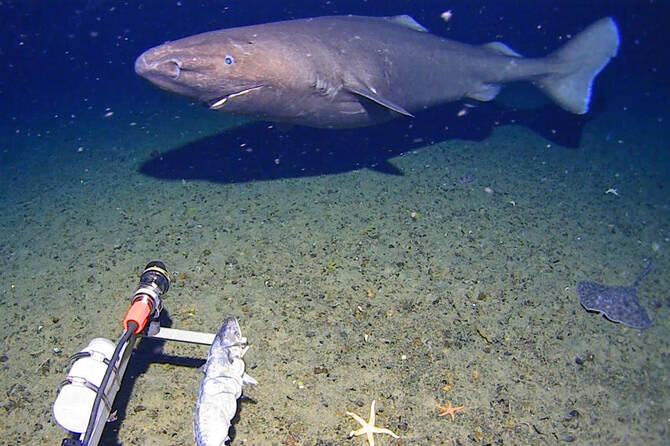
Surprise shark caught on camera for first time in Antarctica’s near-freezing deep

The camera operated by the Minderoo-UWA Deep-Sea Research Center was positioned off the South Shetland Islands near the Antarctic Peninsula. (AP)
Short Url
Updated 18 February 2026
Follow

Surprise shark caught on camera for first time in Antarctica’s near-freezing deep

  • The camera operated by the Minderoo-UWA Deep-Sea Research Center was positioned off the South Shetland Islands near the Antarctic Peninsula
  • Conservation biologist Peter Kyne agrees that a shark has never before been recorded so far south

MELBOURNE: An ungainly barrel of a shark cruising languidly over a barren seabed far too deep for the sun’s rays to illuminate was an unexpected sight.
Many experts had thought sharks didn’t exist in the frigid waters of Antarctica before this sleeper shark lumbered warily and briefly into the spotlight of a video camera, researcher Alan Jamieson said this week. The shark, filmed in January 2025, was a substantial specimen with an estimated length of between 3 and 4 meters (10 and 13 feet).
“We went down there not expecting to see sharks because there’s a general rule of thumb that you don’t get sharks in Antarctica,” Jamieson said.
“And it’s not even a little one either. It’s a hunk of a shark. These things are tanks,” he added.
The camera operated by the Minderoo-UWA Deep-Sea Research Center, which investigates life in the deepest parts of the world’s oceans, was positioned off the South Shetland Islands near the Antarctic Peninsula. That is well inside the boundaries of the Antarctic Ocean, also known as the Southern Ocean, which is defined as below the 60-degree south latitude line.
The center on Wednesday gave The Associated Press permission to publish the images.
The shark was 490 meters (1,608 feet) deep where the water temperature was a near-freezing 1.27 degrees Celsius (34.29 degrees Fahrenheit).
A skate appears in frame motionless on the seabed and seemingly unperturbed by the passing shark. The skate, a shark relative that looks like a stingray, was no surprise since scientists already knew their range extended that far south.
Jamieson, who is the founding director of the University of Western Australia-based research center, said he could find no record of another shark found in the Antarctic Ocean.
Peter Kyne, a Charles Darwin University conservation biologist independent of the research center, agreed that a shark had never before been recorded so far south.
Climate change and warming oceans could potentially be driving sharks to the Southern Hemisphere’s colder waters, but there was limited data on range changes near Antarctica because of the region’s remoteness, Kyne said.
The slow-moving sleeper sharks could have long been in Antarctica without anyone noticing, he said.
“This is great. The shark was in the right place, the camera was in the right place and they got this great footage,” Kyne said. “It’s quite significant.”
The sleeper shark population in the Antarctic Ocean was likely sparse and difficult for humans to detect, Jamieson said.
The photographed shark was maintaining a depth of around 500 meters (1,640 feet) along a seabed that sloped into much deeper water. The shark maintained that depth because that was the warmest layer of several water layers stacked upon each other to the surface, Jamieson said.
The Antarctic Ocean is heavily layered, or stratified, to a depth of around 1,000 meters (3,280 feet) because of conflicting properties including colder, denser water from below not readily mixing with fresh water running off melting ice from above.
Jamieson expects other Antarctic sharks live at the same depth, feeding on the carcasses of whales, giant squids and other marine creatures that die and sink to the bottom.
There are few research cameras positioned at that specific depth in Antarctic waters. Those that are can only operate during the Southern Hemisphere summer months, from December through February.
“The other 75 percent of the year, no one’s looking at all. And so this is why, I think, we occasionally come across these surprises,” Jamieson said.


Judge declares 4 men wrongly accused of 1991 Austin yogurt shop murders innocent

Updated 19 February 2026
Follow

Judge declares 4 men wrongly accused of 1991 Austin yogurt shop murders innocent

  • The declaration was aimed at closing a dark chapter for the men and their families
  • Investigators chased thousands of leads and several false confessions before the four men were arrested in late 1999

TEXAS, USA: A Texas judge on Thursday declared four men who were wrongfully accused of the 1991 Austin yogurt shop murders innocent, formally clearing their names in a courtroom for the first time since the killings of four teenage girls that haunted the city for decades.
“You are innocent,” state District Judge Dayna Blazey said during a hearing in a packed Austin courtroom.
The declaration was aimed at closing a dark chapter for the men and their families, and for a city that was shaken by the brutality of the crime and investigators’ inability to solve it for decades. Blazey called her order “an obligation to the rule of law and the obligation to the dignity of the individual.”
Cold case detectives announced last year that they had connected the killings to a suspect who died in a 1999 standoff with police in Missouri.
Two of the original four suspects, Michael Scott and Forrest Welborn, were in the packed courtroom with family members to hear prosecutors tell the judge that they are innocent. Robert Springsteen, who was initially convicted and spent several years on death row, did not attend. Maurice Pierce died in 2010.
“Over 25 years ago, the state prosecuted four innocent men ... (for) one of the worst crimes Austin has ever seen,” Travis County First Assistant District Attorney Trudy Strassburger said at the opening of the hearing. “We could not have been more wrong.”
A declaration of “actual innocence” would also be a key step for the men and their families to seek financial compensation for years they spent in jail or in prison.
“All four lived under the specter of the yogurt shop murders. These four never had the chance to live normal lives,” Strassburger said.
The murders shocked Austin and confounded investigators for years
Amy Ayers, 13; Eliza Thomas, 17; and sisters Jennifer and Sarah Harbison, ages 17 and 15, were bound, gagged and shot in the head at the “I Can’t Believe It’s Yogurt” store where two of them worked. The building was set on fire.
Investigators chased thousands of leads and several false confessions before the four men were arrested in late 1999.
Springsteen and Scott were convicted based largely on confessions they insisted were coerced by police. Both convictions were overturned in the mid-2000s.
Welborn was charged but never tried after two grand juries refused to indict him. Pierce spent three years in jail before the charges were dismissed and he was released.
Prosecutors wanted to try Springsteen and Scott again, but a judge ordered the charges dismissed in 2009 when new DNA tests that were unavailable in 1991 had revealed another male suspect.
“Let us not forgot that Robert Springsteen could be dead right now, executed at the hands of the state of Texas,” Springsteen attorney Amber Farrelly said at the hearing.
Connection to a new suspect revealed
The case effectively went cold until 2025. It got new public attention when an HBO documentary series explored the unsolved crime.
Investigators announced in September that new evidence and reviews of old evidence pointed to Robert Eugene Brashers as the killer.
Since 2018, authorities had used advanced DNA evidence to link Brashers to the strangulation death of a South Carolina woman in 1990, the 1997 rape of a 14-year-old girl in Tennessee and the shooting of a mother and daughter in Missouri in 1998.
The link to the Austin case came when a DNA sample taken from under Ayers’ fingernail came back as a match to Brashers from the 1990 murder in South Carolina.
Austin investigators also found that Brashers had been arrested at a border checkpoint near El Paso two days after the yogurt shop killings. In his stolen car was a pistol that matched the same caliber used to kill one of the girls in Austin.
Police also noted similarities in the yogurt shop case to Brashers’ other crimes: The victims were tied up with their own clothing, sexually assaulted and some crime scenes were set on fire.
Brashers died in 1999 when he shot himself during an hourslong standoff with police at a motel in Kennett, Missouri.