

Saudi Arabia preparing for strategic economic pact with Pakistan, Saudi envoy says

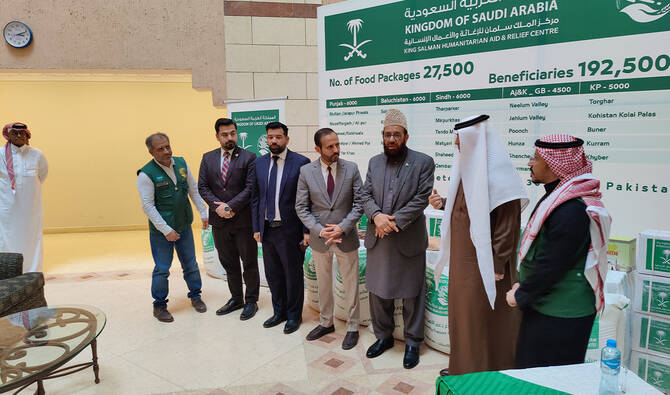
Pakistani Religious Affairs Minister Sardar Muhammad Yousaf (third right), Saudi Ambassador to Pakistan Nawaf bin Saeed Al-Malki (second right), and other officials attend the launching ceremony of the King Salman Humanitarian Aid and Relief Center’s (KSrelief) Ramadan food assistance program in Islamabad, Pakistan, on February 17, 2026. (AN)
Short Url
Updated 17 February 2026
Follow

Saudi Arabia preparing for strategic economic pact with Pakistan, Saudi envoy says

  • The statement follows the signing of a bilateral defense agreement in Sept. to enhance joint deterrence
  • Both nations also agreed on an economic framework to prioritize energy, industry, mining and other projects

ISLAMABAD: Saudi Arabia is preparing to sign a strategic economic pact with Pakistan to further strengthen ties between the two brotherly nations, the Saudi ambassador to Pakistan said on Tuesday, months after both countries signed a Strategic Mutual Defense Agreement (SMDA).

The statement by Saudi Ambassador Nawaf bin Said Al-Malki came during his interaction with Arab News on the sidelines of the launch of the King Salman Humanitarian Aid and Relief Center’s (KSrelief) Ramadan food assistance program for deserving Pakistanis.

It followed a landmark defense pact between the two countries, signed in Sept. last year, under which Islamabad and Riyadh pledged that aggression against one would be treated as an attack on both.

The move was widely viewed as formalization of longstanding military cooperation into a binding commitment, while both countries agreed a month later to launch an economic cooperation framework to strengthen trade and investment ties.

“Three months ago, we signed, you know, the Strategic Mutual Defense agreement. Today, god willing, we will be preparing for another, you know, strategic plan for the economy of Pakistan and Saudi Arabia,” the Saudi ambassador told Arab News, adding the economic plan would be signed “soon.”

Saudi Arabia and Pakistan agreed to launch the economic cooperation framework to strengthen trade and investment ties during Prime Minister Shehbaz Sharif’s visit to Riyadh in Oct. last year.

A joint statement issued after Sharif’s meeting with Crown Prince Mohammed said the framework would include several strategic, high-impact projects, prioritizing energy, industry, mining, information technology, tourism, agriculture and food security.

“This framework represents an extension of both countries’ efforts to strengthen their fraternal relations and reaffirms their shared vision toward building a sustainable partnership across various economic, trade and investment fields,” the joint statement said in Oct.

The two countries have already signed a memorandum of understanding for an electricity interconnection project.

Saudi Arabia and Pakistan have enjoyed close relations for decades but have moved to broaden their cooperation in recent years. In 2024, the two countries had also signed 34 memorandums of understanding (MoUs) worth $2.8 billion across multiple sectors.

The KSrelief Ramadan food assistance program, launched on Tuesday, aimed to distribute 27,000 food baskets to support 192,500 vulnerable individuals in 30 districts across Pakistan.

Each food package includes 80 kilograms of wheat flour, 5 liters of cooking oil, 5 kilograms of sugar, 2 kilograms of dates, and 5 kilograms of gram pulse, according to the charity. The contents are calculated to sustain an average household for the entire month of Ramadan.

“The project reflects the Center’s broader humanitarian mandate to alleviate suffering, enhance resilience, and support vulnerable communities,” the Saudi charity said.

“KSrelief reaffirms its continued commitment to addressing food security challenges in Pakistan.”


IMF staff to visit Pakistan Feb. 25 for key loan reviews as reforms stabilize economy

Updated 6 sec ago
Follow

IMF staff to visit Pakistan Feb. 25 for key loan reviews as reforms stabilize economy

  • Talks to cover third review under $7 billion bailout and climate resilience program
  • Analysts warn tax shortfall, power tariff cuts could face scrutiny by lender 

KARACHI: An International Monetary Fund (IMF) staff team will visit Pakistan from Feb. 25 to begin discussions on key program reviews, the lender said on Thursday, as authorities seek to lock in recent economic stabilization after a prolonged financial crisis.

The talks will cover the third review under Pakistan’s $7 billion Extended Fund Facility (EFF) bailout and the second review under the Resilience and Sustainability Facility (RSF), which supports countries dealing with climate vulnerabilities.

Pakistan has spent the past year implementing tough fiscal and structural reforms — including tax increases, subsidy cuts and a tighter monetary policy — to stabilize a fragile economy that faced record inflation, dwindling foreign reserves and default fears in 2023.

“We do have a staff team that is expected to visit Pakistan starting February 25th for discussions on the third review under the EFF and the second review under the RSF,” IMF communications director Julie Kozack said at a regular press briefing.

The IMF says the program aims to restore macroeconomic stability, rebuild external buffers and make Pakistan more resilient to climate shocks following devastating floods in recent years.

Kozack said Pakistan’s policy implementation had already produced measurable improvements.

“Pakistan’s policy efforts under the EFF have helped stabilize the economy and rebuild confidence,” she said.

She noted fiscal indicators were improving in line with program targets.

“Pakistan currently has a primary fiscal surplus of 1.3 percent of GDP in FY25, which was in line with program targets. Headline inflation has been relatively contained. And Pakistan posted its first current account surplus in 14 years in FY2025.”

Pakistani authorities have also cited improving macroeconomic trends. 

Governor State Bank of Pakistan Jameel Ahmad has said growth could reach about 4.75 percent in the fiscal year ending June, while inflation, which peaked above 38 percent in May 2023, has fallen sharply over the past year following interest rate hikes and fiscal tightening.

The IMF official added that governance reforms remain a major component of the program.

“The governance and corruption diagnostic assessment report was recently published,” Kozack said.

“It includes proposals for reforms, including simplifying tax policy design, levelling the playing field for public procurement, and improving the asset declaration transparency.”

The upcoming review will determine whether Pakistan remains eligible for continued disbursements under the bailout program and help reinforce investor confidence.

Analysts say the review is likely to pass but may involve difficult negotiations on fiscal discipline and energy policy.

“This is expected to be a smooth sailing, however questions might arise,” Shankar Talreja, head of research at Karachi-based Topline Securities Limited, told Arab News.

Experts say the IMF could question whether Islamabad consulted the lender before reducing electricity tariffs by about Rs4 per unit for export-oriented industries, a move designed to support manufacturing but with fiscal implications.

He also flagged a revenue gap.

“Pakistan has missed” the IMF’s revenue target by Rs336 billion ($1.2 billion), he said.

“Tax revenue shortfall which is one of the indicative targets which Pakistan has missed.”

Muhammad Waqas Ghani, head of research at JS Global Capital Limited., said the next review may be “tough”:

“Although (Pakistan’s) macroeconomic indicators have improved since the start of the program, the IMF is still expected to press firmly on energy reforms and circular debt before clearing the next tranche, which the government is likely to secure after tough negotiations.”