

Lawyers in Sanaa face Houthi repression: report

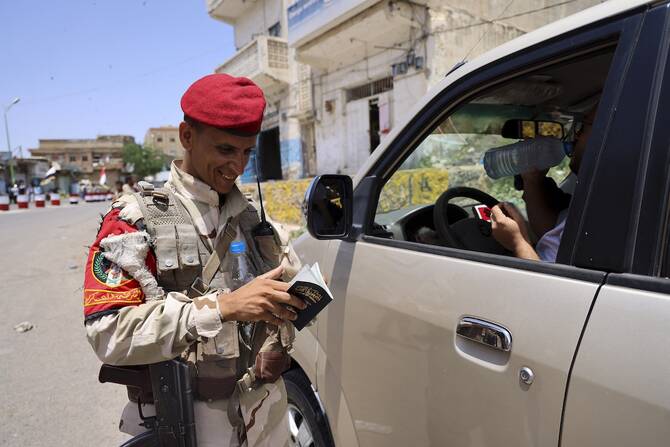
The ID of a driver is checked as people celebrate the reopening of the road from the city of Taiz, in the southwest of the country, to the Huthi-controlled capital Sanaa, after barriers were removed, on June 13, 2024. (FILE/AFP)
Short Url
Updated 17 February 2026
Follow

Lawyers in Sanaa face Houthi repression: report

  • Claims of arbitrary arrests and detentions, direct threats
  • 159 Houthi violations in 2025, 88 in 2024, 135 in 2023

RIYADH: In Yemen, the Houthis are attacking lawyers, raising widespread concerns about the rule of law and state of the justice system, Asharq Al-Awsat reported on Tuesday.

“Recent reports from local human rights organizations have revealed a recurring pattern of systematic restrictions on the practice of (the) law profession, including arbitrary arrests, prolonged detentions, and direct threats,” according to Arab News’ sister publication.

The publication added that the situation “in Sanaa and other Houthi-controlled cities no longer provides a professional environment for lawyers who themselves are now subject to questioning or targeted for defending their clients, especially in cases of a political or human rights nature.”

The Daoo Foundation for Rights and Development organization have reported more than 382 Houthi violations against lawyers in Sanaa from January 2023 to December 2025.

These include arbitrary arrests, prolonged detention without legal justification, threats of murder and assault, preventing them from practicing law, and restrictions on the right to defense in cases of a political or human rights nature.

The report stated that there were 159 Houthi violations against lawyers in 2025, 88 in 2024 and 135 in 2023, which was described as a “systematic pattern.”

Local and international human rights organizations have called for urgent intervention to protect the legal practitioners in Yemen.

“Human rights activists believe that protecting lawyers is a prerequisite for maintaining any future reform or political path because the absence of an independent defense means the absence of justice itself,” Asharq Al-Awsat reported.


Arab, Muslim countries slam US ambassador’s remarks on Israel’s right to Middle East land

Updated 47 min 36 sec ago
Follow

Arab, Muslim countries slam US ambassador’s remarks on Israel’s right to Middle East land

  • The backlash widened sharply on Sunday as more than a dozen Arab and Islamic governments issued a joint statement denouncing the US diplomat’s comments as “dangerous and inflammatory”

JERUSALEM: Arab and Islamic countries issued a joint condemnation on Sunday of remarks by US ambassador to Israel Mike Huckabee, who suggested Israel had a biblical right to a vast swath of the Middle East.
Huckabee, a former Baptist minister and a fervent Israel supporter, was speaking on the podcast of far-right commentator and Israel critic Tucker Carlson.
In an episode released Friday, Carlson pushed Huckabee on the meaning of a biblical verse sometimes interpreted as saying that Israel is entitled to the land between the river Nile in Egypt and the Euphrates in Syria and Iraq.
In response, Huckabee said: “It would be fine if they took it all.”
When pressed, however, he continued that Israel was “not asking to take all of that,” adding: “It was somewhat of a hyperbolic statement.”
The backlash widened sharply on Sunday as more than a dozen Arab and Islamic governments — alongside three major regional organizations — issued a joint statement denouncing the US diplomat’s comments as “dangerous and inflammatory.”
The statement, released by the United Arab Emirates’ foreign ministry, was signed by the UAE, Egypt, Jordan, Indonesia, Pakistan, Turkiye, Saudi Arabia, Qatar, Kuwait, Oman, Bahrain, Lebanon, Syria and the State of Palestine, as well as the Organization of Islamic Cooperation, the Arab League and the Gulf Cooperation Council.
They said the comments contravene the UN Charter and efforts to de-escalate the Gaza war and advance a political horizon for a comprehensive settlement.
Iran joined the chorus with its foreign ministry accusing Huckabee on X of revealing “American active complicity” in what it called Israel’s “expansionist wars of aggression” against Palestinians.
Earlier, several Arab states had issued unilateral condemnations.
Saudi Arabia described the ambassador’s words as “reckless” and “irresponsible,” while Jordan said it was “an assault on the sovereignty of the countries of the region.”
Kuwait decried what it called a “flagrant violation of the principles of international law,” while Oman said the comments “threatened the prospects for peace” and stability in the region.
Egypt’s foreign ministry reaffirmed “that Israel has no sovereignty over the occupied Palestinian territory or any other Arab lands.”
The Palestinian Authority said on X that Huckabee’s words “contradict US President Donald Trump’s rejection of (Israel) annexing the West Bank.”
On Saturday, Huckabee published two posts on X further clarifying his position on other topics touched upon in the interview, but did not address his remark about the biblical verse.
The speaker of the Israeli parliament, Amir Ohana, praised Huckabee on X for his general pro-Israel stance in the interview, and accused Carlson of “falsehoods and manipulations.”
Carlson has recently found himself facing accusations of antisemitism, particularly following a lengthy, uncritical interview with self-described white nationalist Nick Fuentes — a figure who has praised Hitler, denied the Holocaust and branded American Jews as disloyal.