

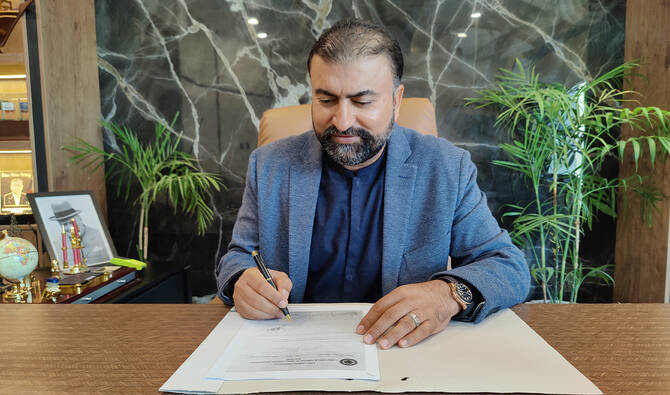

ISLAMABAD: Pakistan has assured foreign investors it has the “capacity and capability” to secure the multibillion-dollar Reko Diq copper-gold mine, Balochistan Chief Minister Sarfraz Bugti said on Monday after Canada’s Barrick Mining Corporation ordered a review of the project following deadly separatist attacks in the province last month.
The mining giant announced it would reassess all aspects of the project after coordinated Jan. 30-31 assaults by the Baloch Liberation Army (BLA) killed 36 civilians and 22 security personnel across multiple districts of the remote southwestern province. Pakistani authorities say 216 militants were killed in follow-up operations.
The Reko Diq mine, one of the world’s largest undeveloped copper and gold deposits, is a cornerstone of Pakistan’s efforts to attract foreign investment and expand mineral exports after a prolonged economic crisis. Islamabad hopes the mines will generate $70 billion in free cash flow and $90 billion in operating cash flow. The project, expected to begin production in 2028, is jointly owned by Barrick Gold and the governments of Pakistan and Balochistan.
The project’s development, however, has repeatedly been overshadowed by security concerns in Balochistan, a sparsely populated province bordering Iran and Afghanistan that has faced a decades-long insurgency in which separatist groups target security forces, infrastructure and projects linked to foreign investment. Militants accuse the state of exploiting local resources without benefiting residents, an allegation the government denies.
“Of course, the government of Balochistan is concerned [about security], it’s not that they aren’t,” Bugti told Arab News in an interview in Islamabad.
“Barrick Gold has a very large investment and we have other international partners in that [Reko Diq mining project]. We want to assure them through your platform as well and also when our meetings will take place that we have the capacity and capability to protect our foreign investors.
“The state is intact, the government is intact. There is a functional government, there is a functional state in Balochistan.”
Bugti said authorities were redesigning security arrangements for the project, including raising a dedicated protection force in mineral-bearing areas and strengthening border controls. However, he acknowledged that attacks affected investor confidence.
“Yes, [attacks] do make a dent, when your country or province takes off [economically],” he said. “It does impact the perception.”
However, Bugti refused to describe the coordinated January attacks as a “security failure.”
“A security failure is when the [army’s] corps headquarters is captured ... when someone seizes control of the biggest cantonment in Quetta, or for that matter, captures our IG [Inspector-General of Police] headquarters, or the IG FC [Frontier Corps] headquarters, you call it a security failure,” the chief minister said.
“I say it was a success of security forces that within hours, as I told you, other than Nushki, everything was clear.”
The minister accused Pakistan’s neighbor and archival India of supporting insurgent groups in Balochistan, an allegation New Delhi has repeatedly denied.
“What evidence do you need? Kulbhushan Jadhav was not here to sell chickpeas. It is on record that he was an intelligence officer who came to support Baloch insurgents, and the way he was arrested highlighted this,” he said.
Jadhav is an Indian national arrested by Pakistan in 2016 and convicted by a military court on espionage charges. India disputes the allegations and challenged the case at the International Court of Justice, which ordered Pakistan to review the conviction but did not rule on guilt or innocence.
Ultimately, Bugti said long-term stability in Balochistan depended on pursuing economic development alongside security operations.
“See there is a development paradigm and the security paradigm. Both should be carried forward together,” he said.
“My vision is that meritocracy and an anti-corruption drive are key to success in Balochistan.”


