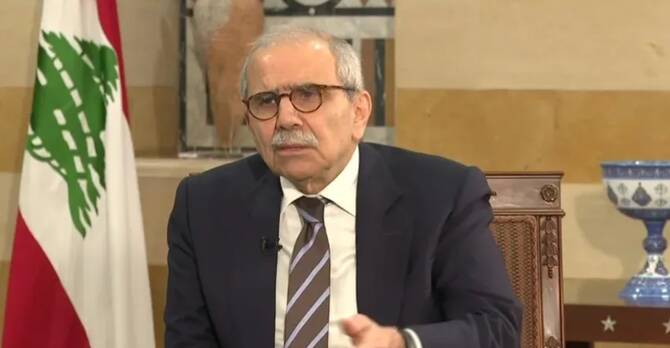

BEIRUT: Lebanese Prime Minister Nawaf Salam stated that his government can overcome differences with the International Monetary Fund regarding a draft law that would allow depositors to recover billions of dollars stuck in the struggling banking sector.
In December, Salam’s government approved a rule known as the Financial Gap Law, which allows depositors to withdraw up to $100,000 each over the next four years, with larger amounts being converted into bonds backed by central bank assets. The cash withdrawals will be financed by local banks and the regulatory authority.
The IMF is holding talks with Lebanon regarding a financing program and seeks the implementation of a package of government measures before committing to providing funding, most notably restructuring banks and repaying depositors’ funds.
In an interview with Bloomberg, Salam explained that the IMF “wants further clarifications on a number of issues,” adding: “In my opinion, any observations or statements that might create a gap can be bridged.”
Lebanon defaulted on about $30 billion in international bonds in 2020, amid the worst economic crisis it has witnessed since the 19th century. Investors see cooperation with the IMF as crucial for achieving a positive recovery.
In previous years, Lebanese banks deposited massive amounts of dollars with the Banque du Liban, but this arrangement collapsed in 2019 as foreign capital inflows stopped and the currency peg collapsed. The central bank was unable to repay around $80 billion to the banks, leading to financial paralysis and the loss of citizens' savings.
IMF reservations
Speaking on the sidelines of the Munich Security Conference, Salam said the IMF is “not completely satisfied” with the “wording concerning the sequencing of claims” in the draft law, which will soon be reviewed by a parliamentary committee.
He added: “It’s also about sustainability, and sustainability is linked to debt sustainability. They want to ensure that sufficient liquidity is available to meet our obligations.”
The legal hierarchy of claims stipulates that local bank shareholders should bear the losses first, followed by creditors, and then depositors. The current draft law stipulates that banks and the central bank share the burden of repaying deposits for both small and large depositors.
The IMF has emphasized that the restructuring plan must align with international principles, including respecting the hierarchy of claims and not imposing losses on depositors before they are imposed on shareholders or junior creditors.
The BDL’s foreign currency reserves currently stand at around $11.9 billion, while gold reserves are estimated at about $45.8 billion.
No agreement on currency value
Salam, a former president of the International Court of Justice, noted that the IMF mission concluded a four-day visit to Beirut on Friday, explaining that he met with the delegation before heading to Germany.
He also said that the central bank considers the government owes it around $16.5 billion, but an agreement has not yet been reached on the value of the currency, and therefore, the precise value of this debt. He warned that finalizing this agreement could affect the government's ability to service its debt.
Salam concluded by saying: “There is an aspect of this file related to the IMF, and we have made it clear that we will also negotiate with them. We hope to reach an agreed-upon figure within a few weeks.”