

Pakistan PM in Austria to strengthen economic ties on first official visit in over 30 years

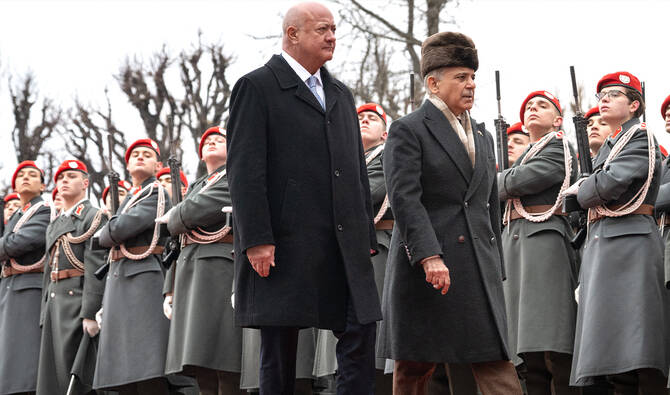
Austrian Chancellor Christian Stocker (left) receives Pakistani Prime Minister Shehbaz Sharif (right) at the chancellery in Vienna, Austria, February 16, 2026. (Reuters)
Short Url
Updated 16 February 2026
Follow

Pakistan PM in Austria to strengthen economic ties on first official visit in over 30 years

  • PM Shehbaz Sharif will meet Austrian Chancellor Christian Stocker, address Pakistan–Austria Business Forum
  • The Pakistan premier says the focus of his interactions would be on trade, investment and economic cooperation

ISLAMABAD: Prime Minister Shehbaz Sharif arrived in Vienna on Sunday on a two-day visit to strengthen bilateral economic cooperation, marking the first official visit by a Pakistani premier to Austria in over three decades.

Sharif is undertaking the visit, which marks 70 years of diplomatic relations between the two countries, at Austrian Chancellor Christian Stocker’s invitation, according to the Pakistani foreign office.

This marks the first visit by any Pakistani prime minister to Austria in more than three decades since then prime minister Nawaz Sharif, who is also Sharif’s elder brother, visited the country in 1992.

Sharif, accompanied by a high-level delegation, was warmly welcomed by Austrian officials and presented a salute by a contingent of Austrian armed forces upon arrival at the Vienna airport, his office said.

“Wheels down in Vienna, a city of history, culture and global diplomacy,” the Pakistan premier said on X late Sunday, adding that he looked forward to his meeting with Chancellor Stocker.


Austrian Chancellor Christian Stocker (left) receives Pakistani Prime Minister Shehbaz Sharif (right) at the chancellery in Vienna, Austria, February 16, 2026. (Reuters)

“Our focus shall be on trade, investment and economic cooperation.”

He said he was also keen to engage with the leadership of the International Atomic Energy Agency, United Nations Office of Drugs and Crime and United Nations Industrial Development Organization to deepen cooperation in peaceful nuclear energy, counter-narcotics and crime control, sustainable industrial development and shared progress.

During the visit, Sharif’s office said, the prime minister will also address the Pakistan-Austria Business Forum and co-chair with the Austrian chancellor a meeting of leading businessmen to increase investment between the two countries.

Islamabad and Vienna enjoy cooperation in the domains of trade, economy, culture and education, according to the Pakistani foreign ministry. Sharif’s visit will establish new dimensions to the Pakistan-Austria relations.


Pakistan hails Bangladesh’s ‘historic democratic transition’ as ties gather momentum

Updated 6 sec ago
Follow

Pakistan hails Bangladesh’s ‘historic democratic transition’ as ties gather momentum

  • Ahsan Iqbal visits Dhaka for the swearing-in of PM-elect Tarique Rahman after recent elections
  • Islamabad calls for building connectivity, expanding trade and shaping a stable region together

ISLAMABAD: Pakistan’s Planning Minister Ahsan Iqbal on Tuesday congratulated Bangladesh on a “historic democratic transition,” as he pointed to positive momentum in Pakistan-Bangladesh relations during a visit to Dhaka for the oath-taking of Prime Minister-elect Tarique Rahman.

Bangladesh’s parliament was sworn in earlier in the day, marking the first elected legislature since a deadly 2024 uprising that toppled the government of Sheikh Hasina. Rahman, 60, is chief of the Bangladesh Nationalist Party (BNP) and won a landslide victory in the February 12 elections.

He is set to formally take office later on Tuesday after lawmakers pledged loyalty before their country’s chief election commissioner.

The Pakistani minister said in a social media post on X he met Bangladesh’s Chief Adviser, Muhammad Yunus, and congratulated him “on the successful conduct of elections and the historic democratic transition.”

“Our discussions focused on opening a new, forward-looking chapter in Pakistan-Bangladesh relations,” he said. “I expressed appreciation for the positive momentum in bilateral ties, including growing trade engagement, revival of direct air connectivity, and renewed people-to-people contacts.”

Pakistan’s Minister for Planning, Development and Special Initiatives, Ahsan Iqbal (left), paid a courtesy call on Chief Adviser Professor Muhammad Yunus (right) at the State Guest House Jamuna in Dhaka, Bangladesh, on February 17, 2026. (AhsanIqbal/X)

“We agreed that the current regional and geopolitical environment demands greater economic cooperation, connectivity, and collaboration between our two countries,” he added.

Iqbal also extended an invitation to Yunus to visit Pakistan to institutionalize cooperation in youth empowerment, innovation and sustainable development.

“Pakistan and Bangladesh share deep cultural, historical, and social affinities,” he said. “It is time to transform these affinities into structured economic partnerships, academic exchanges, and regional cooperation. Our future lies in building connectivity, expanding trade, empowering youth, and shaping a stable and prosperous South Asia together.”

Bangladesh’s Prime Minister-elect Rahman has pledged to restore economic stability and revive growth after months of turmoil that rattled investor confidence in the world’s second-largest garment exporter. In his victory speech, he described the outcome as a win for democracy but warned of challenges, including a fragile economy and weakened institutions.

Pakistan and Bangladesh have improved bilateral ties amid a recent thaw in relations. The two countries were part of the same state until Bangladesh’s secession following a bloody civil war in 1971, an event that long cast a shadow over ties.

Relations have warmed since August 2024, after the ouster of Hasina, who was widely viewed as close to India. While Islamabad and Dhaka have moved closer, ties between Bangladesh and New Delhi remain strained over India’s decision to grant asylum to Hasina.