


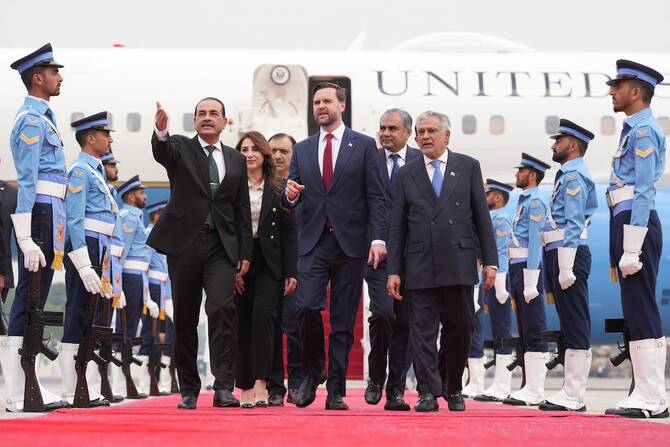
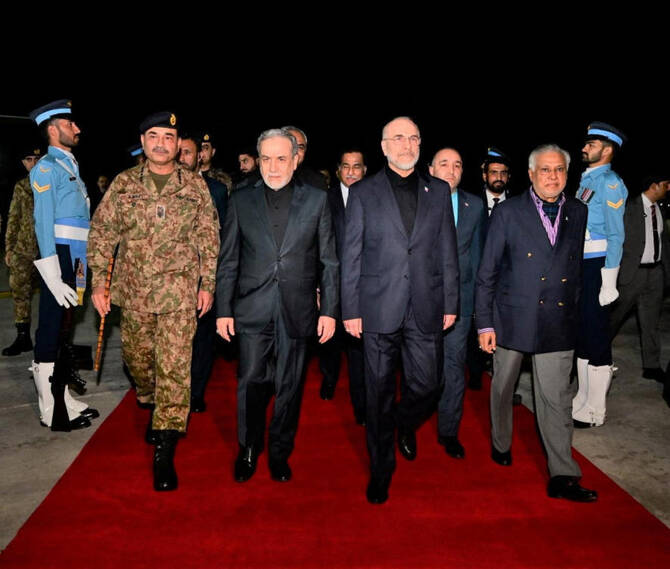


ISLAMABAD: Two rounds of talks have taken place between Iranian and US officials in Pakistan, while a third round got underway late on Saturday evening into Sunday morning, Iranian state television reported as negotiations continued in Islamabad.
“According to information provided to the state TV correspondent by a person close to the negotiating team, another round of negotiations will likely be held tonight or tomorrow,” state broadcaster IRIB reported.
The trilateral direct negotiations were taking place with host Pakistan, a senior White House official said earlier Saturday, a departure from recent practice where both sides held talks via a mediator while seated in separate rooms.
Iranian news agency Tasnim reported that the issue of the strategic Strait of Hormuz — through which nearly global crude oil and liquefied natural gas passes in peacetime — was “one of the topics that faces serious disagreement” among the negotiators.
Iran has demanded that the ceasefire extend to Lebanon and that sanctions be lifted, while the United States has ruled out concessions on uranium enrichment and signaled skepticism over reopening key oil routes.
Disagreements also persist over Iran’s missile program and the broader scope of the truce, underscoring the fragile nature of the talks and the risk that negotiations could stall or require multiple rounds to make progress.
“There has been 47 years of tension between the United States and Iran,” Pakistan’s Law Minister Azam Nazeer Tarar told Geo TV. “Such matters are not resolved in just a one- or two-hour sitting.”
“At the outset … a one-day timeframe was expected,” he added. “If this engagement remains positive, the talks could extend into tomorrow.”
The reports came as the White House said high-level in-person trilateral talks with Iran and Pakistan were “ongoing” in Islamabad late on Saturday.
A senior White House official had told Arab News in a written response earlier on Saturday: “The US, Pakistan, and Iran are holding a trilateral face to face meeting today.”
An Iranian government account on X said talks had “entered the expert-level stage as economic, military, legal, and nuclear committees joined.”
It continued: “Negotiations continue at the Serena Hotel to finalize technical details.”
A Pakistani official, speaking on condition of anonymity, told AFP that talks were “progressing in the right direction" after two round and that “discussions are moving positively and the overall atmosphere is cordial.”
The two delegations had earlier communicated through intermediaries and held separate meetings with PM Sharif, a third Pakistani government official told Arab News.
Pakistan is hosting the talks after weeks of diplomatic outreach led by Prime Minister Shehbaz Sharif, Deputy Prime Minister and Foreign Minister Ishaq Dar and Field Marshal Asim Munir, positioning Islamabad as a key intermediary in a conflict that began with US-Israeli strikes on Iran on Feb. 28.
The war has caused the biggest oil supply shock on record, damaging regional energy production and raising fears of inflation, food insecurity and a potential global economic slowdown.
* With AFP


