Kim Jong Un’s sister says South Korea’s drone regret ‘sensible’, but warns of retaliation

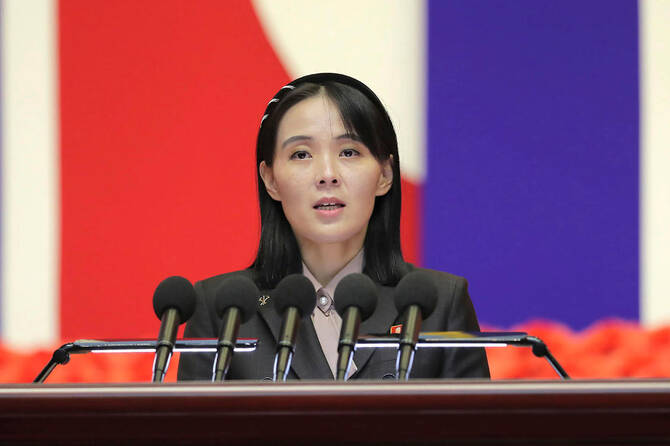
Kim Yo Jong, sister of North Korean leader Kim Jong Un, demanded stronger measures from Seoul to prevent similar activities in the future. (KCNA/KNS via AP)
Short Url
Updated 13 February 2026
Follow

Kim Jong Un’s sister says South Korea’s drone regret ‘sensible’, but warns of retaliation

  • North Korea threatened retaliation last month after accusing South Korea of launching a surveillance drone flight in September and again in January

SEOUL: The powerful sister of North Korean leader Kim Jong Un said Friday it was “sensible” for a South Korean government official to express regret for alleged civilian drone flights over North Korea but warned of counterattacks if they recur.
The statement by Kim Yo Jong came after South Korean Unification Minister Chung Dong-young on Tuesday expressed “deep regret” over the alleged flights and stressed that Seoul’s liberal government seeks “mutual recognition and peaceful coexistence” between the war-divided rivals.
North Korea threatened retaliation last month after accusing South Korea of launching a surveillance drone flight in September and again in January.
The South Korean government has denied operating any drones during the times specified by North Korea but law enforcement authorities are investigating three civilians suspected of flying drones into the North from border areas.
The development threatens to further dampen prospects for a push by Seoul to resume long-stalled talks with North Korea amid a deepening nuclear standoff.
Kim Yo Jong said Chung’s comments displayed “sensible behavior” but were insufficient as a government response, demanding stronger measures from Seoul to prevent similar activities in the future.
“I give advance warning that reoccurrence of such provocation as violating the inalienable sovereignty of the DPRK will surely provoke a terrible response,” she said, using the initials of North Korea’s formal name, the Democratic People’s Republic of Korea.
“Various counterattack plans are on the table and one of them will be chosen without doubt and it will go beyond proportionality,” she said without specifying.
The Unification Ministry, which handles inter-Korean affairs, said the alleged drone flights ran counter to the government’s principles of reducing tensions and that it plans to take unspecified steps to prevent similar incidents.
Analysts say North Korea’s drone accusations were likely driven by its efforts to dial up anti-South Korea sentiments ahead of the ruling Workers’ Party congress in late February. North Korea could add leader Kim Jong Un’s declaration of a hostile “two-state” system on the Korean Peninsula in the party constitution during the congress, the first of its kind in five years.
There have been no public talks between the Koreas since 2019 and drone flights are a source of animosity between the rivals.


India hosts global leaders, tech moguls at AI Impact Summit

Updated 5 sec ago
Follow

India hosts global leaders, tech moguls at AI Impact Summit

  • 20 heads of state scheduled to attend event which runs until Feb. 20
  • Summit expected to speed up adoption of AI in India’s governance, expert says

NEW DELHI: A global artificial intelligence summit opened in New Delhi on Monday, with representatives of more than 60 countries scheduled to discuss the use and regulation of AI with the industry’s leaders and investors.

The India AI Impact Summit 2026 is hosted by the Indian government’s IndiaAI Mission — an initiative worth in excess of $1 billion and launched by the Ministry of Electronics and Information Technology in 2024 to develop the AI ecosystem in the country.

After five days of sessions and an accompanying exhibition of 300 companies at Bharat Mandapam  — the venue of the 2023 G20 summit  — participating leaders are expected to sign a declaration which, according to the organizer, will outline a “shared road map for global AI governance and collaboration.”

Prime Minister Narendra Modi, who will attend the summit on Friday with French President Emmanuel Macron, said on X it was a “matter of great pride for us that people from around the world are coming to India” for the event, which is evidence that the country is “rapidly advancing in the fields of science and technology and is making a significant contribution to global development.”

Among the 20 heads of state that the Indian Ministry of External Affairs has announced as scheduled to attend are Macron, Brazilian President Luiz Inacio Lula da Silva, Spanish Prime Minister Pedro Sanchez, Finnish Prime Minister Petteri Orpo, and Sheikh Khaled bin Mohamed bin Zayed Al-Nahyan, Abu Dhabi’s crown prince.

Also expected are tech moguls such as OpenAI CEO Sam Altman and Google’s chief Sundar Pichai.

The summit will give India, the world’s most populous country, a platform to try to steer cooperation and AI regulation between the West and the Global South, and to present to the global audience its own technological development.

“India is leveraging its position as a bridge between emerging and developed economies to bring together not just country leaders and technologists, but also delegates, policy analysts, media, and others … to explore the facets of AI, multilateral collaborations, and the direction that large-scale development of AI should take,” said Anwesha Sen, assistant program manager for technology and policy at Takshashila Institution.

“India is trying to do three things through the AI Impact Summit. One, India is advocating for sovereign AI and the development of inclusive, population-scale solutions. Two, establishing international collaborations that prioritize AI diffusion in sectors like healthcare and agriculture. And three, showcasing how Indian startups and organizations are using frameworks such as that of digital public infrastructure as a model to bridge the two.”

It is the fourth such gathering dedicated to the development of AI. The first one was held in the UK in 2023, a year after the debut of ChatGPT; the 2024 meeting in South Korea; and last year’s event took place in France.

The summit is likely to help the Indian government in speeding up the adoption of AI, according to Nikhil Pahwa, digital rights activist and founder of MediaNama, a mobile and digital news portal, who likened it to the Digital India initiative launched in 2015 to provide digital government services.

“A summit like this, with this much bandwidth allocated to it by the government, even if the agenda is flat, ends up making AI a priority focus for ministries and state governments,” Pahwa told Arab News.

“It encourages diffusion of AI execution-specific thinking and ends up increasing adoption of AI in governance and by both central and state-level ministries. That reduces time for adoption of AI.

“We saw this play out with the government’s Digital India focus: it increased digitization and the adoption of digital technology. The agenda and India’s role in AI globally is less important than speeding up adoption.”