North Korea accuses South of another drone incursion

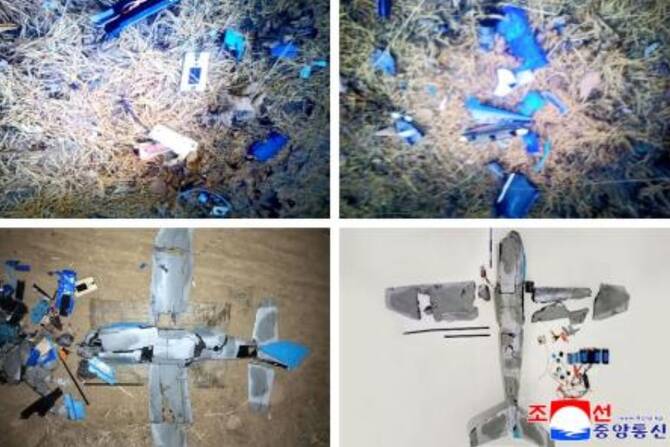
These images taken on Jan. 4, 2026 and released as a combo image by North Korea’s official Korean Central News Agency (KCNA) via KNS on Jan. 10, 2026 shows wreckage of a drone that North Korea claims originated from South Korea. (AFP)
Short Url
Updated 10 January 2026
Follow

North Korea accuses South of another drone incursion

  • The North Korean military tracked a drone “moving northwards” over the South Korean border county of Ganghwa
  • South Korea said it had no record of the flight

SEOUL: North Korea accused the South on Saturday of flying another spy drone over its territory this month, a claim that Seoul denied.
The North Korean military tracked a drone “moving northwards” over the South Korean border county of Ganghwa in early January before shooting it down near the North Korean city of Kaesong, a spokesperson said in a statement carried by the state-run Korean Central News Agency (KCNA).
“Surveillance equipment was installed” on the drone and analysis of the wreckage showed it had stored footage of the North’s “important targets” including border areas, the spokesperson said.
Photos of the alleged drone released by KCNA showed the wreckage of a winged craft lying on the ground next to a collection of grey and blue components it said included cameras.
South Korea said it had no record of the flight, and Defense Minister Ahn Gyu-back said the drone in the photos was “not a model operated by our military.”
The office of South Korean President Lee Jae Myung said a national security meeting would be held on Saturday to discuss the matter.
Lee had ordered a “swift and rigorous investigation” by a joint military-police investigative team, his office said in a later statement.
On the possibility that civilians operated the drone, Lee said: “if true, it is a serious crime that threatens peace on the Korean Peninsula and national security.”
Located northwest of Seoul, Ganghwa County is one of the closest South Korean territories to North Korea.
KCNA also released aerial images of Kaesong that it said were taken by the drone.
They were “clear evidence” that the aircraft had “intruded into (our) airspace for the purpose of surveillance and reconnaissance,” Pyongyang’s military spokesperson said.
They added that the incursion was similar to one in September when the South flew drones near its border city of Paju.
Seoul would be forced to “pay a dear price for their unpardonable hysteria” if such flights continued, the spokesperson said.
South Korea is already investigating alleged drone flights over the North in late 2024 ordered by then-President Yoon Suk Yeol. Seoul’s military has not confirmed those flights.
Prosecutors have indicted Yoon on charges that he acted illegally in ordering them, hoping to provoke a response from Pyongyang and use it as a pretext for his short-lived bid to impose martial law.

- Cheap, commercial drone -

Flight-path data showed the latest drone was flying in square patterns over Kaesong before it was shot down, KCNA said.
But experts said the cheap, commercially available model was unlikely to have come from Seoul’s armed forces.
“The South Korean military already has drones capable of transmitting high-resolution live feeds,” said Hong Min, an analyst at the Korea Institute for National Unification.
“Using an outdated drone that requires physical retrieval of a memory card, simply to film factory rooftops clearly visible on satellite imagery, does not hold up from a military planning perspective.”

Uganda’s presidential election experiences hours of delays at some polling stations

Updated 7 sec ago
Follow

Uganda’s presidential election experiences hours of delays at some polling stations

  • Some polling stations remained closed for up to four hours after the scheduled 7 a.m. start time due to “technical challenges“
  • The East African country of roughly 45 million people has 21.6 million registered voters

KAMPALA, Uganda: Uganda’s presidential election was plagued by widespread delays Thursday in addition to a days-long Internet shutdown that has been criticized as an anti-democratic tactic in a country where the president has held office since 1986.
Some polling stations remained closed for up to four hours after the scheduled 7 a.m. start time due to “technical challenges,” according to the nation’s electoral commission, which asked polling officers to use paper registration records to ensure the difficulties did not “disenfranchise any voter.”
President Yoweri Museveni, 81, faces seven other candidates, including Robert Kyagulanyi, a musician-turned-politician best known as Bobi Wine, who is calling for political change.
The East African country of roughly 45 million people has 21.6 million registered voters. Polls are expected to close at 4 p.m. Thursday, according to the electoral commission. Results are constitutionally required to be announced in 48 hours.
Impatient crowds gathered outside polling stations expressing concerns over the delays Thursday morning. Umaru Mutyaba, a polling agent for a parliamentary candidate, said it was “frustrating” to be waiting outside a station in the capital Kampala.
“We can’t be standing here waiting to vote as if we have nothing else to do,” he said.
Wine alleged there was electoral fraud occurring, noting that biometric voter identification machines were not working at polling places and claiming there was “ballot stuffing.”
“Our leaders, including Deputy President for Western Region, arrested. Many of our polling agents and supervisors abducted, and others chased off polling stations,” Wine wrote in a post on social media platform X.
Museveni told journalists he was notfied biometric machines were inoperable at some stations and he supported the electoral body’s decision to revert to paper registration records. He did not comment on the allegation of fraud.
Ssemujju Nganda, a prominent opposition figure and lawmaker seeking reelection in Kira municipality, told The Associated Press he had been waiting in line to vote for three hours.
Nganda also noted biometric machines were malfunctioning, in addition to the late arrival of balloting materials, and predicted the delays likely would lead to apathy and low turnout in urban areas where the opposition has substantial support.
“It’s going to be chaos,” he said Thursday morning.
Nicholas Sengoba, an independent analyst and newspaper columnist, said delays to the start of voting in urban, opposition areas favored the ruling party.
Museveni serving Africa’s third-longest presidential term
Uganda has not witnessed a peaceful transfer of presidential power since independence from British colonial rule six decades ago.
Museveni has served the third-longest term of any African leader and is seeking to extend his rule into a fifth decade. Some critics say removing him through elections remains difficult, but the aging president’s authority has become increasingly dependent on the military led by his son, Muhoozi Kainerugaba.
Museveni and Wine are reprising their rivalry from the previous election in 2021, when Wine appealed to mostly young people in urban areas. With voter turnout of 59 percent, Wine secured 35 percent of the ballots against Museveni’s 58 percent, the president’s smallest vote share since his first electoral campaign three decades ago.
The lead-up to Thursday’s election produced concerns about transparency, the possibility of hereditary rule, military interference and opposition strategies to prevent vote tampering at polling stations.
Uganda’s Internet was shut down Tuesday by the government communications agency, which cited misinformation, electoral fraud and incitement of violence. The shutdown has affected the public and disrupted critical sectors such as banking.
Heavy security deployed
There has been heavy security leading up to voting, including military units deployed on the streets this week.
Amnesty International said security forces are engaging in a “brutal campaign of repression,” citing a Nov. 28 opposition rally in eastern Uganda where the military blocked exits and opened fire on supporters, killing one person.
Museveni urged voters to come out in large numbers during his final rally Tuesday.
“You go and vote, anybody who tries to interfere with your freedom will be crushed. I am telling you this. We are ready to put an end to this indiscipline,” he said.
The national electoral commission chairperson, Simon Byabakama, urged tolerance among Ugandans as they vote.
“Let us keep the peace that we have,” Byabakama said late Wednesday. “Let us be civil. Let us be courteous. Let’s be tolerant. Even if you know that this person does not support (your) candidate, please give him or her room or opportunity to go and exercise his or her constitutional right.”
Authorities also suspended the activities of several civic groups during the campaign season. That Group, a prominent media watchdog, closed its office Wednesday after the interior ministry alleged in a letter that the group was involved in activities “prejudicial to the security and laws of Uganda.”
Veteran opposition figure Kizza Besigye, a four-time presidential candidate, remains in prison after he was charged with treason in February 2025.