

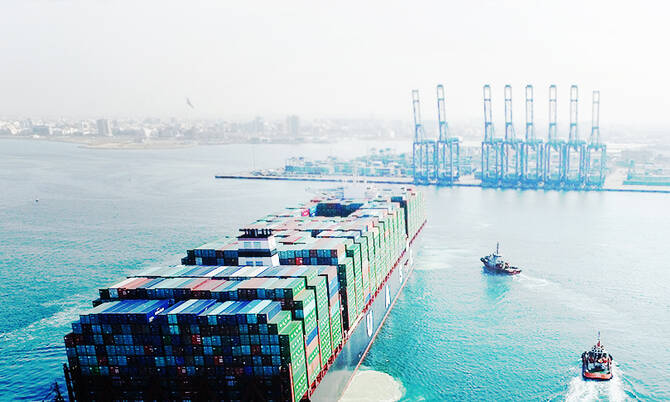
Saudi ports container handling rises 2% to 738k TEUs in January: Mawani 

Ports overseen by the Saudi Ports Authority, known as Mawani, reported that transshipment containers surged 22.44 percent year on year to 184,019 TEUs. File photo
Short Url
Updated 12 February 2026
Follow

Saudi ports container handling rises 2% to 738k TEUs in January: Mawani 

RIYADH: Saudi Arabia’s ports handled 738,111 twenty-foot equivalent units in January, a 2.01 percent increase from a year earlier, driven by a sharp rise in transshipment volumes despite weaker inbound and outbound trade. 

Ports overseen by the Saudi Ports Authority, known as Mawani, reported that transshipment containers surged 22.44 percent year on year to 184,019 TEUs, helping offset softer cargo flows.  

This comes as Saudi Arabia accelerates efforts to position itself as a global logistics hub under its National Transport and Logistics Strategy, investing heavily in port infrastructure and supply-chain integration to capture a larger share of regional trade flows. 

Mawani emphasized in a statement that the increased container handling “delivers multiple economic benefits, including enhanced trade activity, stimulation of maritime-related industries, tourism growth, and strengthened supply chains.” 

While overall container volumes grew, the figures revealed a mixed performance across different segments. Inbound container volumes declined 3.23 percent to 284,375 TEUs, while outbound containers fell 3.47 percent to 269,717 TEUs compared to January 2025. 

Passenger traffic through Saudi ports jumped 42.27 percent to 143,566 travelers in January, while vehicle volumes rose 3.31 percent to 109,097 units.  

Livestock imports showed particularly strong momentum, with ports receiving 886,908 heads of cattle — a 49.86 percent increase compared to 591,824 heads during the same period in 2025. 

Liquid bulk cargo registered a marginal increase of 0.28 percent, reaching 14.1 million tonnes. However, total handled tonnage — including general cargo, dry bulk, and liquid bulk — declined 3.04 percent to 19.2 million tonnes. General cargo stood at 839,987 tonnes, while dry bulk reached 4.26 million tonnes. 

Vessel traffic experienced a slight decrease of 1.75 percent, with 1,121 ships calling at Saudi ports compared to 1,141 ships in January 2025. 

The positive January figures follow a strong 2025 performance, during which Mawani-supervised ports achieved a 10.58 percent annual increase in container throughput, handling 8.32 million TEUs compared to 7.52 million TEUs in 2024. Transshipment containers for full-year 2025 rose 11.78 percent to 1.93 million TEUs. 

The total number of outgoing containers rose by 11.72 percent in 2025 to reach 3.1 million TEUs, compared to 2.8 million TEUs, while the total number of incoming containers increased by 8.82 percent to reach 3.2 million TEUs in 2025, compared to 2.9 million TEUs a year earlier. 


Industry minister inaugurates advanced factories in Sudair

Updated 8 sec ago
Follow

Industry minister inaugurates advanced factories in Sudair

SUDAIR: Minister of Industry and Mineral Resources and Chairman of the Board of the Saudi Authority for Industrial Cities and Technology Zones, known as MODON, Bandar Alkhorayef, on Feb. 16, inaugurated several advanced factories to produce food, pharmaceuticals, medical equipment, and construction materials in Sudair City for Industry and Businesses.

The move is part of the ministry’s efforts to localize high-value industries and enhance the Kingdom’s health and food security.

The minister inaugurated the Sierra Life factory, the first facility in the Middle East specializing in producing medical foods for metabolic disorders.

This strategic investment aims to localize advanced therapeutic food production and integrate the industrial and health sectors to meet medical needs previously heavily reliant on imports.

Alkhorayef reviewed precise production lines for patients with metabolic disorders such as phenylketonuria, or PKU, and urea cycle disorders, as well as gluten-free and low-protein products for celiac patients.

The facility employs advanced manufacturing technologies and global quality standards, establishing a unique medical-industrial hub serving specialized medical cases in the region.

The minister also inaugurated the Sudair Warehouses project, representing an important step in developing logistics and industrial infrastructure.

The project reflects the industrial sector’s commitment to supporting industrial investors, stimulating high-value investments, and enabling national supply chains, thereby contributing to the achievement of Saudi Vision 2030 objectives.

Among the facilities inaugurated was Qomel Pharmaceutical Industries, supporting the localization of biopharmaceutical production in Saudi Arabia.

During his tour, the minister also reviewed the fully integrated industrial environment for producing solid pharmaceutical forms, such as tablets and capsules, advanced manufacturing operations, robust quality systems, high-level regulatory compliance procedures, and modern technologies that enhance production efficiency according to international standards. These measures help ensure product quality, reliability, and safety.

Alkhorayef also inaugurated Al-Hatab Foods Factory, the largest chilled food facility in the Middle East and a pioneering national project supporting the growth of the Kingdom’s food industry.

The minister reviewed advanced manufacturing methods that reduce bacterial growth and prolong shelf life without preservatives or heat treatment, maintaining nutritional value and high quality.

Al-Hatab operates 15 production lines for a wide range of fresh foods, including juices, salads, and sandwiches, with a capacity exceeding 6 million units per week, meeting growing domestic demand and reflecting the evolution of the Saudi food industry.

Alkhorayef also inaugurated the Industrial Orthopedic Co., which focuses on localizing the production of orthopedic medical devices. He reviewed production processes and technologies for manufacturing rods and screws for limb and spinal fracture treatment, artificial joints, and patient-specific products using 3D printing.

The project is currently undergoing operational testing, qualification, and workforce training, while quality, documentation, and traceability systems are being finalized ahead of full-scale production and regional and global expansion.

Additionally, the minister inaugurated a factory specializing in construction panels and industrial building solutions, providing sustainable insulation products that support the Kingdom’s construction sector.

The facility represents an investment of SR100 million ($27 million), incorporates 80 percent industrial automation across its production lines and operations, and has an annual capacity of 200,000 linear meters of insulating panels.

During his visit to Sudair City for Industry and Businesses, the minister also inaugurated the ready-made factories project, developed by Pan Kingdom Co.

This initiative is a key step in developing logistical and industrial infrastructure, supporting industrial investors, promoting strategic investments, and enabling national supply chains, contributing to the objectives of Saudi Vision 2030.

The project provides advanced operational spaces, fosters the growth of the manufacturing sector and creates quality jobs, as well as enhances local content and strengthens industrial sector efficiency.

The minister’s visit underscores the ministry’s commitment to creating a competitive investment environment in the industrial sector, developing infrastructure in industrial cities, and expanding the localization of industries related to food and health security, further positioning the Kingdom as a leading industrial hub regionally and globally.