

China, Pakistan sign livestock tech agreements under second phase of economic corridor

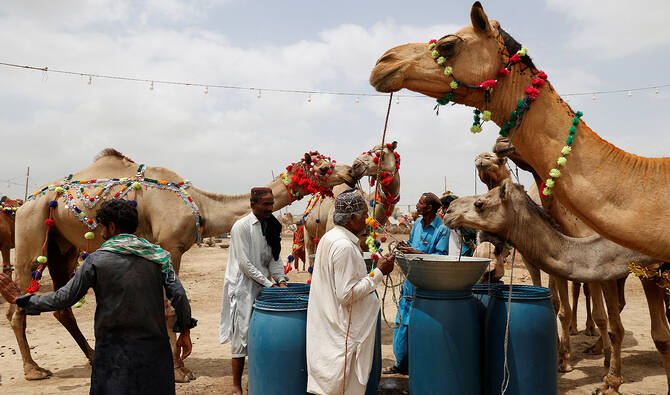
Men with their sacrificial camels for sale, feed water at a cattle market, ahead of Eid al-Adha celebrations, in Karachi, Pakistan on June 13, 2024. (REUTERS/File)
Short Url
Updated 12 February 2026
Follow

China, Pakistan sign livestock tech agreements under second phase of economic corridor

  • Agreements signed on sheep IVF, dairy cow breeding and joint research and development 
  • Initiative aligns with shift from infrastructure to industrial, agricultural collaboration under CPEC

ISLAMABAD: China and Pakistan are expanding cooperation in livestock technology and agricultural research, with new agreements signed during a recent Chinese delegation’s visit to Pakistan, Radio Pakistan reported on Thursday, as both sides seek to deepen economic collaboration under the second phase of the China-Pakistan Economic Corridor (CPEC).

The collaboration follows a visit by Jinan Animal Husbandry Industry Craftsman College to Pakistan in January during the 2026 China-Pakistan Agriculture Investment Conference, where multiple cooperation documents were signed.

CPEC, launched in 2015 as part of China’s Belt and Road Initiative, initially focused on large-scale infrastructure projects including highways, energy plants and the development of Gwadar port. In recent years, the corridor has entered what officials describe as “CPEC 2.0,” aimed at shifting toward industrial cooperation, agriculture modernization, technology transfer and private-sector partnerships.

Agriculture and livestock are central to Pakistan’s rural economy, employing millions and contributing significantly to agricultural output. Expanding technical cooperation in breeding, veterinary sciences and value-added production is seen as part of broader efforts to diversify bilateral economic ties beyond infrastructure.

“The collaboration injects new impetus into bilateral livestock industry development, aligning with the advancement of China-Pakistan Economic Corridor (CPEC) 2.0,” Radio Pakistan reported on a visit by Jinan Animal Husbandry Industry Craftsman College to Pakistan from Jan. 19-24.

During the visit, two key cooperation documents were signed. A Framework Agreement on Industrial and Technological Cooperation and Talent Training was concluded with the Pak-China Joint Chamber of Commerce & Industry (PCJCCI) to establish a China-Pakistan Animal Husbandry and Veterinary Industry Technology Cooperation Center. The center is expected to focus on technological research and development, standard-setting and customized training programs.

In addition, a Memorandum of Understanding was signed with GO DAIRY Private Limited covering the transfer of sheep in vitro fertilization technology and dairy cow breeding techniques, alongside technical guidance to address production bottlenecks.

Radio Pakistan reported that consensus was also reached with the University of Veterinary & Animal Sciences (UVAS) on curriculum collaboration and the development of a joint training base.

The report added that Chinese and Pakistani experts would focus on three areas of cooperation — Himalayan pink salt application, sheep in vitro fertilization and dairy cow breeding — and plan to establish a joint laboratory to support technology localization.


Pakistan says Afghanistan operation targeting only militants

Updated 09 March 2026
Follow

Pakistan says Afghanistan operation targeting only militants

  • Both countries claim to have inflicted heavy battlefield losses on the other since the clashes began on Feb. 26
  • Islamabad has been bombing areas it says harbor ‘militant targets’ in Afghanistan, an allegation Kabul has denied

ISLAMABAD: Pakistan’s Information Minister Ataullah Tarar has said that no civilian areas were targeted in the ongoing Afghanistan operation and Pakistani strikes were solely aimed at militant infrastructure and support networks, his office said on Monday.

The statement came after the Afghan Taliban government and the United Nations mission in Kabul accused Pakistan of targeting civilian areas during the ongoing operation, “Ghazab Lil Haq,” or the “Wrath for Truth.”

Clashes between the countries began on Feb. 26, when Afghan forces launched an attack on Pakistani military along their shared border in retaliation for Pakistan’s earlier airstrikes on what Islamabad said were militant camps inside Afghanistan.
In a conversation with foreign media correspondents, Tarar said that Pakistan was taking action inside Afghanistan based on “accurate” intelligence information.

“Pakistan has not targeted any civilian area in Afghanistan,” he was quoted as saying by his ministry. “Pakistan is only targeting the infrastructure of terrorists and their support system.”

The minister denied reports of civilian deaths, saying the UN agency was “completely dependent on the Taliban government” for information. The UN rights chief said Friday that 56 Afghan civilians had been killed, nearly half of them children, since the hostilities began.

Tarar also dismissed as “just propaganda” the claims made by an Afghan defense ministry spokesperson about inflicting battlefield losses on Pakistan. Tarar said on Sunday that 583 Afghan Taliban fighters had so far been killed in Pakistani strikes, a claim difficult to verify independently.

Islamabad has long accused Kabul of sheltering militant groups, including the Pakistani Taliban, or the Tehreek-e-Taliban Pakistan, and facilitating attacks against Pakistan. Afghanistan denies the allegations and says Islamabad’s security challenges are an internal matter.

Afghanistan has called for dialogue to resolve the conflict. Pakistan, however, has rejected talks, saying the operation will continue until its objectives are met.

“There is a nexus between the Afghan Taliban government and several terrorist organizations operating from Afghan soil,” Tarar added.