

Pakistan PM seeks review of new solar rules, orders protection of existing contracts

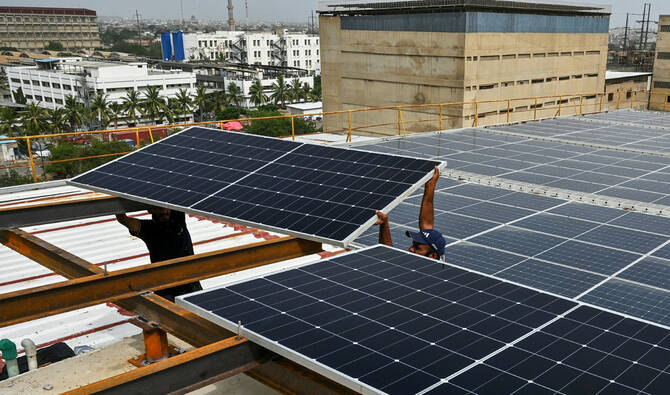
In this photograph taken on July 2, 2025, technicians install solar panels on the rooftop of a factory in Pakistan's port city of Karachi. (AFP/File)
Short Url
Updated 11 February 2026
Follow

Pakistan PM seeks review of new solar rules, orders protection of existing contracts

  • Shehbaz Sharif directs appeal to NEPRA to safeguard contracts of 466,000 rooftop solar users
  • He asks the government to ensure the cost does not shift to 37.6 million grid-only consumers

ISLAMABAD: Prime Minister Shehbaz Sharif on Wednesday ordered a review of new rooftop solar regulations issued by the power regulator, directing authorities to protect existing consumer contracts while ensuring the policy does not shift financial burden onto non-solar electricity users.

The move follows recent changes by the National Electric Power Regulatory Authority (NEPRA) that altered compensation rules for surplus electricity generated by rooftop solar users, part of broader power sector reforms aimed at easing pressure on state-run utilities.

Pakistan has been restructuring its energy sector under an International Monetary Fund-backed reform program to contain mounting circular debt and rationalize subsidies. Rapid growth in rooftop solar installations has reduced grid demand but also strained distribution companies’ revenues, prompting regulatory adjustments.

“The Power Division should immediately file a review petition before NEPRA to ensure maximum protection of existing contracts of solar consumers,” the prime minister instructed, according to a statement issued by his office.

He further instructed authorities to formulate a comprehensive plan to ensure that the cost burden of 466,000 solar beneficiaries does not fall on more than 37.6 million consumers who rely solely on the national grid.

Solar power grew from 4 percent of the energy mix in 2021 to over 14 percent–25 percent in 2024-2025, official figures show.

Driven by skyrocketing grid tariffs, Pakistan became one of the world’s top new solar adopters, importing roughly 22 gigawatts (GW) of solar panels in 2024 alone.

Industry data shows tens of thousands of new solar connections have been added annually, significantly reducing demand from the grid during daylight hours.

However, NEPRA’s new compensation rules have been designed so that consumers continue to pay full tariffs for electricity drawn from the grid while receiving a lower, market-linked rate for excess power they export.


Pakistan, Saudi Arabia discuss regional situation, upcoming engagements

Updated 14 February 2026
Follow

Pakistan, Saudi Arabia discuss regional situation, upcoming engagements

  • Ishaq Dar and Prince Faisal bin Farhan agree to stay in contact amid Middle East tensions
  • The two officials speak ahead of Trump’s Feb. 19 Board of Peace meeting in Washington, DC

ISLAMABAD: Pakistan’s Deputy Prime Minister and Foreign Minister Ishaq Dar discussed regional developments and upcoming international engagements with Saudi Foreign Minister Prince Faisal bin Farhan in a phone call on Saturday, according to the foreign office in Islamabad.

The conversation took place against the backdrop of deepening strategic ties between Islamabad and Riyadh. In September last year, the two countries signed a bilateral defense agreement that formalized decades of military cooperation and included a commitment to view aggression against one as an attack on both countries.

“Deputy Prime Minister/Foreign Minister Mohammad Ishaq Dar held a telephonic conversation today with the Foreign Minister of Saudi Arabia, Faisal bin Farhan Al Saud,” Pakistan’s foreign ministry said in a statement.

“The two leaders discussed the evolving regional situation, forthcoming international engagements, and agreed to remain in close contact,” it added.

The two officials spoke at a time of heightened tensions in the Middle East, with the conflict in Gaza far from resolution amid ongoing ceasefire violations by Israel.

The region has also been on edge as the United States pursues nuclear negotiations with Iran, prompting regional states to call for diplomacy rather than new military flare-ups.

Both Pakistan and Saudi Arabia are participants in US President Donald Trump’s Board of Peace, which is scheduled to meet on Feb. 19 in Washington.

Islamabad and Riyadh have consistently coordinated positions over regional and global issues.

The foreign ministry did not provide further details of the discussion.
