At least 9 dead in Madagascar as Tropical Cyclone Gezani hits the Indian Ocean island

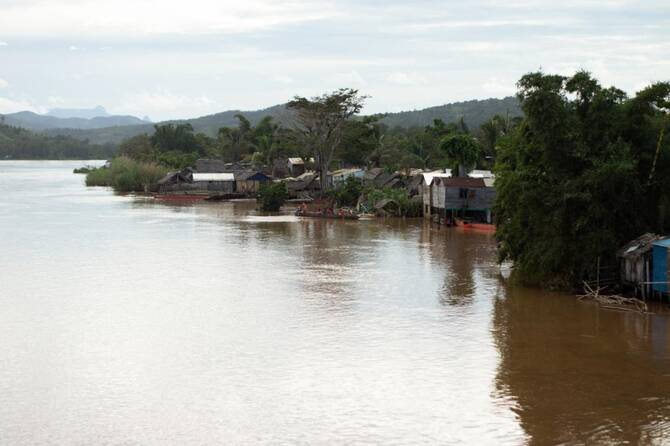
A general view of the Ambinany river in strong flood following the passage of the cyclone Cheneso near Antalaha on January 20, 2023. (AFP)
Short Url
Updated 11 February 2026
Follow

At least 9 dead in Madagascar as Tropical Cyclone Gezani hits the Indian Ocean island

ANTANANARIVO, Madagascar: At least nine people died in the Indian Ocean island of Madagascar after Tropical Cyclone Gezani made landfall, unleashing winds in excess of 195 kph (121 mph), authorities said Wednesday.
Madagascar’s weather service issued red alerts for several regions, warning of possible floods and landslides as Gezani moves across the largely poor country of 31 million people.
The National Office for Risk and Disaster Management said at least nine people have died due to building collapses and at least 19 have been injured.
The cyclone made landfall in the eastern city of Toamasina, the island’s main port, which sustained severe damage, residents told The Associated Press.
Madagascar President Michael Randrianirina, who took power in a military coup in October, visited Toamasina to survey damage and meet residents, according to videos posted on the Facebook page of the president’s office.
“It’s devastation. Roofs have been blown away, walls have collapsed, power poles are down, trees have been uprooted. It looks like a catastrophic landscape,” Toamasina resident Michel, who gave only his first name, said by phone.
Gezani was forecast to move across Madagascar from east to west on Wednesday, though the system had weakened to a tropical storm with wind speeds of around 110 kph (68 mph), according to the national weather service.
The storm passed around 100 kilometers (62 miles) north of the capital, Antananarivo, which is one of the regions under a red alert warning for possible flooding.
Gezani hit less than two weeks after Tropical Cyclone Fytia killed 14 people in Madagascar, according to the risk and disaster management agency.


Migrant charities call on Italy to ID dead washed ashore

Migrants rescued south of Crete walk after their arrival at the the port of Lavrio, Greece, on Thursday, July 10, 2025. (AP)
Updated 5 sec ago
Follow

Migrant charities call on Italy to ID dead washed ashore

  • Local news reports in recent days have indicated that approximately a dozen bodies of migrants, many in an advanced stage of decomposition, had been discovered on various southern Italian beaches

ROME: Italian migrant charities called on authorities Friday to promptly identify the dead migrants whose bodies have washed up on Italy’s shores in recent weeks following Cyclone Harry.
The non-profit groups said they had urged national and local authorities to “immediately activate all necessary procedures for the identification of bodies recovered along the Sicilian and Calabrian coasts... in order to provide answers to the many families searching for their loved ones.”
The groups Memoria Mediterranea, the Association for Legal Studies on Immigration (ASGI) and Mediterranea Saving Humans joined with European organization Alarm Phone — whose hotline accepts distress calls from migrants at sea — in calling for swift action.
Local news reports in recent days have indicated that approximately a dozen bodies of migrants, many in an advanced stage of decomposition, had been discovered on various southern Italian beaches.
In a statement, the groups said hundreds of people departed from the eastern Tunisian city of Sfax in January, many of them between January 14 and 21, when Cyclone Harry hit the central Mediterranean.
“According to reports from the organizations Mediterranea, Refugees in Libya, and Alarm Phone, more than ten boats departed during that period, with an estimated total of at least 1,000 people missing at sea,” said the groups.
“To date, only one of the boats is known to have reached (the Italian island) Lampedusa, while there is no news of the others.”
Both Alarm Phone and Memoria Mediterranea have received “numerous reports” from anxious loved ones of migrants believed to have departed from the Tunisian coast during that period.
Many migrants perish while risking the dangerous central Mediterranean crossing from North Africa to Italy. At least 567 lives have been lost so far this year, according to the UN’s International Organization for Migration (IOM).